


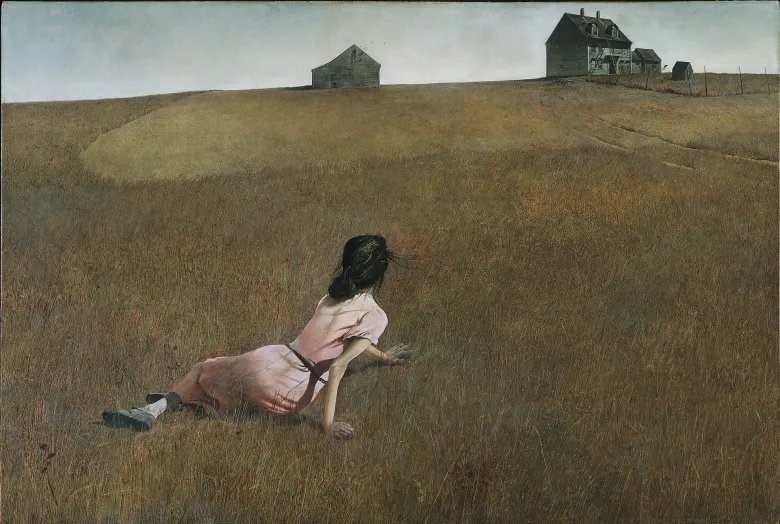
Andrew Wyeth, “Christina’s World,” 1948, egg tempera on panel, 32¼ x 47¾ in. Museum of Modern Art, ©2025 Wyeth Foundation for American Art/Artists Rights Society (ARS), NY. (Courtesy of Wyeth Foundation for American Art)
When talking about the most famous paintings of Maine, “Christina’s World” is a given.
The 1948 masterpiece that catapulted Andrew Wyeth’s career is an icon of American art, the image of a woman half-lying in a field nearly as recognizable as the farmers in “American Gothic” and Andy Warhol’s cans of Campbell’s soup.
What else tops the list, however, is a little more subjective.
We asked several local experts, as well as a curator from the Smithsonian and a couple of artificial intelligence search engines, to give us their picks for the best-known paintings of the state, a place with outsize influence on the art world, thanks to its natural beauty and a serene environment conducive to creating.
While they mentioned many of the same artists, there was less consensus about the specific works. These are the people and pieces that came up most frequently.
Winslow Homer (United States, 1836–1910), “Weatherbeaten,” 1894, oil on canvas, 28 1/2 x 48 3/8 inches. Portland Museum of Art, Maine. Bequest of Charles Shipman Payson, 1988.55.1. (Image courtesy Luc Demers)
WINSLOW HOMER’S SEASCAPES
Four of the experts and ChatGPT included a Winslow Homer seascape on their lists, but even AI couldn’t decide which painting to pick, changing from “The Fog Warning” to “Maine Coast,” depending on when you asked.
Carl Little, the Mount Desert Island author of several art books who also chose “The Fog Warning,” said the 1885 painting of a man with his catch rowing in choppy waters shows Homer’s “ability to document a piece of maritime history — halibut fishing off the coast of Maine — and to highlight a perilous and dramatic moment on the seas as the mother ship begins to slip into the fog.”
“Maine Coast” was among the selections that looked upon the ocean pounding against the rocky coast, as seen from Homer’s studio on Prouts Neck in Scarborough, along with “Weatherbeaten” and “High Cliff, Coast of Maine.” Another pick, “Kissing the Moon,” came from the end of Homer’s career and shows three men in a boat, obscured by a wave in the foreground, traversing the open sea under the moonlight.
Frederic Edwin Church, “Mt. Ktaadn,” 1853, oil on canvas. (Courtesy of Yale University Art Gallery)
FREDERIC EDWIN CHURCH’S KATAHDIN
Hudson River School painter Frederic Edwin Church returned to the Katahdin area many times over his career, depicting the mountain from various vantage points, often around sunset.
Smithsonian American Art Museum senior curator Eleanor Jones Harvey named Church’s “Mt. Ktaadn” (1853) her favorite painting of Maine and also included a painting of his from a different part of the state, “Otter Creek, Mt. Desert,” on her list.
Bob Keyes, chairman of the Maine Arts Commission, called “Mount Katahdin from Millinocket Camp” (1895) a “luminist masterpiece about the majesty of the wilderness,” while Sarah Humphreville, Lunder Curator of American Art at the Colby College Museum of Art, veered from the peak itself, choosing “Twilight in the Wilderness” (1860), which shows more of the surrounding area.
Marsden Hartley, “After the Storm, Vinalhaven,” 1938-1939, oil on Academy board. Bowdoin College Museum of Art, Brunswick, Maine. Gift of Mrs. Charles Phillip Kuntz, 1950.8
MARSDEN HARTLEY’S MAINE SCENES
ChatGPT favored Lewiston-born artist Marsden Hartley’s version of Maine’s tallest mountain, also among Harvey’s selections.
Hartley’s paintings of Vinalhaven were the preference of Center for Maine Contemporary Art curator Grant Wahlquist and Bowdoin College Museum of Art curator Cassandra Mesick Braun: “End of Storm” for him, and “After the Storm” for her. Both were made in the late 1930s, soon after Hartley returned to the state, determined to become “the painter of Maine.”
Colby’s Humphreville and Jaime DeSimone, chief curator at the Farnsworth Art Museum, followed Hartley to other parts of Maine with their respective selections of “Robin Hood Cove” (Georgetown) and “On the Beach” (Old Orchard).
‘THE LIGHTHOUSE AT TWO LIGHTS,’ BY EDWARD HOPPER
Lighthouses were a favorite subject of Edward Hopper, and a painting he did of one on Monhegan, during visits to the island between 1916 and 1919, recently sold for $4.1 million at auction.
A postage stamp featuring Edward Hopper’s “Ligthouse at Two Lights” from 1970, the 150th anniversary of Maine’s statehood.
That dwarfs the $1,500 he fetched for a painting in 1927, enabling him to buy a car that he took to Cape Elizabeth, where he worked that summer and again in 1929, when he painted “The Lighthouse at Two Lights.”
“Standing proudly upright and seen from below, the lighthouse at Two Lights seems to symbolize a resolute resistance, even refusal, to submit to change or nature,” says a blurb on the website of the Metropolitan Museum of Art, where the painting lives.
It appeared on a 6-cent U.S. postage stamp in 1970, the 150th anniversary of Maine’s statehood.
Lois Dodd (born 1927), “The Painted Room,” 1982, oil on linen, 60 x 50 inches. Farnsworth Art Museum, Gift of the American Academy and Institute of Arts and Letters, New York: Hassam, Speicher, Betts and Symons Funds, 1991.7. © 2026 Lois Dodd, courtesy Alexandre Gallery, New York
‘THE PAINTED ROOM,’ BY LOIS DODD
Recently featured in the New York Times’ “10-minute challenge,” which asks readers to spend time considering a painting without distraction, “The Painted Room” shows a wooded scene on an interior wall, surrounding a window.
The wall is in Dodd’s farmhouse in Cushing, according to the Farnsworth, where the painting is housed. Dodd, who is in her late 90s, is among the New York artists who began coming to Maine after World War II.
Little, the art writer, called the 1982 painting “one of the modern master’s most engaging images, at once surreal, enigmatic and astounding.”
David C. Driskell (United States, 1931–2020), “Pine and Moon,” 1971, oil on Masonite, 47 3/8 x 35 1/8 inches. Portland Museum of Art, Maine. Museum purchase with support from Friends of the Collection, 2011.4. © Estate of David C. Driskell. Courtesy DC Moore Gallery, New York. (Image courtesy Pillar Digital Imaging)
‘PINE AND MOON,’ BY DAVID DRISKELL
Introduced to Maine as a student at the Skowhegan School of Painting and Sculpture, David Driskell has said that he started painting pine trees when he got here and never stopped.
He continued to find inspiration around the cabin in Falmouth where he kept a studio and lived part time, and this piece remains nearby in the collection of the Portland Museum of Art.
Keyes, who selected the 1971 painting along with Jordia Benjamin of Indigo Arts Alliance, said it’s “about the power of nature, endurance, place and time.”
