


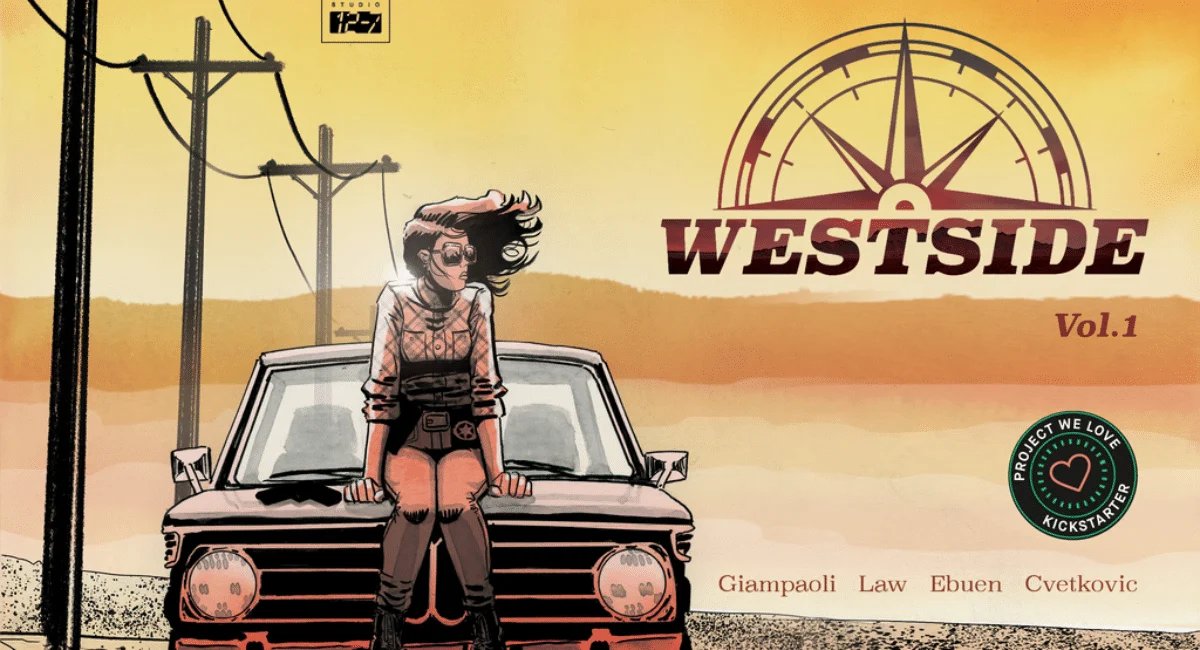
After exploring everything from sci-fi anthologies to geopolitical storytelling, Studio 12-7 is heading somewhere more grounded with Westside, a crime drama rooted in California’s Central Valley that blends social commentary, history, and noir sensibilities into a deeply personal story.
Written by Justin Giampaoli with art by Dave Law, Westside examines race, violence, identity, and systemic issues through the lens of a region rarely spotlighted in mainstream storytelling. While crime fiction often gravitates toward major metropolitan settings, Westside stands out in that it turns its attention toward overlooked communities and the histories embedded within them.
The Beat caught up with Giampaoli and Law to discuss bringing California’s Central Valley to comics, the collaboration between both creators, the creative influences behind West Side, and how Studio 12-7 continues expanding its publishing ambitions.
DIEGO HIGUERA: To jump right in, Westside leans heavily into themes of race, race relations, violence, systemic decay, and life in small-town America. Were there any specific conversations or emotional reactions you hoped readers would walk away with after finishing the first volume?
JUSTIN GIAMPAOLI: I think one of the goals of the book was really to shine a light on a part of California that you don’t really see a lot in mainstream media or pop culture. Typically, if stories are set in California, they’re in Los Angeles, Hollywood, at the beach, maybe occasionally San Diego or the Bay Area. But you really don’t see stories set in California’s Central Valley. Part of this was simply wanting to spotlight a part of America that often feels overlooked or ignored in the media.
Otherwise, Westside is intersectional in a lot of ways. There’s crime, racial tension, socioeconomic commentary, military history commentary, the history of the town itself, gender inequality. A lot of themes intersect here.
From a reader perspective, there’s a lot to unpack and a lot to chew on, so I hope people give some of those ideas consideration and that it provokes further thought.
DIEGO HIGUERA: Dave, what conversations or emotional reactions are you hoping readers walk away with after finishing this first volume?
DAVE LAW: I always like the idea of exposing more people to other people’s challenges. It helps us become more understanding and compassionate.
Some readers might relate to a character in the story and feel represented, and that’s always cool. Others might come away even a little more open and understanding toward one another, and that’s important to me.
HIGUERA: I think that’s really interesting because I feel like for a lot of people, the idea of this kind of thing happening in smaller towns flies under the radar. People hear about the major stories happening in big cities, but there really is a lot happening in between those places. Do you feel there was a specific part of the story where you really got to shine a light on that, or was it more the collective whole of everything you put into the book?
GIAMPAOLI: I think it’s a collection of everything.
I definitely wanted to comment on people being mixed race. Having grown up that way, having met a lot of people who are mixed race, and having children who are mixed race, I think it’s common for people to feel othered in certain social circles. With the main character, I wanted to explore what that does to somebody personally and professionally, and the impact that has over a prolonged period of time. I’m also kind of a history buff, so I really enjoyed putting real-world historical facts about the town into the story and interspersing those little factoids throughout the narrative.
I think it’s fun to show that any town can be interesting. Any town can have an interesting history and stories people may not know unless they’re from that area.
Cities can become characters in their own right.
HIGUERA: Every place has its own soul. I completely agree. I think people forget there are institutions and places we walk by every day without realizing there’s a deeper story attached to them.
JUSTIN GIAMPAOLI: Exactly. You never know what’s happening behind the scenes with people or places. Every small town in America probably has a compelling story if you dig deep enough.
HIGUERA: It’s funny you mention cities themselves being layered because when I was reading through the project page, Hope and David felt like ideological opposites to me. Hope carries years of cynicism while David still believes in the system.
What drew you toward that dynamic, and how do those conflicting worldviews drive tension in the story?
JUSTIN GIAMPAOLI: With Hope’s character, I really wanted to subvert expectations. In mainstream media, it’s more common to see the male character as the grizzled veteran leading the story, and I wanted Hope to fill that role instead. She’s also older than David by about ten years, so I wanted to flip expectations wherever possible. There were a couple role models I thought about while developing her. I thought a lot about Jessica Jones in Marvel Comics, especially early Jessica Jones, and I also thought a lot about Rachel McAdams’ character in True Detective.
I wanted Hope to be older. I wanted her to be pessimistic. She doesn’t have a love interest in the story. You don’t have to see that expected romance blossom. Whenever there was an opportunity to do something unexpected with her character, that felt interesting to me.
HIGUERA: Dave, how did you help bring that tension to life visually?
LAW: That’s definitely a big part of their chemistry. I think a lot about body language and how you can tell a story with it.
I tried to use that as much as possible to help push the tension between them. It’s not an action-heavy script, so that kind of acting has to stay subtle, which can be challenging, but it’s one of my favorite things to capture in comics.
HIGUERA: That’s actually really cool hearing those different detective influences behind her story. Pulling from Jessica Jones especially makes a lot of sense when you’re thinking about cynicism.
It’s also interesting hearing the level of thought that goes into building these characters because your background spans criticism, editing, and writing across different publishers.
How has your experience as a critic and editor influenced the way you structure and piece together a comic like Westside?
GIAMPAOLI: It’s been really useful. One thing that always bothered me as a critic was blatant exposition in dialogue. There’s an old Punisher comic I always think about. I think it was from the 1980s. Frank Castle walks into a room, and then the caption says, “Frank Castle enters the room.” The art was already showing exactly what the caption was saying. I’ve never forgotten that. When I became a writer, it became an effort to channel the positive storytelling traits I’d accumulated over the years while eliminating things that frustrated me as a critic.
Finding ways to communicate personality visually, through actions, or even through how other characters talk about someone, feels much more natural. People don’t usually walk around announcing exactly how they’re feeling in real life. Being a critic made me a better writer, and being a writer now helps me become a better reviewer when I occasionally dip back into criticism.
HIGUERA: That’s actually fantastic. I love hearing how those experiences can help shape something like this because even from what I’ve read, the story already feels deeply rooted in lived experiences, history, and your understanding of the place you’re writing about. I feel like some stories do research to build a world, but here it feels like your lived experiences are actively molding the comic itself. And honestly, I can only imagine what working alongside Dave Law must have been like bringing that to life. How did Dave’s art influence your writing going into the story?
GIAMPAOLI: Dave and I had a really collaborative relationship. Early on, Dave and I actually took a road trip to Merced together. I walked him through the town, pointed out landmarks, and he took a ton of reference photos. Almost every shot of the city in the book comes from a real reference image, and I think that authenticity comes through whether readers consciously realize it or not. One of Dave’s greatest strengths as an artist is that he can stay true to the script while also making his own artistic choices. He intuitively understands the tone and vibe you’re going for.
There’s a scene early on where Hope is at her father’s funeral, and my scripting direction was pretty minimal. It was basically just, “It’s a somber funeral scene.” But Dave understood the emotional tone immediately. He made choices with camera placement and composition that weren’t scripted at all, like creating elongated shadows in the foreground that pull your eye into the panel. He’s making dozens of artistic decisions like that throughout the book.
I was also fortunate because I had previously edited California Inc., which Dave and Art worked on together, so I already understood Dave’s strengths. I trusted his ability to translate tone directly onto the page.
HIGUERA: Dave, how did those real-world influences shape the visual atmosphere of the book?
DAVE LAW: Quite a bit. While I was mostly raised in California, my neighborhood was different than Justin’s and I really had no experience with Merced. Before I started to really dig into the art, we took a trip there and I shot hundreds of photos of all the different places the story was going to take us.
I later heavily referenced those photos when depicting the scenery in Westside.
HIGUERA: That’s honestly incredible because when I look through the project pages, it’s amazing hearing how much energy has been poured into this. I think some people see a black-and-white comic and assume there’s less going on visually, and I would argue the complete opposite. There’s so much storytelling happening here. Just because something isn’t exploding with color doesn’t mean less effort or emotion went into it. I’m really glad we’re having this conversation because that’s exactly the kind of thing I wanted to spotlight.
GIAMPAOLI: It’s interesting because I almost feel like the black-and-white presentation is a positive. I think color would actually be distracting in this book. Without color, you focus more on facial expressions, body posture, movement, and Dave is a master at that. He communicates so much storytelling through the way characters stand, move, or even how Hope’s hair changes from panel to panel depending on her emotional state or the environment. There’s so much emotive storytelling happening in facial expressions and body language.
Black and white really forces your attention onto those details.
HIGUERA: Dave, your black-and-white artwork gives Westside such a distinct identity. What was the visual language behind the book?
LAW: I really got an old-school crime vibe from the script. The detectives, the internal monologue, the grittiness. Black and white gives that seriousness I wanted for the story. Central California can be very sunny, and black and white felt like a great way to show that environment without making it feel cheerful or upbeat. Bright. Hot. Dry. I’ve been tempted to draw cool jackets on Hope and David, but I can’t imagine anyone wearing jackets there during certain parts of the year.
HIGUERA: You’re getting readers to actually pay attention to the storytelling itself instead of waiting for things to be spelled out for you. I completely agree. That’s phenomenal, and honestly, kudos to both of you because that really speaks to your ability as storytellers. And I wanted to ask because the campaign compares Westside to The Wire, True Detective, and the crime work of Ed Brubaker and Sean Phillips.
Were there any particular films, novels, comics, or real-life events that became major creative touchstones while developing the series?
GIAMPAOLI: Definitely.
From film, Martin Scorsese was a huge influence. The voiceover narration from Henry Hill in Goodfellas definitely influenced the narration style in Westside. I also love William Friedkin’s work. People usually know him for The Exorcist or The French Connection, but To Live and Die in L.A. is one of my favorite crime films ever made, and that absolutely influenced the book. You can probably see traces of Antoine Fuqua and Training Day in there too.
From comics, writers like Greg Rucka and Rick Remender are always influences. Jason Aaron had a Vertigo book called Scalped that was set on an Indian reservation in South Dakota, and Brian Wood had an older book called Supermarket that blended youth culture, futurism, and crime. There are definitely comic influences in there, consciously and subconsciously. Those are just the ones I’m aware of.
HIGUERA: Dave, were there visual touchstones for you?
DAVE LAW: Visually, I thought a lot about Alfred Hitchcock and the framing and camera angles he used. I wanted some of that same atmosphere from films like Vertigo and The Birds.
HIGUERA: Any last words for fans or readers?
GIAMPAOLI: We always like to highlight the rewards included in the campaign, whether that’s Art’s variant cover or the retailer bundles we’ve put together. We’re big supporters of comic shops and retailers, and they remain a vital part of the industry, so it’s important to us to spotlight those offerings. In this campaign, retailers can essentially get three copies of the book for the price of one, making it a low-risk way to support the project, test it out, and still have the potential to turn a profit on the back end. We’re always looking to encourage that kind of engagement, and we also love doing signings at local shops, so we want to make sure those bundles get attention.
I’d also add, just to reassure both new and returning backers, that the book is 100% complete. The art is finished, the writing is done, it’s fully edited, and it’s already at the printer even while the campaign is still running. We prioritize fulfilling campaigns as quickly as possible. We’re also already moving into volume two, which is fully written and edited, with artwork set to begin in the next month or two. Volume two will be larger than the first, expanding from 44 pages of story content to 66 pages.
If readers enjoyed volume one, there’s more on the way. The second volume pushes further into racial tension, includes larger action sequences, and explores gang subculture within the California prison system, offering a denser and more expansive continuation of the story.
Westside brings to life the ideas of two talented creators, all the while bringing to light the examination of race, violence, identity, and systemic issues through the eyes of creators who have re-imagined their reality into impactful fiction. Make sure to check out the campaign now in its final days before it’s too late!
