


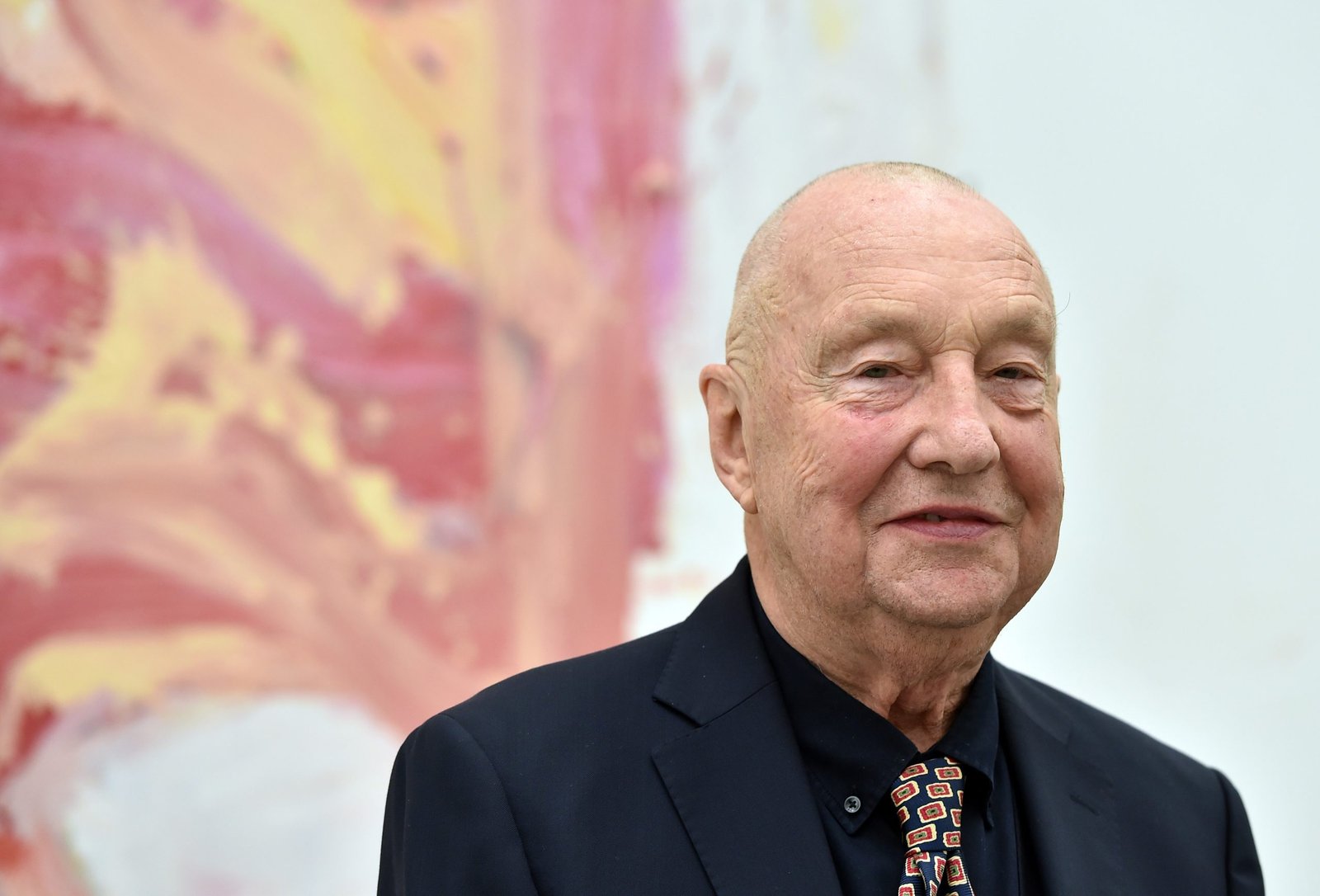
The pioneering German Neo-Expressionist artist Georg Baselitz, who challenged German culture after World War II with ever-provocative works, has died.
His death was confirmed by his family, via an obituary penned by poet Robert Isaf. It was shared by Thaddaeus Ropac, the artist’s gallery of over 20 years, which was founded in Salzburg, Austria, the city where Baselitz and his wife Johanna “Elke” Kretzschmar had lived since 2013. In it, Isaf wrote that the artist “has died peacefully at the age of 88.” Along with Elke, Baselitz’s two sons, Daniel Blau and Anton Kern, who are both art dealers, survive him.
The artist only kept his birth name, Hans-Georg Kern, until 1961, when he was a 23-year-old preparing to graduate from art school in West Berlin. The fledgling talent named himself in honor of his home village, Deutschbaselitz, about 35 miles northeast of Dresden in East Germany. Baselitz’s parents were teachers; his father was barred from working in East Germany because he had followed orders to join the Nazis, so his mother taught instead. Isaf noted that Baselitz discovered his love of art as a boy because plein air painters sought Deutschbaselitz’s natural beauty en masse.
Installation view of Georg Baselitz’s “Hommage à Georg Baselitz” at CFA, Berlin. Photo: courtesy of CFA, Berlin.
In some ways, Baselitz was angst incarnate from the start. He studied at the University of Fine and Applied Arts in East Berlin in 1956, after getting denied from the Art Academy of Dresden—where he would have been classmates with Gerhard Richter, who has also transformed postwar German art over the past 50 years. Two semesters in, Baselitz was expelled for “sociopolitical immaturity.”
To escape working the coal mines, the artist moved to West Berlin, and enrolled at the Berlin University of the Arts, graduating in 1962. Four years prior, a traveling exhibition of Abstract Expressionism left Baselitz besotted with the work of Jackson Pollock and Philip Guston. “Today we know that it was financed by the CIA to show the German public what culture is,” Baselitz told Naomi Rea in Artnet News in 2021.
His first solo show arrived in 1963, bringing with it a legal dispute. A public prosecutor seized two paintings rendered in Baselitz’s signature style—recognizable even then—on the grounds of public indecency. One of the offending works, The Big Night Down The Drain (Die große Nacht im Eimer), 1962–63, blatantly depicts masturbation, despite its abstract elements. Authorities returned the works to Baselitz after a lengthy trial, in 1965.
George Baselitz, “Hero” series (c. 1960s). Courtesy of Sotheby’s London.
The artist started some of his most iconic series soon after. He embarked upon his “Heroes,” in 1965, upon returning from a Florentine residency. These oversized, hulking, and haggard figures are allegorical self-portraits, in some sense. In 1969, Baselitz produced his first painting featuring an upside-down figure—a novel compositional approach meant to scramble the viewer’s perception of the painting as anything other than pigment on a surface. Upside-down figures became the artist’s signature style, and examples reside at major museums around the world, including the Metropolitan Museum of Art in New York and the Fondation Beyeler, outside of Basel.
“When on show for the first time, nobody noticed and whoever did thought they were a joke,” Baselitz told Artnet. “Nobody really understood the personal risk I took by inverting motifs.”
Despite all the acclaim Baselitz eventually achieved throughout his career, controversy remained a constant. In 1972, his increasingly abstract upside-down paintings drew criticism at Documenta 5 in Kassel, Germany. In 1980, he represented Germany at the Venice Biennale alongside Anselm Kiefer. There, Baselitz revealed his first sculpture, which quickly became a Biennale flashpoint, when viewers noticed its gesture resembled a Nazi salute. (Baselitz, for his part, has said that the position references carvings by the West African Lobi people, for whom the gesture symbolized surrender).
In 2013, he made headlines yet again for calling women painters lesser talents in Der Spiegel and theGuardian. The artist has since contended those remarks were taken out of context. He even showed a series of upside-down, leggy portraits named for women artists like Helen Frankenthaler and Kiki Smith at Gagosian in 2021.
Georg Baselitz’s studio, Ammersee, Germany, 2019. Courtesy of the artist and Gagosian. Photo by Ealan Wingate.
Aside from scandal, exploration defines Baselitz’s oeuvre. Alongside the painting practice he perpetually pushed, he kept presenting new drawings, prints, and sculptures at galleries and institutions around the globe up until the very end of his life. He’d even experimented with set and puppet design in recent years.
While reflecting on Baselitz’s still-forming legacy, Isaf posits that because of his interest in “the relationship between viewer and viewed,” history will perhaps say that Baselitz bears a closer kinship with Pop artists than the Neo-Expressionists with whom he is most often associated.
Baselitz’s final series of pensive, gilded paintings will debut on May 6 in “Georg Baselitz: Eroi d’Oro (Heroes of Gold)” at the Fondazione Giorgio Cini in Venice.
