


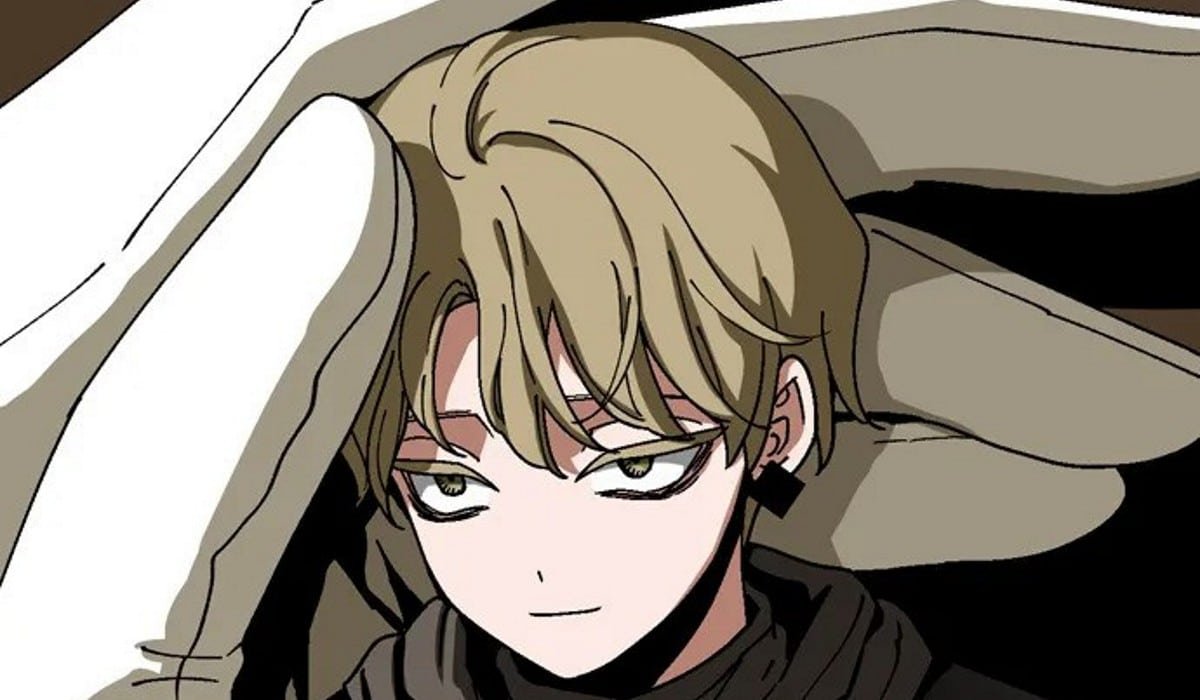
With more people reading manga and webtoons (aka vertical scroll comics) than ever before, Beat’s Bizarre Adventure gives three writers an opportunity each week to recommend some of their favorite books and series from Japan, Korea, and elsewhere. This week we have pet ownership, werewolf high schoolers, and, of course, garbage.
False Paradise
Writer/Artist: samchon
Platform: WEBTOON
Sanho is an ordinary guy with just one exception–he has incredible intuition. He knows what’s safe, what’s dangerous, and how to hit someone where it hurts. So when he’s spirited away by an unfathomable, an all-powerful entity that adopts dying humans as pets, he assumes all he has to do is trust his intuition and he’ll be home free in no time. Instead he kills another unfathomable in lawless territory and catches the attention of a ragtag group of humans with killing intent. Could his unfathomable owner, Seomyeong, have been right all along? Is he really just another wounded animal who should let other, more conscious creatures decide for him?
Webtoon artist samchon is best known for her earlier series I Don’t Want This Kind of Hero, a superhero parody with an extensive, memorable cast of weirdo characters. Just like that series asks how organizations of people with special powers might function in reality, False Paradise digs into the contradictions of its setting immediately. How does it feel to be told, as a human, that you cannot be held responsible for your behavior, because as far as an unfathomable is concerned you’re a senseless animal? Can you really be “independent” in a world that is fundamentally hostile to your existence without an unfathomable’s aid? Also, if unfathomables are truly enlightened, why are they so willing to wound or even kill each other?
While the character designs are similar to those in I Don’t Want This Kind of Hero, samchon does a good job (within the limitations of a weekly webtoon schedule) creating an alien landscape in False Paradise. Rocks hang from the sky like curtains made of stone, while unfathomable “cars” resemble spherical tangles of leaves and vines. House-sized slugs and tardigrades wander the wilds. Then there’s “garbage,” invisible leftovers from unfathomables that are just as deadly to humans as plastic pollution is to sea creatures.
The idea of being adopted as a pet is appealing to some, repulsive to others. Would you happily give up your agency and submit to being loved? Or would you consider that to be a kind of slavery, or death? What’s interesting about False Paradise is that I can’t say exactly where it’ll land. The world of the unfathomables is full of nice, kind people (and eldritch entities) who are doing their best, despite their problems, to help others live good lives. It’s also a horror show. If you’ve ever loved a pet while simultaneously being haunted by the existential terror of pet ownership, False Paradise has plenty to offer. — Adam Wescott
Tsumiki Ogami’s Not-So-Ordinary Life
Writer/Artist: Miyu Morishita
Translation: Mei Amaki
Lettering: John Hunt
Publisher: VIZ
Being a teenager in high school is hell. Any social mistake can be a death sentence. Finding a friend group can often feel impossible, especially when you move to a new school. So imagine how much harder it might be when your new school is populated with monsters!
Tsumiki Ogami’s Not-So-Ordinary Life falls into the grand tradition of Urusei Yatsura. An ordinary high school boy meets a weirdo girl. Or in this case, a weirdo werewolf girl. Having socially bombed at his last school, Yutaka Shinso transfers to Keiki Private High School. The catch? Keiki has a high concentration of mythfolk, human and mythical creatures in its student bodyt. After Yutaka shows werewolf student Tsumiki kindness, the two become inseparable.
Much of the charm in reading this series comes from how writer/artist Miyu Morishita builds out the world of Keiki High. The students go through the same trials and tribulations most high schoolers do. Except in this case they’re werewolves, vampires, bird people, or even invisible.
Each mythfolk student has their own brand of troubles. Tsumiki likes to dig holes on school grounds and howls at images of the moon. The vampire student can’t be sure if people have succumbed to his vampiric charms. Winning baseball games requires that the players find ways to cancel out each other’s unique abilities.
The heart of this series is the friendship between Yutaka and Tsumiki. The two compliment each other well; he’s awkward but has empathy for those around him, while she’s popular but also brusque and no-nonsense. Through Tsumiki, Yutaka learns about mythfolk and slowly comes out of his shell. Through Yutaka, Tsumiki has a way to understand humans.
Tsumiki Ogami’s Not-So-Ordinary Life is a charming slice of life manga that also features werewolves, vampires, and even squid people. Miyu Morishita knows what all high schoolers crave, no matter who or what they are: being understood. — D. Morris
The Stranger in the Hoarding House
Writer/Artist: Joe Aruku
Translation: Dylan Jekels
Retouching and Lettering: Vibrant Publishing Studio
Cover Design: Yeonwoo Baik
Editor: Emelia Baum
Publisher: TOKYOPOP
In a short span of time, Kamakura’s life is turned upside down twice; first, by his abusive boss’s mug, and then, by a stranger’s unexpected helping hand. Not being able to “smile through the pain,” Kamakura resigns and shuts himself in his home. Soon his apartment turns into a dumpster.
His landlord finds out about the state of the rental and she’s not happy about it. Then another tenant, Katsuyoshi, offers to help Kamakura clean his place and deescalate the situation. Kamakura finds it inconceivable that Katsuyoshi would offer free help to someone he doesn’t know. He’s also suspicious when Katsuyoshi insists Kamakura stay at his place until they’re done with cleaning.
One of the most common tropes in Boys’ Love is picking up drunk strangers on the street, taking them home and caring for them. Sounds outrageous, I know. It’s a trope that only works in the absence of a glaring power imbalance between parties. Yet, BL is a miraculous genre that can pull off almost anything.
The Stranger in the Hoarding House is yet another example of that trope. Instead of a neighbor who passed out on the heaps of trash in the collection area, though, the love interest Katsuyoshi “picks up” Kamakura spending his days among trash of his own making. While the series touches upon Kamakura’s circumstances and the psychological inclination behind Katsuyoshi’s insistence on helping, I’m reluctant to say it is more substantive than your usual stranger-pick-up BL. It does, however, make for a distinct angle.
Joe Aruku‘s men are beautiful to look at. While the panelling doesn’t offer much out of the ordinary, there are several pages that really invite your eyes to linger. If you’re looking for titles to add to your TBR this Pride Month, or to gift a beloved friend or fan, The Stranger in the Hoarding House is a great contender! TOKYOPOP has been really gearing up when it comes to BL, so I recommend keeping them on your radar. — Merve Giray
Follow Beat’s Bizarre Adventure to get weekly manga and webtoon recommendations!
