


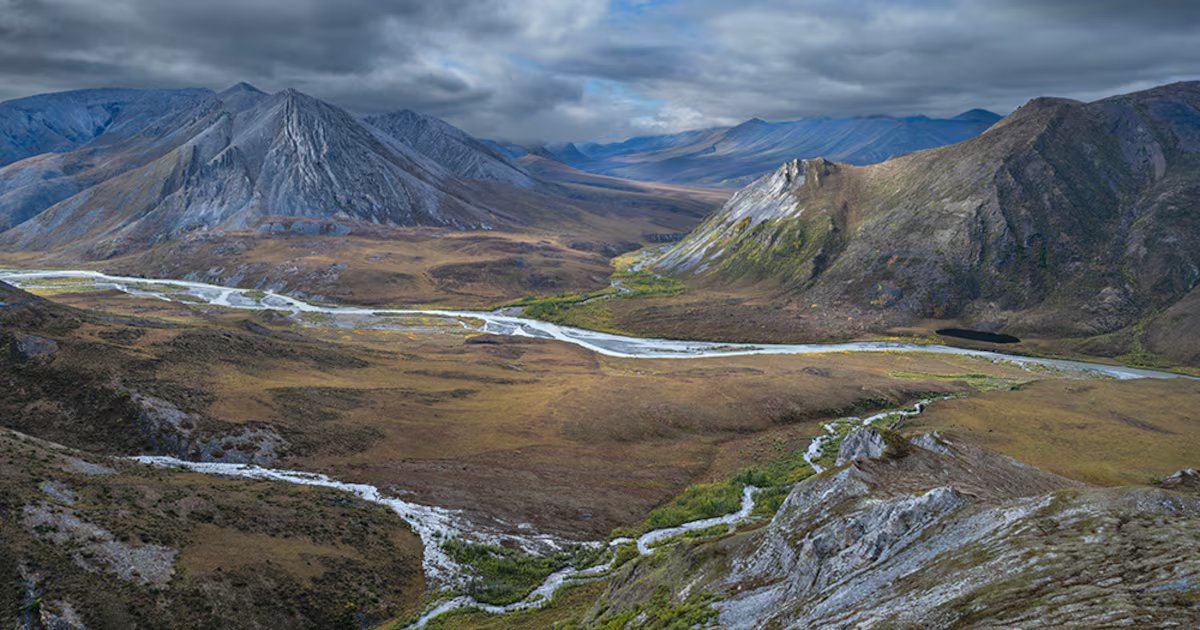
A view up Drain Creek is seen in this photo, which appears in “The Brooks Range: Journey, Life & Art in the Gwazhal” by Claude Fiddler. (Photo by Claude Fiddler)
“The Brooks Range: Journey, Life, & Art in the Gwazhał”
By Claude Fiddler; independently published; 124 pages; 2025; $85.
Rising up from the coast of the Chukchi Sea and spanning eastward to the Alaska Yukon border, the Brooks Range is the northernmost extension of the Rocky Mountains and northernmost mountain range in North America. Home for thousands of years to small Athabascan communities, the mountains are all but undeveloped in the modern industrial sense save for the remote Dalton Highway threading its way through them on its path to Prudhoe Bay.
Accessible only by small boats and small planes, or by foot, much of the chain is divided between Gates of the Arctic National Park and the Arctic National Wildlife Refuge. Parts of it lie on contested grounds, but no one will deny that these mountains, known to their Indigenous Gwich’in inhabitants as Gwazhał, are one of North America’s last strips of largely untrammeled lands.
It’s to this place that photographer Claude Fiddler, who has previously documented the Sierras, Yosemite and the Great Basin, turns his lens in his latest collection, appropriately titled “The Brooks Range.”
“What I latched onto was the otherness of the landscape. What grabbed my attention was a place with an abundance of variety,” Fiddler writes in his photographer’s note, continuing, “the landscape changed at every river bend, every small up, or down, or just ahead.”
His photos, accompanied by essays from Alaska writers both famed and less known, bring readers into a stark vastness that could easily be thought to unspool forever. Rivers cascade through immense valleys carved through mountains flung every direction. Broad expanses of tundra sweep upward at the foots of peaks before giving way to gravel. Psychedelically colored rocks and foliage surrender to snow as elevations rise. Clouds and fog and rainbows fill skies that are reflected on bodies of water.
Many of the photos were taken in fall, when colors are most ablaze and skies are at their most complex. One of the standouts is an awe-inspiring sunset over the Noatak River, where clouds, mountains, and water are bathed in a labyrinth of whites, blues, and purples.
Elsewhere the East Fork Chandalar River flows towards a rainbow that arcs over a backdrop of hills clothed in post-peak fall colored tundra and faraway spruce trees, one, in iconically Alaskan fashion, tilting towards collapse as its shallow roots release their grip on the soil.
A two-page spread presents a clearing storm at the headwaters of Fire Creek. Strips of flat green, flows of rust red, multiple shades of gray and small patches of white displaying Fiddler’s “abundance of variety.”
A rainbow at sunset at Caribou Pass is seen in this photo, which appears in “The Brooks Range: Journey, Life & Art in the Gwazhal” by Claude Fiddler. (Photo by Claude Fiddler)
This landscape is where the famed Alaska adventurer Roman Dial has found challenges both physical and mental. In the first and longest essay in the book, he begins by tracing the arrival of Koyukon, Gwich’in and Iñupiat peoples who traveled across the Bering Sea Land Bridge (Beringia) thousands of years ago, and were the sole inhabitants for millennia.
“How was it then that a group of the ultimate survivalists — people who scrounged for every plant, grub, land, air, and water creature — came to know of the catastrophic events that shaped the lives of their ancestors,” Adeline Raboff, a Gwich’in/Koyukon Athabascan author, asks in her contribution. She points to the role of storytellers. “These long-ago stories, myths, and legends laid out ancient and distant events to eager listeners young and old.”
Only recently in Gwazhał time, Dial tells us in his narrative, Russian and British explorers intruded on Arctic peoples, bringing modern conveniences and also plagues while claiming ownership over lands and waters traditionally held in common by Indigenous groups.
After the U.S. purchase, military men mapped Alaska in the late 19th and early 20th centuries, wandering deep into the Brooks and beyond. Resource interests brought the next wave of Americans, who continue to venture north today, seeking riches and sparking epic battles with those who would prefer to leave the land as it is.
In the second half of his narrative, Dial recalls in detail a grueling 1980s trek with Chuck Comstock, replete with difficulties that would send most people to their satellite phones begging for a bailout.
In a lyrical remembrance, Caroline Van Hemert reflects on a fall canoe journey down the Noatak River, pondering the departures of migratory birds bound for locales as far away as southern Africa and Antarctica, and the seasonal movement of caribou.
“On the river, there’d been little to see until a stick broke the surface in front of us, spinning oddly as it did. Another appeared, followed by two more in quick succession. Soon branches morphed into antlers, and backs emerged from the ripples. With white tails and wild eyes, several caribou swam across, leaving gentle V’s in their wake. When they reached the far shore, they leapt onto the bank and shook, droplets of water mixing with rain.”
Wildlife is — surprisingly — mostly absent from Fiddler’s images, rendering a poignancy to two pictures of a dead caribou calf, its body curled on the tundra, a reminder of the indifference of nature to the animals and people who roam over it.
Humans are more present than animals. Kaktovik appears as a somewhat ramshackle settlement, owing to the grueling effects of the climate on machinery, which is easier to import when needed than to ship back out when no longer of use.
Robert Thompson, an elder from the village, bemoans the ravages of climate change that have warmed winters in his five decades of hunting, devastating Dall sheep populations.
“We have been here for thousands of years, and I will be making active efforts to preserve our culture,” he writes. “I have been asked by young people to teach them.”
To this he affirmatively adds, “I will.”
Homer author Nancy Lord is given the final word. Remembering a summer spent in Gwazhał at age 19, an experience that set her life’s course, she summarizes that “for me it was a barely imagined place of tremendous beauty and astounding life.”
Beauty, life and an abundance of variety are what readers of this book will discover.
