


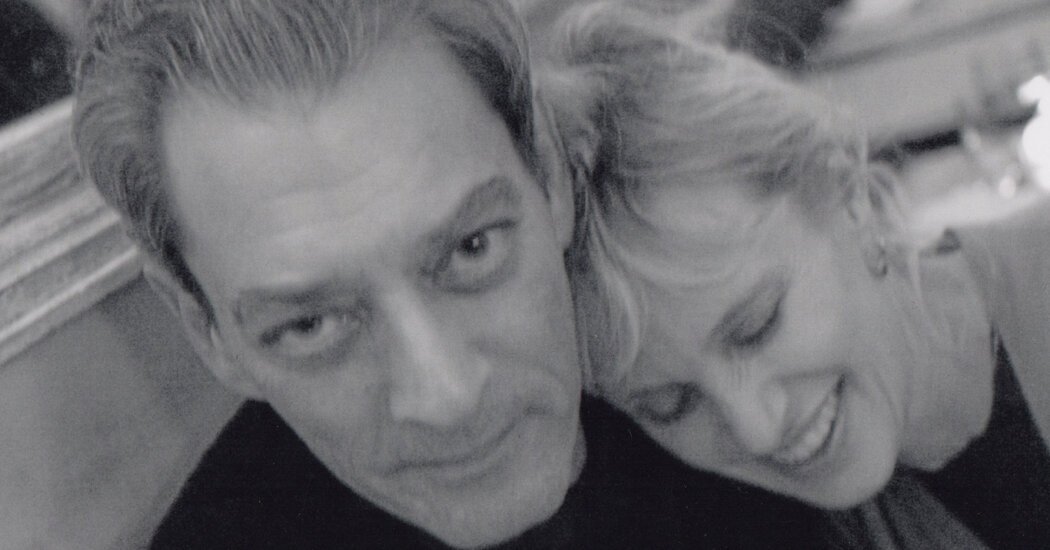
She was blond and he was dark-haired; they were almost photonegatives. She looked as if she’d been in Bergman films. He was, visually, America’s Camus — wary, heavy-lidded, wreathed in cigarillo smoke, an intellectual turned out in black Levi’s and sheepskin-lined leather jackets.
Hustvedt and Auster’s double-barreled impact could prompt strange reactions. Before their wedding dinner, Hustvedt writes, a poet friend of Paul’s lifted a glass and said, “To the bride and groom, two people so good-looking I’d like to slice their faces with a razor.” Hustvedt wasn’t surprised when he slowly faded from their lives.
Auster was diagnosed with cancer in January 2023, when he was 75. Hustvedt tells the story of his illness — the chaotic E.R. visits, the hair loss, the shrinking and then metastasizing of his tumor, the wracking immunotherapy, the wheelchairs, the inability to write and the gradual loss of language — largely by reprinting the matter-of-fact group emails she sent to close friends to keep them apprised of his progress.
These sorts of missives, as anyone who has written or received them knows, are an art form of their own. When delivering good news, Hustvedt urged caution. “There is an important difference between optimism and hope,” she wrote in one such email. “The optimist’s tendency to cheer every piece of good news and predict a good outcome is understandable but creates emotional swings that, at least for those who love the patient, are unsustainable. Hope, on the other hand, is necessary for living on.”
Auster was stoic about his illness, but restless and held captive in the borderless region he termed “Cancerland.” No longer able to write fiction, near his death he began to compose a series of letters to his grandson. These letters, which are largely about family history, are printed here and are models of that form: warm, direct, undogmatic.
