


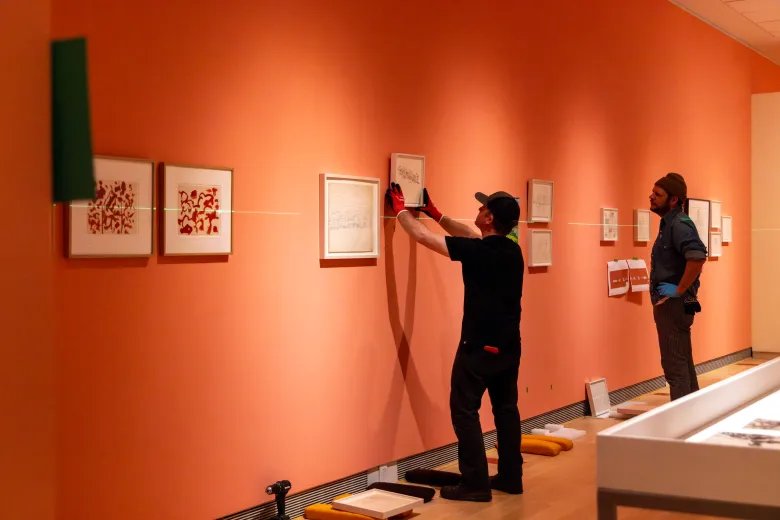
Art preparators Matthew Russ, of Waterville, and Travis Sehorn, of Belfast, assist with the installation of “Alex Katz: Out of Sight” at the Colby College Museum of Art on May 13. (Anna Chadwick/Staff Photographer)
WATERVILLE — Right now, almost 100 drawings and sketches from one of Maine’s most popular living artists are hanging on coral pink walls in the Colby College Museum of Art.
Many drawings are recent, drawn just last year, but the oldest is more than 80 years old.
How did 95 drawings, decades apart in age and owned by different collectors, all end up in the same room in Waterville? And who decided the walls should be pink?
Senior art preparator Chris Patch, left, and preparators Matthew Russ, center, and Danae Lagoy hold artwork as Kiko Aebi, Katz curator, visualizes its placement for the “Alex Katz | Out of Sight” exhibition on May 13 in Waterville. (Anna Chadwick/Staff Photographer)
Purchase this image
BACK TO THE BEGINNING
In the 1940s, Alex Katz, now considered one of the most influential American artists working, attended a vocational high school in Queens where he sketched a cast sculpture of a young woman.
It was a labor of love.
On his first day, Katz just looked at the sculpture and drew some dots on his paper. The next day, he connected the dots. It wasn’t until the third day that he started shading. On his fourth day with the sculpture, Katz finished his drawing.
He signed it “Alec Katz,” not quite settled in his artistic identity yet. For Kiko Aebi, who is curating the Katz exhibit for Colby, this drawing represented the beginning of the story she wanted the new show, “Alex Katz | Out of Sight: A Drawing Survey,” to tell.
Katz curator Kiko Aebi studies a space inside the Davis Gallery ahead of the opening of the “Alex Katz | Out of Sight” exhibition at the end of May at the Colby College Museum of Art on May 13. (Anna Chadwick/Staff Photographer)
Purchase this image
CHOOSING THE ART
Aebi, who began working on the show in 2024, wanted to capture the diversity of Katz’s drawings, show how his techniques changed over the years and offer insight into his process, like the cast sculpture drawing does.
Colby’s collection alone contains nearly 350 of Katz’s drawings. With this as a starting point, Aebi began sorting through Katz’s work decade by decade. Many would be included in the show.
To have the variety she wanted, Aebi needed to see as many drawings as she could. She spent a year researching and traveling to see his work.
She saw work that inspired famous paintings, drawings that took weeks and quick sketches Katz drew on the subway in the 1940s.
Some of what Aebi selected for the show came from Katz’s New York studio, unframed — like the Sharpie sketches he spent every day of 2025 drawing at his dining table. Some came from famous institutions, like the Museum of Modern Art or the Whitney Museum of American Art.
She kept track of everything with a PowerPoint and a massive checklist. As the list started coming together, Christopher Patch, Colby’s senior preparator, got involved.
A preparator’s job is to ensure safe handling and installation of all artwork. Different materials require different techniques to preserve the art.
Kiko Aebi, Alex Katz curator, discusses the different stages of Katz’s artistic process during “Alex Katz | Out of Sight,” an exhibition uniting drawings from across the artist’s career at the Colby College Museum of Art on Wednesday May 13. (Anna Chadwick/Staff Photographer)
Purchase this image
Since the exhibition includes many works on paper, a lot of them needed framing. About a year before the show opened, Patch started going over Aebi’s checklist of works and deciding how to frame them. He collaborated with Katz to match art with frames and made sure none would clash.
Aebi needed to finalize her list by the first week of January. Out of thousands, she narrowed the exhibition down to 95 drawings. She said she could have done this five times over.
“I sort of feel like there wasn’t a wrong way about it, just because the work is really strong and there’s so much of it.” Aebi said. “But I was trying to tell a story too.”
BRINGING KATZ INTO THE SHOW
Katz’s relationship with Colby began when the museum first came to be. When the Colby Museum opened its inaugural exhibition in 1959, he lent two works on paper, one featuring a Maine landscape.
Katz’s relationship with Maine is even older. He first came to central Maine early in his career, when he won a scholarship for summer study at the Skowhegan School for Painting and Sculpture. Now, Katz spends his summers in the Midcoast, and his paintings of Maine are beloved. When Aebi first moved to Maine, she found it eye-opening to see the work in its original context.
Aebi met with Katz every month or two while she was putting the show together. She’d arrive with her checklist of works, thinking it was final, but Katz, who will turn 99 in July, would have more new drawings to show her.
About a year and a half ago, Aebi asked Katz what color he wanted for the museum’s walls. He pointed at Jacqueline Terrassa, Colby Museum’s director, who was wearing a brilliant coral coat. Katz said he’d like that color.
Aebi was a little surprised when she followed up with a swatch book and he doubled down, picking the exceedingly bright Sherwin Williams coral “charisma.”
Maquettes line a wall during the early stages of gallery installation for the exhibition at the Colby College Museum of Art on May 13. (Anna Chadwick/Staff Photographer)
Purchase this image
“It’s kind of a unique color,” Aebi said. “A bold choice, to say the least.”
A blind test of the color and similar options among the museum’s staff confirmed what everyone already knew: Alex Katz has a good eye.
The wall color complements what are mostly black and white works and is a nod to Katz’s talent with colors, Aebi said, even though that’s not a highlight of this exhibition. It also brings Katz into the design.
“Everyone who comes in is going to notice that,” Aebi said.
The show is timed to be open for the summer, when, in addition to his Maine fan base, Katz lovers from out of state will be able to come and see the exhibition.
GETTING THE ART TO MAINE
After she finalized the list of works, Aebi wrote to museums and collectors, and asking that they loan their art to Colby.
Paige Doore, Colby’s registrar for collections, said institutions usually want to do this.
“You can only show so much of your collection at one time,” she said. “There’s a benefit to lending because you can’t have everything up all the time.”
When Colby is asked to loan a piece in its collection, Doore considers whether the show in question is important to the artist, whether the art has been shown before, and, for works on paper, whether they’ve reached the limited amount of exposure they can stand in a five-year period.
Shipping art requires professionals, special materials and sometimes even a climate-controlled box. So even though Aebi was often at Katz’s New York studio, she couldn’t just take his latest drawings back to Maine in her car.
Doore helped coordinate shipping and manage the arrival of artwork from other collections. She unpacked and checked it, and wrote reports on the condition of each piece. When it came time to install the work, she helped get everything in place.
Doore’s primary focus is safety. She keeps an eye on environment, temperature and humidity. Many of the objects on loan come with additional requirements, like specific lighting levels, or that the work must be in view of guards and cameras, so she coordinates those, too.
Registrar for collections Paige Martha Doore, of Hallowell, holds up the elevation for the title wall to help visualize installation in the exhibition at the Colby College Museum of Art on May 13. (Anna Chadwick/Staff Photographer)
Purchase this image
ART ON PINK WALLS
After careful planning from Aebi, Patch, Doore and the 12 other Colby employees who had a part in the show, it was time to get the art on freshly painted pink walls.
Patch and the other preparators — two full time and three part time — know how to handle fragile works on paper. Most of them are artists themselves.
Art preparator Matthew Russ, of Waterville, uses a level while installing artwork for the exhibition at the Colby College Museum of Art on May 13. (Anna Chadwick/Staff Photographer)
Purchase this image
Matthew Russ and Travis Sehorn, both part-time preparators who worked on the Katz show, said there’s something special about hanging the work.
“To have the opportunity to be up close and personal and literally hands-on with these art pieces is inspiring,” Russ said. “You might install work very different from what you do … it’s a great way to broaden your perspective on what art is.”
The loaned art arrived at the end of April. It took six days to unpack the work and ready the studio, and then preparators spent eight days installing the exhibition.
“It’s got similar feeling to (a play),” Russ said, “where you’re all building up to a final result.”
Every preparator has a niche. Someone’s the guy who’s really good at working with vinyl. Someone’s the tall guy.
“I get the short-guy jobs,” Russ joked.
Art preparator Travis Sehorn, of Belfast, drills a cleat into the wall for artwork in the “Alex Katz | Out of Sight” exhibition at the Colby College Museum of Art on May 13. (Anna Chadwick/Staff Photographer)
Purchase this image
Russ and Sehorn said whether they like the art they’re working with or not, it has the same effect: “It makes me want to go out and make art,” Sehorn said. But the Katz show in particular has a special appeal for artists.
“You get to see the process of Alex Katz working through ideas,” Sehorn said. “All the things as artists, we do.”
IF YOU GO
“Out of Sight | A Drawing Survey,” through Oct. 11 at Colby College Museum of Art, 5600 Mayflower Hill Drive, Waterville. Admission free. Museum hours 10 a.m.-5 p.m. Tuesday-Saturday. Sunday hours noon-5 p.m. Closed Monday. For more, 207-859-5600 or museum.colby.edu.
