


This year’s Sundance Film Festival, the 42nd, is a last hurrah in Park City, Utah, before the event relocates to Boulder, Colorado, in 2027. The prospect of a roomier home base makes practical sense for the festival’s future growth and health, but the mood in the mountains wasn’t celebratory, coming only a few months after the death of Sundance himself, founder Robert Redford, and escalating tensions elsewhere in the US.
Whatever their individual strengths, the films that premiered by midweek haven’t galvanised audiences or critics as in past years. There are no clear frontrunners that might begin a journey here to next year’s Academy Awards, like last year’s little-films-that-could, Train Dreams and If I Had Legs I’d Kick You. It is also hard for dramas to hold the attention of festivalgoers amid the latest news of ICE’s campaign of violence in Minneapolis, which has triggered a protest on Park City’s Main Street and forthright commentary from stars in attendance, such as Natalie Portman and Olivia Wilde.
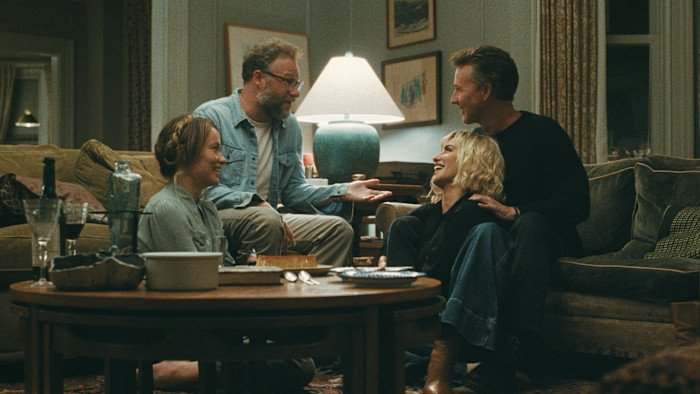
Comedies have provided some relief, and the requisite annual Sundance bidding war has mostly surrounded The Invite, a well-acted crowd-pleaser about a dinner party starring Wilde and Seth Rogen. A24’s winning bid (reportedly north of $10mn) followed another big-ticket sale: Leviticus, an Australian horror provocatively centred on conversion therapy, scooped up by Neon, US distributor of Anora and Parasite. Yet in this transitional festival year, the industry approach could be described as wait-and-see.
‘The Gallerist’, with Natalie Portman and Jenna Ortega, struggles to catch fire
The attraction of The Invite was clear, offering as it does the straightforward pleasures of four stars riffing off one another with flair. Rogen and Wilde (who also directs) play a mutually frustrated couple, Joe and Angela, who host two neighbours in their renovated Bay Area apartment. Wilde’s Angela is especially agitated, probably because her dinner guests are the hyper-confident pair Pína and Hawk (Penélope Cruz and Ed Norton), a therapist and ex-firefighter with floor-shaking bedroom proclivities.
Rather than straining for sophistication, Wilde’s entertaining romp steers into the clash between Joe and Angela’s sexual insecurities and the comical self-assurance of Pína and Hawk. The confined apartment setting lets us appreciate each actor’s rhythms: Rogen’s percolating sarcasm, Wilde’s screwball-adjacent nerves, Cruz’s wise leonine poise and Norton’s good-natured amusement. The Invite teeters when tuning into the deeper hurt of Joe and Angela’s damaged marriage, but it provided an agreeable centrepiece for the festival’s prime Saturday night slot.
Doing double duty, Wilde shows her range in Gregg Araki’s raunchy comedy I Want Your Sex as a blithely manipulative artist who recruits her naive assistant (Cooper Hoffman) as her sadomasochistic boy-toy. One of Sundance’s original 1990s enfants terribles, Araki here comes across as an elder statesman of American indie enjoining the youth to be more freaky. Hoffman obliges with a disorientingly down-to-earth turn as a budding art-bro who gets too attached.
But despite Araki’s nicely bitchy banter, too much of I Want Your Sex suggests that the art-satire genre is running on paint fumes. Confirming this is The Gallerist, with Natalie Portman as the curator of a one-woman show at Art Basel Miami that turns macabre when an influencer’s corpse becomes part of the exhibition. But the admirably twisted conceit never catches fire, and the plot’s habit of treating contemporary art as either a boondoggle or power play takes the air out of the film.
Olivia Colman in the sweet and sobering ‘Wicker’ © Lol Crawley
It’s all enough to send one into the arms of a tightly woven homunculus played by Alexander Skarsgård, as found in Wicker, a cheerfully eccentric medieval-ish fable. Built to order for an English spinster fisherwoman (Olivia Colman), the creation swiftly becomes a posterboy for marital devotion. A scenario that initially seems destined for parody becomes alternately sweet and sobering in underlining the village’s gender roles.
Sundance’s genre entries sometimes offer small marvels in special effects, and this wicker man is seamlessly woven into a convincingly humanoid form along the lines of the creature in Beauty and the Beast. He rustles with every move, displays outsized sexual prowess and speaks in a thoughtful creak, a lovely vocal creation by Skarsgård. Rounding out the cast, Elizabeth Debicki plays the wife of a doctor (Richard E Grant) whose envy poisons the idyll.
While it can be a delight to see stars thriving in indie efforts such as these, new faces offer a different kind of satisfaction. Extra Geography immerses us in a girls boarding school and specifically the friendship between Minna (Galaxie Clear) and Flic (Marni Duggan). These two petite teenagers are totally and touchingly in sync, very naive and drawn romantically to their geography teacher, Miss Delavigne (Alice Englert).
Galaxie Clear and Marni Duggan find a touching rapport in ‘Extra Geography’
Molly Manners’ debut feature skips along thanks to the incredibly poised rapport between Clear and Duggan (the latter bringing an especially amusing sense of peevishness as the wheels come off their mission). Their schoolgirl diligence lends the film a certain absurdism, and there’s genuine pathos in how cluelessly they navigate rough spots in their friendship.
This Sundance has less than the usual share of standout social dramas. Among the few is prison drama Frank & Louis, which stars an achingly sad-eyed Kingsley Ben-Adir as a felon who volunteers to look after a formidable inmate (Rob Morgan) losing his edge to Alzheimer’s.
The set-up, which sounds fabricated by a Sundance supercomputer for maximum tearjerking, in fact springs from the imagination of Swiss director Petra Volpe and German co-writer Esther Bernstorff. The film is strongest at its most restrained, which is where Ben-Adir especially excels. There’s implicit social critique in the fact that these men have been incarcerated long enough to develop Alzheimer’s, but despite the narrative progression dictated by the disease, Frank & Louis is in many ways more a mood piece, settling into your bones.
John Wilson stirred up audience interest with ‘The History of Concrete’ © John Wilson
No account of Sundance is complete without mention of documentaries, perhaps its most reliable highlight. Indeed, all five of this year’s nominees for the Academy Award for Best Documentary Feature Film premiered here last year. Two of this year’s best received that go beyond issue-driven interest are The History of Concrete, from HBO star essay-filmmaker John Wilson, and William and David Greaves’ Once Upon a Time in Harlem, a magnificent resurrection of a 1972 party of Harlem Renaissance luminaries at Duke Ellington’s house.
One documentary that captured some of the perversity of American society was All About the Money. Irish filmmaker Sinéad O’Shea (Blue Road: The Edna O’Brien Story) zeroes in on James Cox Chambers Jr, born into a billionaire dynasty in 1985. The film follows the heavily tattooed “Fergie” and his efforts to fund a communist-friendly farm and gym in Massachusetts as a seedbed for revolution. Fergie and his earnest inhabitants exhibit some highly controversial political stances, but O’Shea’s non-judgmental film accomplishes more than a rubbernecking profile, with its illustration of America’s contradictions and yawning wealth gap.
As Sundance prepares for its new chapter in Colorado, it is a good reminder of the vital role movies can play in holding up a mirror to a bewildering world — wherever we find ourselves.
To February 1, festival.sundance.org
Find out about our latest stories first — follow FT Weekend on Instagram, Bluesky and X, and sign up to receive the FT Weekend newsletter every Saturday morning
