


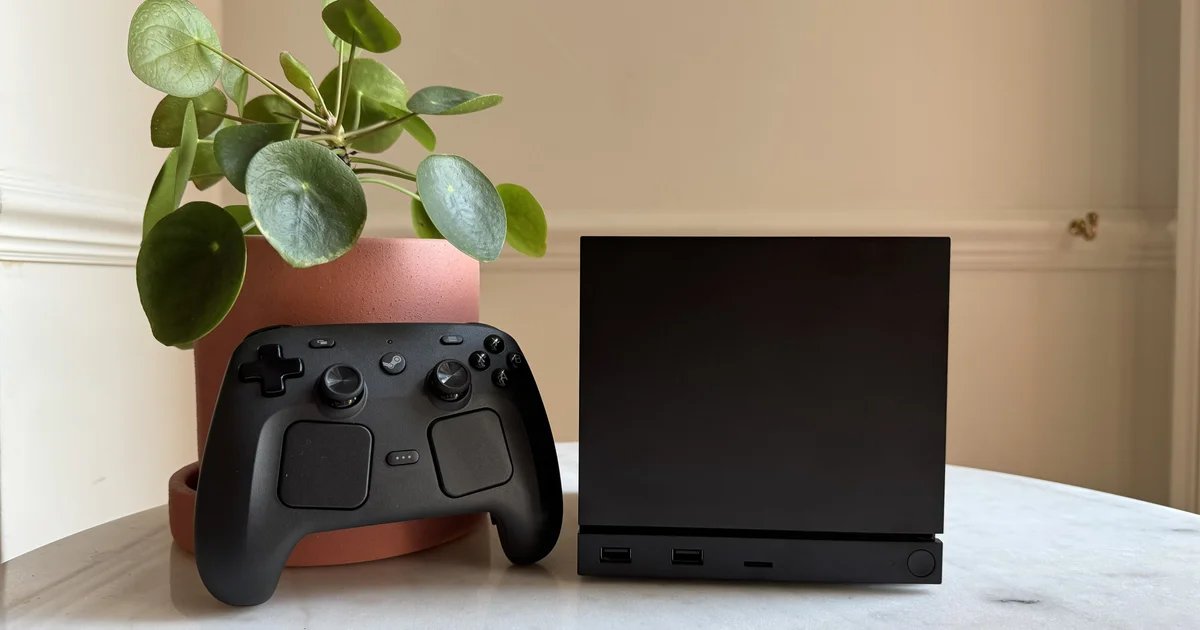
What is the Steam Machine? I must admit I’ve spent a good portion of my time with the thing trying to figure that question out. Valve will tell you, as they told us, that it’s essentially been made for the people who want to bring their existing PC library – on Steam and elsewhere – to the living room. It’s a noble goal, and one the company’s been toying with for more than a decade, since its introduction of Big Picture Mode as far back as 2012, through the original wave of third-party Steam Machines that launched in 2015, to the Steam Link and beyond.
Steam Machine review
- Manufacturer: Valve
- Availability: Sales lottery opens 22nd June
- Price: £879-£1,208
But it’s also a goal that raises some questions, which bring us to this review. A point of order first: we’ve teamed up with our lovely PC gaming sister site RPS for coverage here. And by “teamed up”, I mean I’ve gone to RPS’s deputy editor and specialist hardware guy James Archer and asked him to do a load of extra work (thank you James!). The intention is we’ll leave you with all avenues covered. This review is going to be a user-focused one: what’s it like actually living with the Steam Machine – for instance, is it a not-console you actually want in your home, how enjoyable is it to use, and does it do what you want from it?
If you’re after more technical coverage meanwhile, we’ve also got a Q&A piece focusing on conversations I’ve had with James – designed to answer all your key technical questions about the Steam Machine – and stories from our interview with Valve’s designers to get into their intentions in more depth. Here, they discuss the original price range before hardware shortages and how the Steam Machine sits compared to other consoles, including Xbox’s Project Helix. Plus, we’ve our guide on how to order a Steam Machine if you’re interested, given it’s a somewhat unusual process. Over on RPS meanwhile, James has his own, more technical review and benchmarking for you to look over for even more context.
For now though, those questions. Namely: is the Steam Machine worth such a now-very-large wad of cash? It’s worth running through those numbers again here, as they’ve only just been revealed. Here’s a quick table:
Bundle
GBP
EUR
USD
PLN
CAD
AUD
Steam Machine 515GB
£879
€1,039
$1,049
zł4,389
C$1,509
A$1,609
Steam Machine 515GB + Steam Controller
£938
€1,108
$1,128
zł4,698
C$1,628
A$1,728
Steam Machine 2TB
£1,149
€1,359
$1,349
zł5,739
C$1919
A$2,109
Steam Machine 2TB + Steam Controller
£1,208
€1,428
$1,428
zł6,048
C$2,038
A$2,228
Not cheap! And this is where the “What is a Steam Machine?” question comes to the fore. A “PC games in your living room” machine is one answer – and does immediately raise some more questions of its own. An example: should you spend the aforementioned huge wad of cash on the Steam Machine, as opposed to investing in such classics as “Big HDMI Cable” (you could get your usual PC wired in from the office to the lounge all invisible and professional-like for a fraction of that cost too)? Or even: would making a more modernised Steam Link have been a better venture for Valve?
The Steam Machine’s box is incredibly minimal and economically packaged, plus entirely made of cardboard – a nice upside of it not having to stand out on actual store shelves. Inside the main box is the Machine, an HDMI cable, power cable, and USB-A to C cable.
Alternatively, there’s the idea that the Steam Machine could make a very nice entry point into PC gaming, competing price-wise with budget gaming PC builds. As RPS’ James explains – and explained to me, as we talked this through – you could build a decent rig based on Nvidia’s entry-level RTX 5050 for a similar cost. But then: that entry-level PC would get a decent bit more performance, as James’ benchmarks show.
Then there’s the other option of what the Steam Machine could be: Valve’s attempt at a console. It definitely isn’t that – at least according to Valve, as its hardware architects made a point of explaining to us – but it does look and operate a lot like a console. Could it be for the people who just want to pay some money, plug in a box, and get playing games on their living room TV? Well, in that case it comes up against arguably its biggest obstacle: the actually ginormous PS5 Pro, which costs less and outputs a heck of a lot more in terms of gaming performance (and, now, a load of future PlayStation exclusives that’ll no longer come to PC).
All of this, again, comes back to the price, something ultimately influenced quite brutally by the AI-driven component crisis that Valve has had no control over whatsoever (unlike, ahem, some other console manufacturers). Valve told us the original plan was for Steam Machine to cost significantly less – the implication was that it had jumped by a similar margin to that of the Steam Deck, which rose by roughly 43-46 percent late last month in something of a warning to the Machine-curious. That would’ve put the £879 512GB edition in the region of £610, and the £1149 model at about £790. So, questions.
Does the Steam Machine make for a good living room console?
Let’s talk about consoles first, because while Valve very deliberately doesn’t want to say it’s a console, a lot of people are going to think of it as one, and for good reason. It has the purpose-built, bespoke-engineered form factor of one. It’s made for the living room and a big TV, and it is, for a lot of people, going to be competing with consoles for a place in your gaming setup.
If you own nothing but a Nintendo Switch or Switch 2, say, the Steam Machine is a fascinating option for expanding what you can play on the big screen. And in this sense it’s a good option too: the nature of PC gaming’s extraordinary breadth is that you will be able to play more games on this thing than any other console-like object you can buy.
It also does a lot of things you want a great console to do. It looks fantastic, for starters – a point that sincerely matters, and which Valve’s designers openly understood, referencing people’s more aesthetically-minded decision-making when it comes to the living room. A tiny cube – it’s genuinely the size of a GameCube, 6x6in, sort of an Xbox Series X cut in half at the waist – it’s delightfully minimalist on the surface. And it takes the brutalism of that Series X monolith, cubing it and cutting out the gamer green for good measure, and makes it its own. There’s also room for a bit of expression. You can get various faceplates from Valve officially – I have the walnut and red fabric ones and they both look delightful. The walnut is a classically flexible modern home option, a bit mid-century, a bit boho; the red a fantastically vibrant burnt hue, and a bit of texture! How rare is it for a console manufacturer to understand the texture of the object they make, beyond function, or maybe a self-facing reference like the PS5’s miniature bumpy symbols. But then elsewhere, Valve’s “open” approach means we’re bound to get tonnes of these after market too – the edgelords at DBrand have already done a Companion Cube skin. And the faceplate itself is incredibly easy to replace: you can pop it on and off with one hand.
It’s also extraordinarily quiet and, touch wood, has zero issues with temperature. I’ve played modern triple-A games on it while keeping the Machine in my closed, built-in cupboard and had no heat troubles whatsoever for instance, while my PS5 Pro can sound like it’s going to take off and act as the room’s only radiator when I do the same. That’s to be expected for a closed cupboard, granted, but the remarkable thing here is the Steam Machine’s absence of issues altogether. Meanwhile, I’ve used it outside the cabinet, just sitting on top, and can’t hear it from the sofa about 2 metres away, even with my TV on mute.
Image credit: Eurogamer
Performance-wise however, the Steam Machine starts to lag behind a little – and that disparity becomes even more stark when you start thinking about performance-per-penny spent. Comparing performance between consoles and PCs is frightfully difficult at the best of times, thanks to the variability in settings and the different methods used for upscaling and equivalent, so I won’t go too far down the rabbit hole here. Broadly speaking, borrowing James’ benchmarking once again, the Machine performs slightly worse than his RTX 5050 build across most games tested. Speaking very loosely here: a rig running an RTX 5050 might get you roughly similar performance to a base PS5, sometimes better and sometimes worse depending on your settings (and the specific optimisations made with each game – often upscaling on PS5 is doing some smart work).
And so a very, very loose back-of-cigarette-packet deduction might be that you’ll see similar-ish performance to a base console from a Steam Machine. And this is where the viability starts to crumble somewhat – at least for this specific use-case. A base PS5 with disc drive currently costs £569.99 direct from Sony here in the UK, with refurbished and second-hand options available at this late point in the console cycle for a fair bit below that. A 2TB PS5 Pro, meanwhile, is still cheaper than the Steam Machine even after its price increase to £789.99, and will consistently outperform it by a fair bit – especially if you want to play your games at 4K (or an upscaled version of it). On a cost-to-performance basis the Steam Machine is just nowhere near competitive.
Similarly, on pure console-like usability, there are some inevitable snags that come in exchange for the freedom offered by Valve’s PC-based vision for openness. Many of the world’s biggest console games are unplayable for a start, given that any game with anti-cheat software requiring kernel-level access is entirely off the table – that includes the likes of GTA Online, Apex Legends, Fortnite, PUBG and more. Attempting to load these comes up with a warning that you’ll either be unable to play them or, if you do manage to get into a game somehow, you’ll probably find yourself swiftly banned for bypassing the software.
Image credit: Eurogamer
Beyond that, there are the usual PC-as-a-console foibles. You’ll need to tinker with graphics settings to get the most out of games, whereas on a console they arrive highly optimised and raring to go. You’ll need to duck out to desktop mode and download some third-party software to play your games from other storefronts like, say, Epic Games or GOG, though Valve has at least made this process super simple – you just select Desktop Mode from the Power menu and its Linux-based OS works a lot like any other desktop OS you’ll have seen before. Likewise, other modern amenities of the latest console generation are missing: you can minimise a game and tool around on the Machine with it running in the background, for instance, but there’s no Quick Resume or equivalent – attempt to open a second game and the Machine gives you a fairly firm warning that it’s not a great idea to simultaneously run both.
And crucially, I’m not convinced that the UI itself – essentially identical to the Steam Deck’s – is really anywhere near as good as a properly ground-up console-specific one. There are three different menus, for instance, each accessed with three different buttons. Each of these offers some overlapping submenu options, plus some which are unique to one menu or the other, the decision of what-goes-where following a logic I can’t quite understand. Or there’s a menu you can access by selecting a tiny little icon from along the top right of the screen – like on a PC! – that again has the same issues. As much as SteamOS has evolved and improved dramatically over the years since the original Big Picture mode, there’s still a lingering sense it’s a PC’s UI retrofitted to something navigable with a controller, rather than being truly controller-first.
Image credit: Eurogamer
Is the Steam Machine better than just getting a really big HDMI cable?
Here’s the alternative vision of what the Steam Machine is, the one pitched by Valve and, according to the company, regularly sought after by PC gamers too: as a PC in your living room that doesn’t look like the usual PCs you can buy, that is purpose-built for the space and everything you’d typically find in it.
And this is where you get the flipside to all those not-as-good-as-a-console foibles. You get the flexibility, should you need it. While third-party stores are more annoying to use than a store ever would be on a console, for instance, at least they can be used at all, and DRM-free games can be played as a result. Different controllers and inputs are incredibly easy to use, too – I plugged in a mouse I happened to have in the same console cupboard on a whim, and could instantly navigate the OS, as I could with a DualSense that worked the second I plugged it in, no annoying pairing or fiddling required.
Storage expansion or exchange likewise is a breeze with the SD card slot on the front (and you can technically change the internal storage and RAM too, if you’re feeling flush). And if you do like fiddling with settings, the whole living room aesthetic thing comes back into play again, with the console’s horizontal light bar on the front usable as say a loading bar or just a nice bit of variable decoration.
It’s also, again, absolutely tiny and absolutely gorgeous and absolutely silent. Games are much cheaper to buy on PC and cheaper to play over time without subscriptions for mere multiplayer access or cloud save functionality. And the breadth of playable ones – not only from today but from across history, or the weirder reaches of the indie scene and the internet – is greater than on any other platform.
But then you get some trade-offs here again too. Compared to an actual gaming PC, the Steam Machine might be dramatically prettier and quieter and probably more efficient, performance-wise, per square inch than any PC you could personally build (and also comes pre-built itself), but it is far less upgradeable. It really is only the RAM and storage you can upgrade here, and so unlike any other desktop gaming PC and indeed some laptops now, the Steam Machine really is frozen in time.
Image credit: Eurogamer
Image credit: Eurogamer
And it’s also not a particularly brilliant time to be frozen: the performance you’ll get for your 900-odd UK smackers and above is about as bad as it’s been for a very, very long time, and that issue shows no sign of going away. In terms of those slightly clunky equivalents again, comparing the Machine to an RTX 5050 and then comparing that to recent Steam hardware surveys puts it more or less at the bottom end of the middle tier – or in other words, it will likely slip, fairly soon, into the ‘low end’ of PC hardware, from which it can never escape. You’ll still be able to play games at 1080p and 60FPS for a fair while, if all things stay equal, but there’s little room below that in terms of tolerable performance, in particular on the increasingly massive 4K TVs in homes today.
The inevitable question then becomes: if I have a gaming PC already, or a viable home office space for one, or I’m thinking about getting one for my living room anyway, why bother with a Steam Machine? To that I’d say: if you’ve got a great PC already, get yourself a massive HDMI cable and a professional to run that discreetly through your home. Or if you’re renting and can’t go round drilling holes in whatever you like, consider building a PC instead. As RPS’ James has written again, you could probably build a similar or more performant PC for a similar cost, and then be able to upgrade that indefinitely over time. The only reason to go for a Steam Machine then becomes aesthetics. I sincerely believe those are very important in the living room, as you have probably gleaned from how much I like telling you I truly hate the sight of my otherwise lovely PS5 Pro. But they’re not everything. You could put a small form factor PC with a case like the Terra or Node from Fractal Design in the living room and get away with that pretty well. Or just stick a plant in front of it.
Is the Steam Machine kind of brilliant anyway?
So the short answer to how it sits versus a console, or indeed an HDMI cable or actual PC of your own is: there is no real short answer. For upfront cost, performance, plug-and-play simplicity and smart features, at the cost of more expensive games and services over time and a console that looks like a hellish mid-00s leisure centre extension dubbed “the future of our town centre” – and is also roughly the same size as that – get a PS5 Pro.
However, for flexibility and breadth and cheapness over time, and something you’ll love people asking about when they come round – something that you can genuinely carry with one hand (LAN parties! If only it had a handle…) and which looks normal or dare I say it even cool next to a nice set of speakers or a stack of coffee table books or something you actually want to see in your home – the Steam Machine absolutely has a place.
And there’s something genuine to be said for that, I think. I can’t help but wonder what could have been, had the base Steam Machine arrived at say £599. It would’ve been competing against PS5s and Xboxes in the £300 range by now, of course. But it would’ve done so as a genuine competitor in that part of the home, from a company with vast resources and the vastest of all installed bases. And it would’ve arrived as something that is evidently made with sincere love and extraordinary expertise in its own way. The wizards at Sony and Microsoft might have the edge when it comes to conjuring pure power from hardware with extraordinary efficiency – and in designing a UI and ecosystem around it, in that order. But with the Steam Machine we have something different: a new perspective, and a new standard for living room sort-of-console design. If nothing else, few people can make a video game curio like Valve.
For much more on the Steam Machine, do take a look at our Steam Machine FAQ with tech expert James, our guide to everything we know about the Steam Machine, how to order one, and rundown of the Steam Machine’s specs as well.
A Steam Machine 2TB was provided by Valve for review.
