


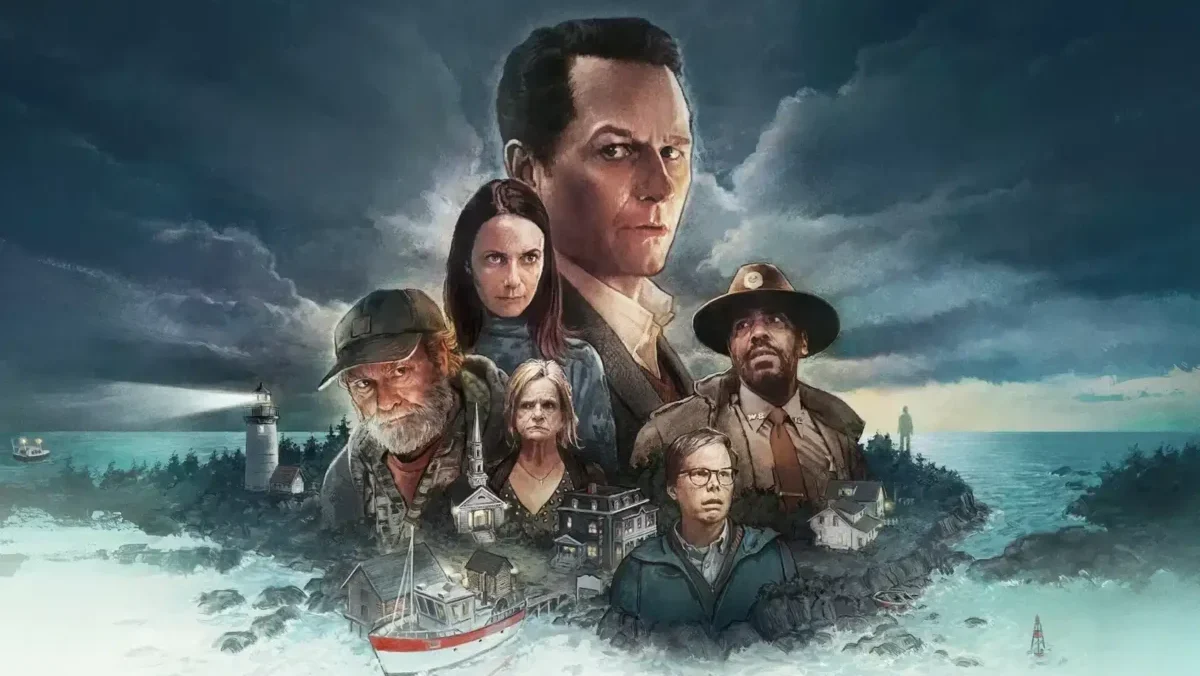
Apple TV’s Widow’s Bay is a horror fan’s horror show. The degree to which it rewards viewers that are well versed in the genre is absolutely astounding and extremely gratifying. It’s evident from the very first episode. Movies and books and genre character types are very easy to pick up on, and the show makes it so that it feels organic. This means that if you don’t know about the things being referenced, you can still engage with them on a narrative level.
This is one of the show’s greatest achievements. References, winks, and inspirations aren’t there for nostalgia’s sake. They’re not throwaway or superfluous. They let fans dive deeper into the story and its lore. It’s a mark of recognition for those who’ve been immersed in the genre for so long, who’ve seen the classics and are always in search for more.
Here’s a list of movies and books that have inspired the show or are directly referenced in it for both fans and horror newcomers alike. If you’re planning on watching, catching up, or rewatching Widow’s Bay before the final episode hits next week, this list will help you appreciate the story better. Oh, and for those lamenting that the end is nigh, do not despair. It’s been renewed for season 2.
Enjoy.
- Jaws and being the mayor of a horror town
Mayor Tom Loftis, played by Matthew Rhys, wants to turn the island of Widow’s Bay into the next Martha’s Vineyard. Problem is the island’s haunted, angry, and hungry. Loftis tries hard to keep this under wraps, but he’s just delaying the inevitable.
Jaws and its stubborn mayor, Larry Vaughn (played by Murray Hamilton), are the first things that spring to mind here. It’s just so easy to see shades of Vaughn in Loftis, especially in their obsession with turning their respective islands into tourist destinations. Vaughn, the mayor of Amity Island, ignores signs that a killer shark is prowling the waters of his beach town. He suffers the consequences dearly, and he’s made to be hated by audience every step of the way.
Widow’s Bay doesn’t frame Loftis as a villain, though. He’s more of a stubborn and anxious leader that has his heart in the right place. He learns his lesson and acts accordingly, though never at the expense of hilarity. He does more than enough to earn our trust, especially through his rocky relationship with his son.
One last point, Jaws was mostly shot on Martha’s Vineyard with some of its residents acting as extras in the film.
- Stephen King would feel right at home at Widow’s Bay
Look close enough at a scene involving a mobile bookstore and you’ll find a copy of Stephen King’s Salem’s Lot casually lying around (the latest version of it, in fact). While that book’s about a vampire slowly taking over the titular town, what really stands out is the small-town mentality that leads its residents to distrust anyone that wasn’t born there. The first few Widow’s Bay episodes really bring this element to the forefront, with Loftis getting a lot of pushback from the locals.
But Lot isn’t the only King influence coursing through the show. One of its best episodes echoes a bit of Carrie (King’s first book) in terms of mood and character work. In it, one the most awkward characters in the story unknowingly finds herself embroiled in witchcraft as an important party looms. King fans will find other influences spread throughout, especially as it pertains to Widow’s Bay dark history. There’s even a bit of King’s original TV miniseries Storm of the Century in there.
- Lovecraft, because when is Lovecraft not an influence?
Some influences are just hard to keep at bay. They contribute on the basis that they’re too colossal in reach and size. HP Lovecraft falls squarely in this category, and his presence is felt in Widow’s Bay. That said, it’s not in the manner of tentacled monsters (though there might be a hint of one in there). It’s more about the terrors that lie in the sea.
It’s made clear early that the waters surrounding Widow’s Bay are mired in mystery. In fact, the very first episode deals with the disappearance of a boat captain that turns supernatural fast. But the focus isn’t placed on the monstrous aspects of Lovecraftian fiction. Instead, it’s all about dread and the feeling that something ancient hides deep within the island. Dagon comes to mind, a short story about a man that ventures into a town ran by a cult that worships aquatic gods.
Fans of Lovecraft will be able to identify a few things more here and there. Just don’t come in expecting Cthulhu.
- Halloween and the night The Boogeyman came to Widow’s Bay
Kate O’Flynn’s Patricia has become one of the series’ standout characters. She gets an episode dedicated entirely to her and she’s treated like an equal in the small group that’s looking to end the island’s curse. She’s as important as Loftis and Wyck (Stephen Root), the third main character involved in the mystery. Wyck starts out as the classic old man who knows the place is haunted but everyone writes off as crazy.
A big part of her backstory concerns a slasher called The Boogeyman. He was a killer that went on a teenage girl murder spree back when Patricia was a teen. The event is referred to as “the night The Boogeyman came home.”
You know who else came home once to go on a murder spree of his own? Michael Myers. John Carpenter’s groundbreaking 1978 film Halloween is perhaps one of the most obvious influences in the show, especially when it comes to the slasher subplot. In fact, the movie’s tagline, “The night He came home,” is directly referenced by Patricia.
There’s an abandoned house that belongs to the slasher, his weapon of choice is a knife, and he’s described as an evil being whose motivations have never been fully parsed. He is simply The Boogeyman, what Dr. Loomis calls Michael Myers at the end of Halloween.
Like all the other influences and references found in Widow’s Bay, Halloween’s lead to a lot of fun fan service. That said, it’s built up through the story so that viewers that are unfamiliar with the movie can still keep up. Incidentally, this perfectly captures what the show thinks horror should be: welcoming but rewarding for horror fiends.
