


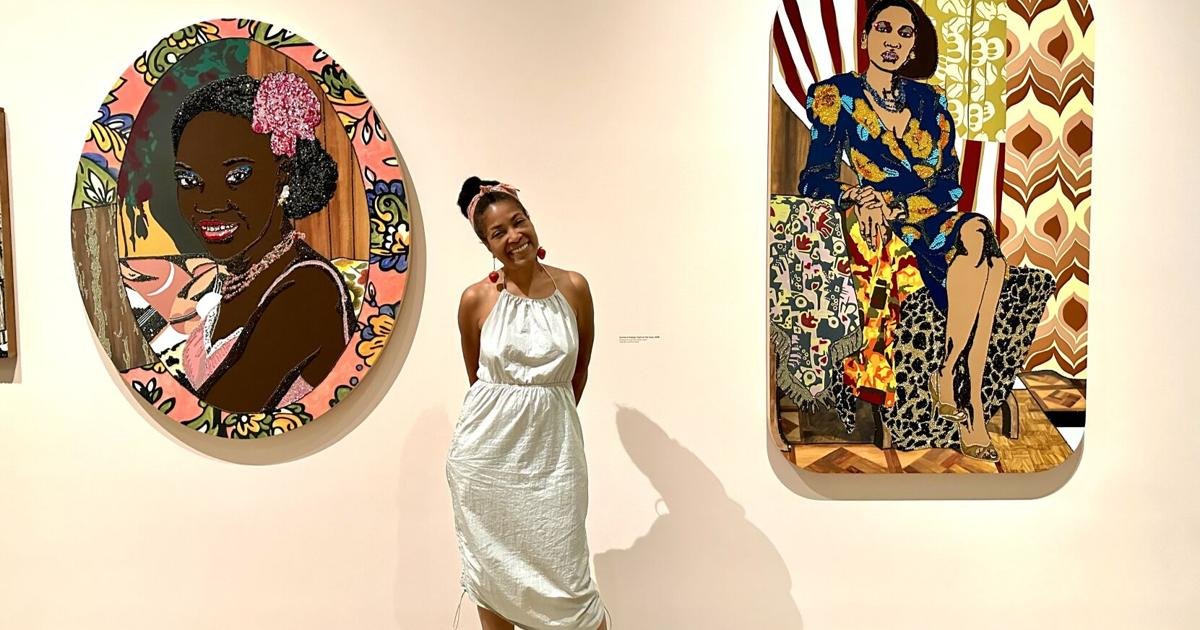
Raelle Myrick-Hodges joined the Contemporary Arts Center of New Orleans as executive director in November 2025. She’d served as the CAC’s performing arts curator for three years about a decade ago and had since created “He Has the Prettiest Handwriting,” a theatrical and visual-arts performance piece, and served as founder and executive director of Philadelphia’s Azuka Theater Collective.
She returned to the CAC as the artist-founded Camp Street institution was preparing to observe its 50th anniversary. On view through July 6, the exhibition “Festival/New/Works” pairs established and emerging artists and serves as the anniversary celebration’s kickoff installation.
This interview has been edited for clarity and length.
You joined the CAC at an important juncture in its history, a half-century legacy that the current exhibit “Festival/New/Works” addresses.
“Festival/New/Works” was conceived as the first step in celebrating the Contemporary Arts Center’s 50th anniversary. While the CAC was officially incorporated in March 1977, its story really began in 1976 with a group of artists who came together to create visceral and kinetic visual art. Over the last five decades, that spirit shaped generations of artists in New Orleans and beyond its city limits.
At its heart, “Festival/New/Works” is a celebration of the mentor-mentee relationship. It is the idea that some of the most meaningful artistic growth happens when knowledge, experience and inspiration are shared across generations. It felt like the right way to begin this milestone anniversary by highlighting connection, exchange and the creative community that has always been central to the CAC.
Curated by DiQuan Forcell, the exhibition explores how artists connected to the CAC’s history continue to support and be inspired by emerging artists today. What drew me to this moment is that it feels both reflective and forward-looking. The CAC is approaching its 50th anniversary, and with that comes an opportunity to honor an extraordinary legacy while also asking what the next 50 years might look like.
“Festival/New/Works” captures that spirit beautifully. At its core, it’s a celebration of artistic lineage — the conversations, mentorships and acts of generosity that allow creativity to move from one generation to the next. By pairing established and emerging artists, the exhibition reminds us that art is never created in isolation. It’s built through relationships, shared curiosity and the willingness to learn from one another.
Where is the institution in its evolution today?
The CAC is at a remarkable point in its evolution. Nothing reaches 50 years without accumulating both mistakes and magic, and the CAC is no exception. What has endured through every chapter is the organization’s legacy that is rooted in experimentation, courage and community.
A practicing artist has not been the executive director at the CAC in over a decade, and I believe the artist perspective requires empathy, curiosity and a willingness to engage in open, fearless dialogue. I know the historical mistakes, and I also know how artists build something from nothing.
After years of grappling with questions of institutional identity, I believe the CAC, its board and its staff are ready to look ahead with the same ambition that inspired its founders. We hope to celebrate locally and platform globally.
As we approach our 50th anniversary, we’re embracing a vision that honors the artist as leader, the curator as teacher and the emerging artist as essential to the future of the field.
You bring a background in theater to the job. What role do interdisciplinary arts play in your vision for what’s to come?
As a theater artist with a multidisciplinary practice, and with experience presenting, venue-making and the deeply humbling work of curation, I believe theater offers one of the strongest models for cultural leadership.
Theater is, by nature, collaborative. It requires artists, technicians, administrators, audiences and communities to participate in a shared act of making. There is growing evidence that arts organizations thrive when they embrace interdisciplinary collaboration, community engagement and artist-centered leadership. We theater artists are uniquely trained in these skills.
My vision for the CAC is straightforward: First, to champion the extraordinary artists who call New Orleans home, across visual art, performance, music, theater, dance and forms yet to be defined. Second, I hope to bring exceptional regional, national and international artists into conversation with our city in ways that elevate local voices rather than overshadow them.
The goal is not simply to present great work. It is to create a cultural ecosystem where local artists are connected to broader conversations outside of the region, where audiences encounter ideas from around the world, and where New Orleans is recognized not only as a place rich in artistic history, but as a city actively shaping the future of contemporary art and performance.
