


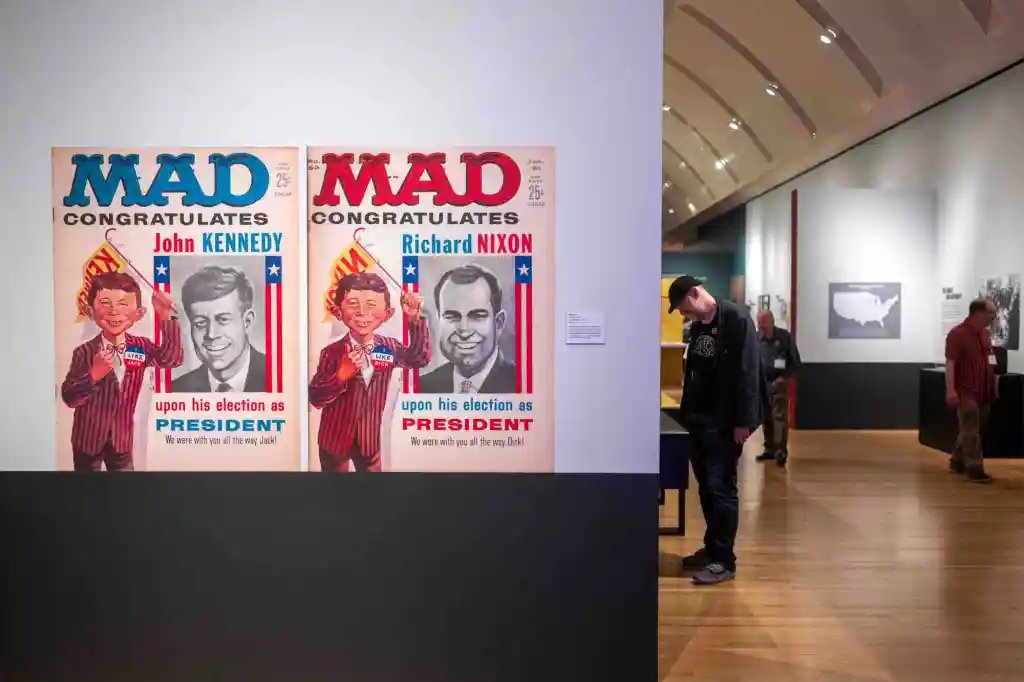
As you leave “Inventing America: The Comic Book Revolution,” the Skirball Cultural Center‘s new exhibit on the role of comics in American history, there’s one last stop before you bid farewell to Superman, MAD magazine, Captain America, and all that’s come before.
It’s an interactive station, with small stacks of paper across the top of which is written, “What can we learn from comic books?”
Rows of metal pegs protrude from a wall nearby, and on the day before the exhibit officially opened, early birds have already started to leave thoughts large and small.
Show Caption
1 of 11
People at the new “Inventing America: The Comic Book Revolution” during a preview at the Skirball Cultural Center on Tuesday, May 19, 2026. (Photo by Hans Gutknecht, Los Angeles Daily News/SCNG)
Expand“That superheroes come in all shapes and sizes and anyone can be a superhero in their own story!” one reads.
“When my grandma immigrated to the States from Yugoslavia, she learned to speak English by reading comics in the newspaper,” another offers.
“We can learn that art and storytelling have the power to shape how we see each other,” a third proposes.
A year ago, the Skirball debuted its first comic-themed exhibition in years, “Jack Kirby: Heroes and Humanity,” a celebration of the life and work of Kirby, who helped create such comic book icons, such as Captain America, the X-Men, Black Panther and the Avengers.
Hey! Ho! Let’s go to the Skirball Cultural Center’s exhibit on punk
Now, with “Inventing America,” the center has widened its gaze to include the story of comic books from the early decades of the 20th century to the present, examining creators such as Kirby, yes, but linking the art and adventures to the story of the United States over the past century.
“We greenlit both of them at the same time, knowing they would build on each other,” says Michele Urton, the Skirball’s museum deputy director and co-curator of “Inventing America” with comics expert Patrick A. Reed.
“The overview, because it’s an American history exhibition, we really wanted to time that to America 250,” she continues. “And for practical reasons, we needed a bit more time to do a larger survey.”
After entering the exhibit, you quickly see the special treats it contains. In a glass display case of its own, a mint copy of 1938’s “Action Comics” No. 1 presents the first appearance of Superman. A year later, “Detective Comics” No. 27 debuted Batman and “Marvel Comics” No. 1 introduced both the original Human Torch and the Sub-Mariner.
One year later, “Captain America” No. 1, reached newsstands in December 1940, featuring Cap in hand-to-hand combat with Adolf Hitler a full year before the United States entered World War II.
From there, it travels a mostly chronological path, with occasional side trips to topics such as early female comic book artist Lily Renée and “All-Negro Comics,” the first-ever comic book to be completely created by Black writers and artists and feature a Black cast of characters.
The exhibit considers comedy with sections on “Archie” comics and MAD magazine, and the counterculture of the ’60s with Zap Comix and the rise of feminist comics in the ’70s with “It Ain’t Me, Babe” and “Wimmin’s Comix.”
Horror comics, romance comics, movie and TV tie-in comics are all represented.
“We knew we had the story of the 20th-century United States of America,” Reed says. “We wanted to tell that narrative, so we looked for objects that fit and reflected certain moments in time, certain social issues, changes in society.
“And so that meant we weren’t just casting around for the biggest, most beautiful objects,” he says. “We wanted things that helped enhance the story. That gave people a way into this history.”
In many ways, “Inventing America,” which runs through February 2027, tells a parallel story of the rise of youth culture in America.
“Comic books were really that first flowering of youth culture,” Reed says. “The first time that there was an entertainment form targeting kids, not only as the audience but as the direct consumer. Publishers recognized that all of a sudden, they can be selling things for nickels and dimes and targeting the kids directly.
“That’s sort of Ground Zero for everything that follows,” he says. “Today in America, youth culture is the driving force of pop culture. That all emerged following the comic book, the 45 RPM record and Saturday morning cartoons.
“So this is very much a story of how comics did build America in many ways.”
Sign up for our free newsletter about books, authors, reading and more
Many of the early comic book creators we still remember today – Superman’s Joe Shuster and Jerry Seigel, Batman’s Bob Kane and Bill Finger, Captain America’s Jack Kirby and Joe Simon – were the children of European Jews who immigrated to the United States.
“A lot of that’s because the industry was founded in New York City, which was a major center of immigration,” Reed says. “The comics companies that were sort of low-end publishing coming out of pulp and broadsheets were an industry founded largely by immigrants, by Jewish Americans.
“And if you were a young Jewish American in New York City, and you had artistic aspirations as Jack Kirby did, if you wanted to work in the arts, the comic book was there.
“The kids in the Lower East Side [where Kirby was born] weren’t necessarily attending fine art programs or going to art schools,” Reed says. “They weren’t necessarily able to jump straight to commercial illustration. So to work in comic books was a way to express your creativity and also provide for your family.”
And the comic book industry has remained, to varying degrees, a world of art and storytelling with its doors open wide.
“As comic books move from the Marvel-DC model and expand in the 1960s, you get the whole underground movement,” Urton says. “People began self-publishing. They’re coming at it from a different angle.
“I think that because the comic book is a format that continues to change and evolve, and that can be created really inexpensively and self-produced, you continue to see entry into this field for a wider and wider range of folks,” she says. “As Patrick likes to say, anyone with a pencil and a piece of paper can become a comic book artist.”
To Reed, that openness creates an energy and vibrancy in comics that’s not always present in the mainstream creative arts.
“Comics were created by kids; rock and roll was created by kids,” he says. “Punk was a reaction, a way to break into a field that people felt did not reflect them, whether it was music, whether it was fashion. Because of that initial sort of outside aesthetic, these were not the forms that the critics were necessarily reviewing in the Sunday Times.
“There is this crackling energy of people who feel the possibility and feel the ability to be creatively unleashed,” Reed says. “That’s part of why I think these two shows” – the Skirball is also now presenting “Outsiders, Outcasts, Rebels + Weirdos: Punk Culture 1076-1986″ – make so much sense and exist so wonderfully in communication with each other.”
Long after “Inventing America” closes, a small but significant part of it will remain at the Skirball.
Riot Games’ co-founder Brandon Beck, whose extensive collection of rare and vintage comic books provides many of the most significant comics in the exhibition, decided to donate his copy of “Captain America” No. 1 to the museum’s permanent collection.
“That piece was the spark to the larger conversation about stories comic books can tell,” Urton says of the Jack Kirby-Joe Simon comic in which Captain America beats up Adolf Hitler. “It was certainly the first piece you saw when you came into the Kirby exhibit, and one of the foundational pieces for that storytelling.
“The Skirball is getting ready to embark on a redesign of our core exhibition, which looks at the history of Jewish life in America, and so having an object like this come into the permanent collection is so exciting for us to think about the ways in which we can tell future stories in that space for different audiences.”
‘Inventing America: The Comic Book Revolution’
When: Now through Feb. 28, 2027
Where: Skirball Cultural Center, 701 N. Sepulveda Blvd., Los Angeles
How much: Admission to Skirball and all exhibits except for Noah’s Ark is $20 for adults, $15 for seniors, full-time students with ID, and children 2-17. Free on Thursdays and for members and children under 2.
For more: For information, hours and tickets, see Skirball.org.
