


Archive SpelunkerArchive Spelunker
Chris Livingston
Senior Editor
From the archives: This review was originally published in PC Gamer magazine #200 (UK, May 2009). The review appears as originally written, with only minor changes in formatting and presentation.
Like busy little content gardeners, we’ve been digging through old issues of PC Gamer to find features that never made it onto our website and replanting them here with a little sprucing up. I’m happy we’ve found a new (s)pot for this review of Plants vs. Zombies written by Tom Francis (now a bigshot developer growing his own games).
I utterly devoured PopCap’s unique take on tower defense when it launched in 2009 and I’ve lost over 200 hours to it, probably most of them tending my Zen Garden. Fun fact: I was working an office job that year, and this was the first time I ever installed Steam on a work PC to sneakily garden away my boring afternoons.
I never forgave PopCap for abandoning PC after the twin hits of Peggle and PvZ, except I guess I did forgive them because when they released Plants vs. Zombies: Replanted, which was just enough of an overhaul of the original to play beautifully on Steam Deck, I put 60 more hours into it. I also played a bit more of the original, and I think I might have scored it even a smidge higher than Tom did in 2009. What score would you give it?
Plants vs. Zombies review – PC Gamer issue #200 (UK, May 2009)
Need to know
Price: $20
Release: May 5, 2009
Publisher: PopCap
Developer: PopCap
Required: 1.2Ghz CPU, 256Mb, DirectX 8 GPU, internet connection
Recommended: Slightly more than that
Multiplayer: None
Link: Popcap.com
Influenced by: Insaniquarium, Tower Defence games
Alternatively: Desktop Tower Defence
This was on the tip of everyone’s tongues, PopCap just gave it a name. The name they wanted to give it was Lawn of the Dead, but apparently there were issues with that.
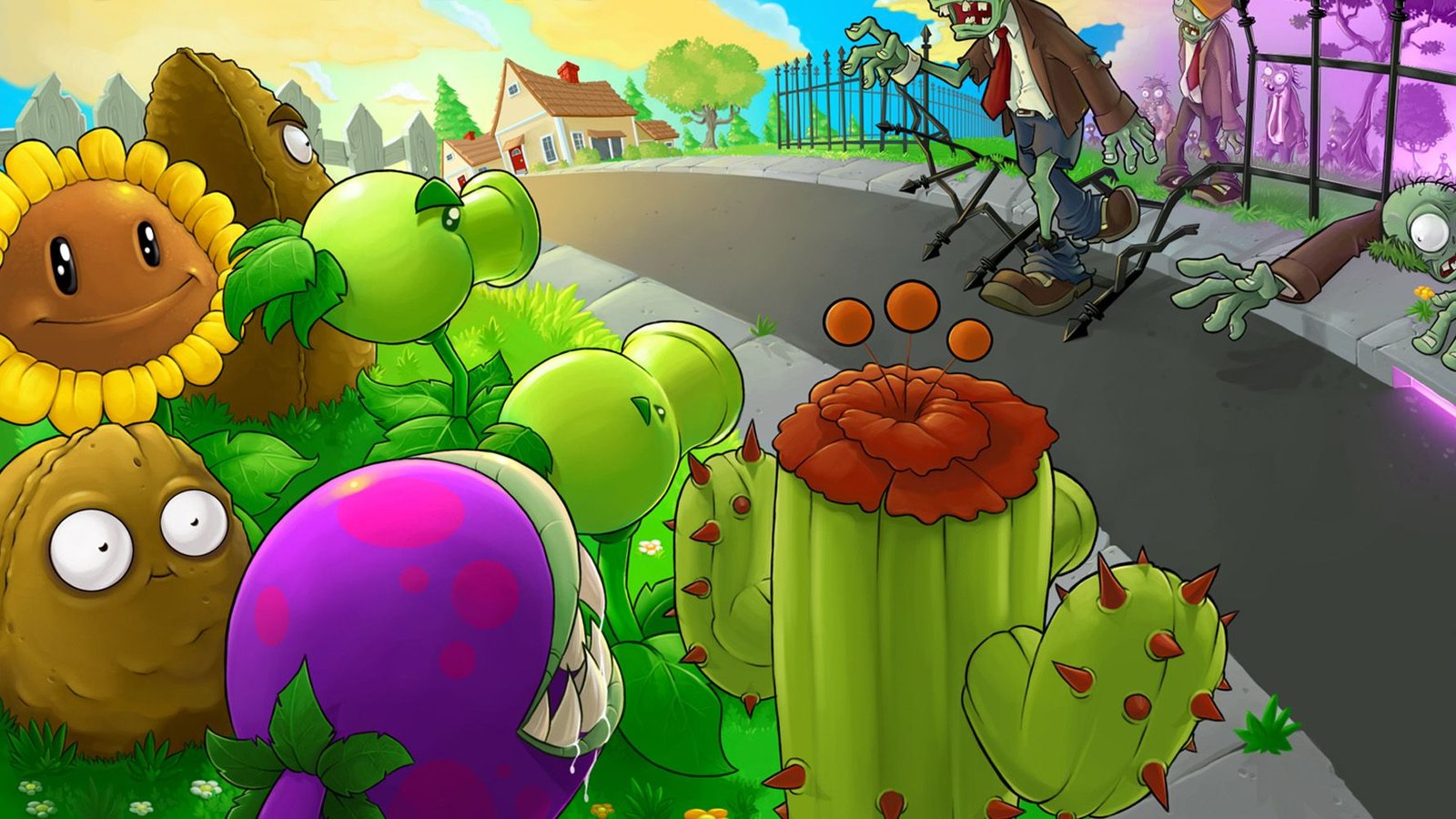
You have a lawn. Soon, the dead will attempt to cross it and eat—as the game puts it in dripping green capitals—”YOUR BRAINS!” To stop them, you collect blobs of sunlight generated by your Sunflowers, and spend them by placing plants that shoot, block, trap, freeze, eat or explode the zombie hordes.
It’s genuinely one of the most exciting games I’ve played this year. It takes a few onslaughts to accept its oddities: zombies won’t navigate around plants in their way, those plants can only shoot directly forwards, and you can’t place many different types at first. If someone had, rashly, told you that it’s PopCap’s take on tower defence games, you might be tasting the familiar tang of disappointment.
Article continues below
You may like
Forget it. Plants vs. Zombies belongs to no genre I know, and it’s casual only in the sense that it’s easy to understand. There’s nothing casual about the 30 goddamn hours I’ve spent, effectively, gardening. PopCap supplied me (and presumably other reviewers) with a guide to what to see if you only play it for an hour. I can promise them now that even the laziest, most wretched hack in this industry won’t need it.
Image 1 of 2
Bungee zombies can strike anywhere, anytime. Help raise awareness today.(Image credit: EA)We won’t spoil the twist.(Image credit: EA)
The key is that scant toolbelt of seeds you can sow: it grows. In fact, you get a new plant type to play with at the end of every level for about seven hours—the total running time of the ‘Adventure’ mode. Soon the seeds available outnumber the maximum you can take on a level – initially seven. So long before you’ve unlocked all 48, the decision of which ones to take with you becomes agonising. If you take both the Wall-Nut and the Tall-Nut for defence, you won’t have space to take the Split Pea to shoot backwards at any burrowing zombies that might get past your Magnet Shrooms. It’s a tough goddamn call.
It helps that you get to peer over your garden fence before a level starts, to see which zombie types are incoming. For a while, the most advanced is a zombie who has had the debatable wit to place a bucket on his head for protection. But soon you’re flooded with more formidable—equally adorable—configurations of ambulatory stiff.
Day levels are straightforward: plant Sunflowers to generate sun, Wall-Nuts to block and Pea Shooters to kill.
Pool levels are tricker: you have to place fragile lilypads before you can plant anything else on water.
At night, sun is understandably scarce. You’re dependent on free but vulnerable nocturnal mushrooms.
Eventually the zombies climb on your roof, where you have to place pots to grow anything in. Note: these pots are plants.
Thriller zombies in red leather jackets, strutting their considerable stuff to summon backup dancer zombies. Floating zombies suspended by helium balloons, miner zombies who tunnel beneath your garden and eat their way back out, crazy zombies who blow themselves up, zombies on bungee ropes, zombies in bobsleds, zombies riding zombie dolphins.
There are counter-plants for each, but the more effective ones only counter one or two types. You tend to learn the hard way which zombies absolutely have to be crushed the second they show up, and which will generally succumb to raw firepower despite their special abilities. Since the mix on each level is different, PvZ never lets you settle into a comfortable build order for your garden, or preferred set of plants.
From the archives
(Image credit: Future)
This review was originally published in PC Gamer #200 (UK, May 2009).
You can still subscribe to PC Gamer to get new issues of the magazine (in print!) every month.
The drip-feed of new toys is what keeps the Adventure exciting, but very quietly, another side to PvZ is building in the background. Sets of levels are punctuated with silly little minigames, and mysterious options appear on the main menu. By the time you finish the Adventure, the obscene wealth of other things to do already outweighs it for entertainment value.
These minigames, challenges, shops and pet projects are all tied together by an economy: some zombies drop money when they die, all minigames give cash rewards, and your Zen Garden generates a steady stream of income. Your profit from all of these can be spent at Crazy Dave’s car boot sale. Some extremely expensive but extremely tantalising plant upgrades give a powerful impetus to play any and all modes that make you money.
What to read next
A few of the extra ways to play deserve special mention: Beghouled is a pitch-perfect mash-up in which you play Bejeweled with your plants even as the zombies try to chomp through them, adding strategy to which types you choose to match.
(Image credit: EA)
Last Stand lets you take as long as you want to design the perfect garden with an enormous budget, but leaves you helpless to watch once the zombies pour in. My favourite is I, Zombie: a delicious reversal in which you have to choose which zombie types to purchase to strategically decimate a preset garden.
I love Bejeweled and Peggle, but I stop playing those games when I tire momentarily of their singular mechanic, or get irritated by their random elements. I stop playing Plants vs. Zombies when someone makes me. It has neither of those limitations, and more substance, invention, humour and depth than either game.
It’s not a hardcore strategy game, nor is it a hard strategy game, but it is a strategy game. And a strategy game by PopCap turns out to be a frighteningly compelling thing.
