


This article was produced by National Geographic Traveller (UK).
Oslo, in its own quiet way, has long been ahead of the curve. In the upmarket Oslobukta neighbourhood, young people stroll in Salomon boots and tie-dyed Patagonia fleeces, looking for all the world — were they not so spotlessly clean — as if they had just returned from a hike.
It’s a sartorial sight now familiar in cities across the world, but Osloites are adamant they got there first. “Go to New York or London nowadays, and everyone’s dressed like they’re going hiking,” says photographer, streetwear designer and restaurateur Mike Ray Vera Cruz Angeles. “Norwegians have been doing that for decades. We invented that!”
We’re in his restaurant, Mike’s Corner, which hums with young Osloites chatting over trays stacked with lobster-loaded fries and sub sandwiches. Everyone is impeccably dressed. Mike cuts a stylish figure himself, in thick-rimmed glasses, a baseball cap and cargo trousers. It’s a look that reflects a fascination with American culture also in evidence in the decor of his restaurant, with posters of Chicago Bulls icons arrayed on the wall behind his head.
Mike is of Filipino descent and says that Oslo’s increasingly diverse ethnic makeup is contributing to the development of the city’s own artistic styles. “We have a language here called Kebab Norwegian, which is like a mixture of Norwegian, Arabic, Urdu, English and other languages. Our streetwear is like that, too. Hip-hop and skate styles with a Norwegian sweater on top.”
This incorporation of Norwegian styles is becoming a trend, Mike says, across the arts. “I used to want to move to the US for the fashion, the streetwear, the music — but kids here are realising Oslo is a cool place to be. That feeling of national pride is growing.”
Mike Ray Vera Cruz Angeles is the owner of Mike’s Corner.
Justin Foulkes
One young artist is Thomas Bliss, a Norwegian painter of Sierra Leonian descent who we’ve arranged to meet in a nearby gallery. We walk through the spotless streets of the Barcode Project, a new district named for the straight lines and monochromatic palette of its architecture. A pink neon sign announces our arrival at Kunsthall Oslo, an independent gallery hosting Thomas’s first exhibition. The walls are hung with huge canvases depicting scenes of social unrest and diamond mining, among other things.
Oslo’s art scene is characterised by an open-minded flow between generations and genres. Among his influences, Thomas lists both Edvard Munch — whose tortured 1893 work The Scream is one of the world’s most famous works of art — and Ma$arati, an Oslo artist whose vibrant, abstract style spans jewellery, clothing design, painting and tattoo art.
“There’s not the division here between the establishment and the youth,” Thomas says. “The established galleries realised that for their legitimacy, in order to feel alive, they need the youth. It used to be the other way around.” The Munch Museum and National Museum regularly host evening exhibitions for artists under the age of 30, and the Norwegian government hands out grants to young artists.
There’s been a shift in societal attitudes, too. “In the past, parents wanted their kids to be a doctor or a lawyer,” Thomas says. “Now they say, ‘Oh, you can draw? Keep drawing.’ As an artist, the government has your back, and the people have your back. Oslo is a place to dream.”
For visitors to Oslo, that foregrounding of the arts is evident in its world-class museums and galleries, particularly those of the newly refurbished Harbour Promenade.
It’s home to the marble-clad Opera House and the Munch Museum, moved here to an imposing new modernist building in 2021. Mightily impressive though they are, they’re monuments to Oslo’s fine arts, and I want to discover more about the graffiti scene that influences Thomas’s work, reflected in his use of bright colours and overlaid text.
It seems unlikely that street art flourishes in this squeaky-clean city. On the short walk from Kunsthall to the more famous museums of the harbour — where the water is so clean there are people swimming in it — it’s hard to imagine a grungier, edgier side to Oslo exists at all. But Thomas suggested I visit the Grünerløkka neighbourhood, north east of the city centre, which is the heart of Oslo’s street-art scene. “Go check it out,” he’d said. “You might be surprised what you find.”
Swimming at the harbour is a popular activity with locals and visitors alike.
Justin Foulkes
Forgiveness, not permission
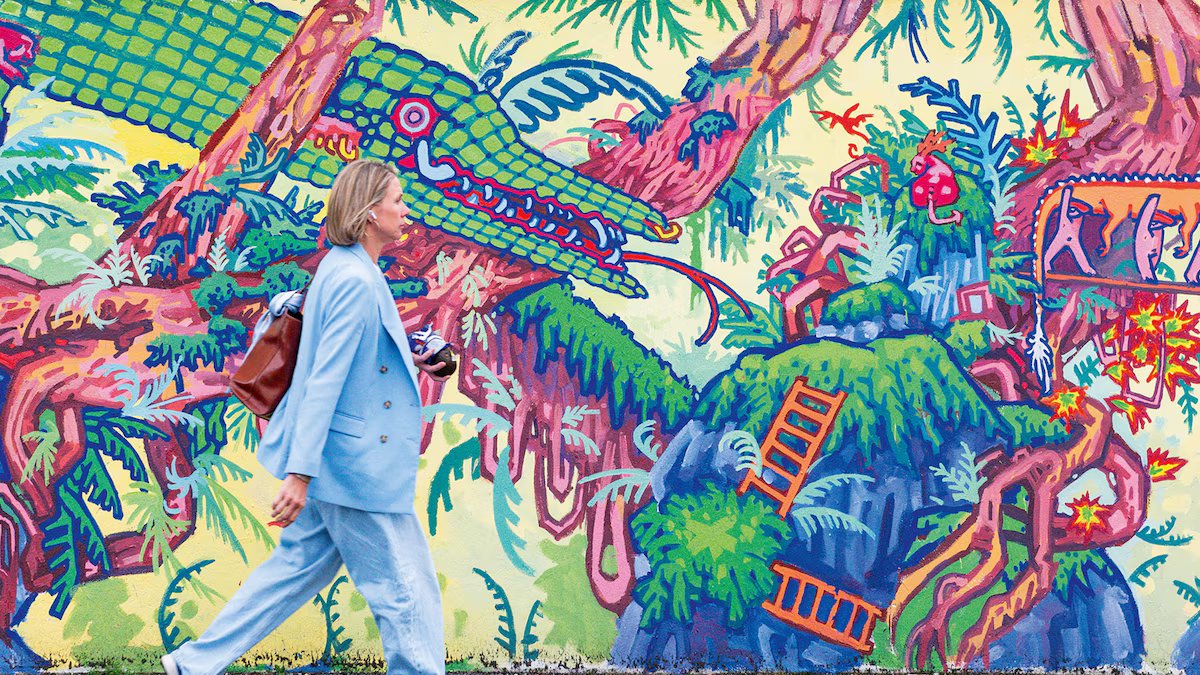
An hour later, I’m standing on a Grünerløkka street corner with James Finucane, founder of non-profit organisation Street Art Oslo. Above us is a huge, psychedelic mural, painted over an end-of-terrace building by self-taught artist Øivin Horvei. Its swirling outlines are filled with kaleidoscopic shapes, detailed with ornate patterns of dots and cryptic symbols and painted in every colour of the rainbow. This is art, alright — of a quality to rival anything hanging on the walls of Oslo’s more rarefied institutions.
“It’s photocatalytic paint,” says James. “When sunlight hits it, it activates enzymes that break down pollution.” It’s street art that doesn’t just beautify the neighbourhood; it cleans it up. With Street Art Oslo, James commissions artists such as Øivin and finds walls like this on which they can create their artworks. I’m curious about the bureaucratic process — surely, I ask, there’s a prohibitive amount of red tape involved? “We ask for forgiveness, not permission,” says James with a smile.
He leads me around Grünerløkka, showing me work that reflects the city’s multicultural artistic spirit, including a huge calligraphic shape resembling an ornamented ampersand, painted with shimmering metallic paint. It’s by Awat Serdashti, an artist of Kurdish descent.
“Ten years ago, people were confrontational towards street artists,” James says. “Now, they give them snacks while they work.”
Oslo’s relationship with graffiti goes back to the art form’s very beginnings. New York and Philadelphia are more associated with tagging, graffiti and its eventual development into other forms of street art, but Oslo can claim to be the true birthplace of the genre — chemical engineer Erik Rotheim invented the spray can here in 1926.
Vigeland Sculpture Park has over 200 sculptures.
Justin Foulkes
Independent art centre Kunstnernes Hus showcases works of contemporary art.
Justin Foulkes
The street art tour has shown me an unexpected part of Oslo — but perhaps I shouldn’t be so surprised. The city might be overwhelmingly safe and clean, but it’s far from stuffy. As my time here draws to a close, I climb the hill to the Vigeland Sculpture Park, in the west of the city, to watch the sun set. The park was the life’s work of sculptor Gustav Vigeland (1869-1943), and the 200 works here are strikingly different from the sombre statues of brooding statesmen usually found in European cities. These are ironic and funny — statues of glum couples sitting, as if post-argument, with their heads on their fists, staring in opposite directions; a sculpture of a mother on all fours being ridden by her demonic children, using a plait of her hair as a bit between her teeth. It suggests the playful creativity I’ve found to characterise modern Oslo has long been present in the city, a place where subversiveness has always simmered beneath the surface.
“People have always thought of Oslo as a little brother to Stockholm and Copenhagen,” Mike had said to me earlier, “but we’ve always been the best at art. Soon, the world is going to know about it, too.”
How to do it
Airlines including Norwegian, SAS and British Airways fly from UK airports to Oslo.
Retaining its 1930s art deco design, Sommerro hotel has a rooftop Japanese-inspired street food and sake bar, an elegant brasserie and a pintxos and wine bar. From 2,232 NOK (£175), B&B.
Trailfinders offers a three-night trip to Oslo from £549 per person, including accommodation and a fjord boat trip. Excludes flights.
Published in the May 2026 issue by National Geographic Traveller (UK).
To subscribe to National Geographic Traveller (UK) magazine click here. (Available in select countries only).
