


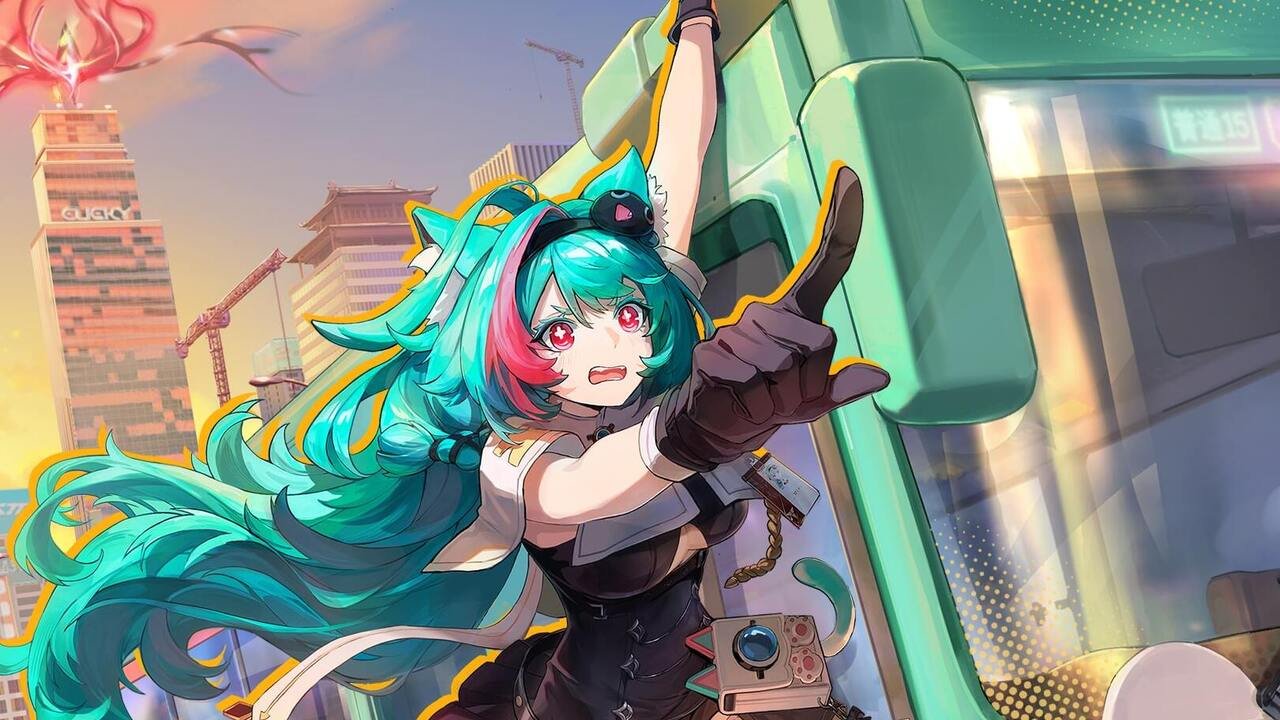
The irritatingly named Neverness to Everness – which I’ll refer to as just NTE for the purposes of my own sanity from this point onwards – has launched into a crowded genre on the PS5.
Ever since Genshin Impact exploded during the pandemic, there have been several console copycats, all adopting the same free-to-play format, with divisive roulette wheel character unlock systems and a brain-breaking array of currencies.
This effort, from Perfect World subsidiary Hotta Studio – the team behind the rough around the edges Tower of Fantasy – sits somewhere between Zenless Zone Zero and Wuthering Waves on the spectrum. It’s an urban open world game with GTA Online life sim elements.
I’m just going to come out and say it: this scratches an itch for me.
I’ve always enjoyed games where the sandbox blends exploration with simulation, and NTE has you managing coffee shops and moonlighting as a taxi driver while you simultaneously work for an undercover anomaly hunting agency named Eibon Antiquities.
There are times where it feels like every pixel of this outing is paying homage to something else; its influences run deep, from the way its menus are presented like Honkai: Star Rail to quests which feel like they’ve been pulled right out of Control.
But I think it’s just about successful at combining all of these elements to create an identity of its own. It’s genuinely fun finding references at every corner of the built-up city of Heathereau, from a stunning replica of real-life Akihabara through to a bar that closely resembles STARRY from the anime Bocchi the Rock.
If you’ve played any of these types of games before, you’ll know the presentation can often be dry and stilted – but NTE pulls from manga, anime, and webtoons to create a schizophrenic style that feels like it’s constantly fighting for your attention.
It feels like a product of the TikTok era, where something interesting needs to be happening on the screen every 30 seconds.
But while it can be hyperactive, I do appreciate the overall artistic ambition of the dev here. In a similar way to K-Pop Demon Hunters, there’ll be moments where the art style completely transforms to represent the personality of a particular character in that moment – it’s a far cry from the static visual novel-style sequences in other similar games.
I’m actually into the story so far as well, even though it has highs-and-lows. As an amnesiac with superpowers, the game’s blank slate protagonist isn’t exactly breaking new ground – but thus far it’s resisted the temptation to go all-in on nonsensical lore, and so its launch day quests are actually quite interesting.
One sees you searching for a missing kid who communicates through sign language, and whose love of botany has got him tangled up with some possessed plants – literally. Another sees you infiltrating a high-stakes auction in search of a mythical object which will presumably have long-standing implications on the plot.
These quests all play out like short episodes, and while there are bad ones – like an unbelievably irritating romance arc involving an otter with an old-fashioned television for a face – I think they’re pretty much all a step ahead of other games occupying the same genre.
Unfortunately, the combat can’t hit the same highs as, say, Zenless Zone Zero.
This is very much a product of the Genshin Impact era, where you build squads with complementary elemental properties and toggle between them to inflict status effects. Sadly, the animation work isn’t as fluid as in HoYoverse’s urban alternative, and it’s not something I personally look forward to engaging with.
Given the nature of the game, new characters could certainly improve this aspect of the experience, but it’s worth remembering you’ll need to interact with gacha to unlock these. Fortunately, NTE’s approach to this is refreshingly generous thus far.
Unlike in other similar games, there’s no 50/50 mechanic here, which means you’re guaranteed to unlock the promoted character you want within 90 pulls. In other titles like this, you’d only have a 50% chance, so this is a game-changer.
I really like how this is all presented, too: through a Mario Party-esque board game named Scarborough Fair, which sees you rolling dice to land on squares to unlock your rewards.
At launch, Hotta Studio is giving away multiple S-Rank characters, and you can even earn signature weapons by clearing boss fights for the first time. This feels necessary in an era where multiple games are all competing for the same audience, but it’s appreciated nonetheless.
Of course, it’s worth noting that the open world adventuring and traditional gacha gameplay is just one aspect of the experience; the GTA Online life sim elements occupy the other.
There’s so much to discover here that I’d blow my word count outlining it all, but effectively you can buy businesses and properties to manage while you’re out and about in Heathereau.
Any apartments you own can be customised with furniture and decorations you purchase, and you can invite characters over to hang out with you. The fanservice is strong here – many of the female units will switch to lingerie while you spend time with them – but the sheer amount of interactions is impressive.
More importantly, this feels like the foundation for something truly special. As a live service game, I’m excited to see how Hotta Studio iterates on what it’s already achieved here; I can imagine it adding more businesses, minigames, and pastimes in the future, and that genuinely fires synapses in my brain.
Furthermore, the presentation is bonkers, leveraging raytracing to create believable rain-slicked city streets that blend inspiration from real-life locations like Tokyo, Seoul, and San Francisco. Tons of buildings can be entered, from coffee shops to book stores and everything in between.
The sheer amount of art assets on the screen at any one time is utterly frightening, and while there have been some accusations of generative AI usage on social media, it’s still a world you’ll want to spend time in. Hopefully Hotta Studio addresses those concerns and swiftly replaces any offending assets if those allegations are true.
My only major complaint is that the game doesn’t particularly scale well to the DualSense, and the dev could do with putting some work into the menus so that they feel more consistent on the controller.
I’ve often found myself scratching my head as the game incoherently swaps between the analogue stick, d-pad, and shoulder buttons; there’s no real rhyme or reason to the control scheme in menus at all, and it needs a ton of refinement.
Similarly, the use of the PS5 pad’s unique features isn’t the best. I instantly turned off the adaptive triggers which feel horrible when you’re trying to drive a car, while I don’t think the haptic feedback is particularly well implemented either. I do like how the light bar reflects your currently selected character, however.
One other thing that’s irked me is how poor the pacing is when cycling through text. Sometimes you’ll be able to skip ahead once you’ve finished reading the subtitles; other times you’ll need to wait for the voice lines to play out in full. This is an irritating issue which only ever seems to affect gacha games, and it’s getting on my nerves.
But I think what’s important to underline here is that this isn’t the finished product by any stretch; games like NTE are designed to be played over many, many years – and while the launch experience is recommended, it’s built to evolve and improve.
That means all of the genre’s usual caveats apply here – you’re encouraged to complete daily quests, and there will be time-limited events once the title matures beyond its launch window – but if you’re looking for an urban open world to invest in, there’s no denying the inherent promise on display here.
