


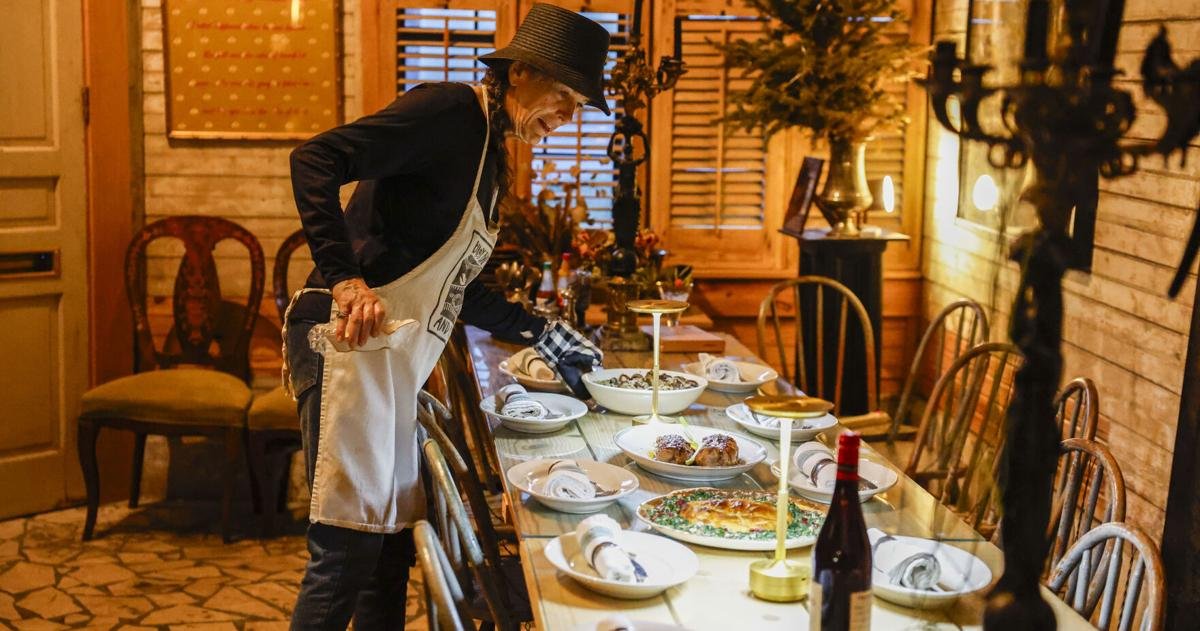
Three days before flying to Italy for the most important exhibition of her life, New Orleans artist Dawn DeDeaux was striding to and from her kitchen, forks in one hand, spoons in the other.
She paused beside her friend Susan Taylor, director of the New Orleans Museum of Art, for a moment to chat, cheerily, about the end of the world.
“A black hole in the sea! It will self-subsume,” DeDeaux said, setting the utensils on a 15-foot dining table that spans the living room of her Gentilly home, an old po-boy shop that she has remade — artwork by artwork, object by object — into an exhibition of its own kind.
“I know,” Taylor said, shaking her head as she read aloud from an article about the puzzling discovery of an undersea neutrino.
Then, a knock at the door.
“Hello! Hello!” DeDeaux exclaimed, throwing her arms into the air before wrapping them around a guest who had arrived to her dinner party. “Look who it is!”
For decades, the 73-year-old conceptual artist has been creating art that explores the universe’s most pressing questions with photography and video, sculpture and installation. Behind each work is an academic study that struck her, a nonfiction book that moved her, a philosophy that tweaked her previous beliefs.
Oftentimes, all three. “I can’t look at anything in a singular way,” she said. “It’s all relational.”
But despite their grand scale and heady inspiration, DeDeaux’s works are intimate, human. She builds a world — then invites you in.
Dawn DeDeaux greets Filippo Meozzi and Paolo Meozzi at the door during a dinner party at Camp Abundance in New Orleans, Wednesday, April 1, 2026. (Photo by Sophia Germer, The Times-Picayune)
“If you give her a conventional environment and let her follow her instincts, it will inevitably be transformed into something marvelous,” said New York-based curator Dan Cameron, who did just that for Prospect New Orleans, the contemporary art triennial, among other exhibitions.
But she’s not creating environments only for art exhibitions. Her home, a cluster of four buildings she’s dubbed Camp Abundance, “pushes the bounds of what art can be,” Cameron said. It feels both antique and futuristic, old-world and space-age. White columns, inscribed with the epic poem “Paradise Lost,” stand near the camp’s entrance. Clear acrylic ladders, offering a fragile escape from this world, lean against wood slats. Massive metal plates, embossed with soft images of swamps and trees, cover one wall.
In May, DeDeaux will remake her most important space, yet — the final room of the Arsenale at the Venice Biennale, where she will be among 111 artists featured in the prestigious central group show, titled “In Minor Keys.” Fellow New Orleanian Demond Melancon, a big chief in the Black Masking Indian tradition, will present his work there as well.
Being picked for the career-making Biennale, arguably the contemporary art world’s most important show, is an honor DeDeaux never anticipated.
It’s a chance for the world to discover what New Orleans knows and New York City ought to have learned by now, Cameron said. “It’s now time for Dawn to get the recognition she deserves.”
Camp Abundance, artist Dawn DeDeaux’s home base, “pushes the bounds of what art can be,” a curator said.
‘A front-row seat to the future’
For years, DeDeaux wondered if she’d made a mistake by remaining in New Orleans.
She’d grown up here, the eldest of six children. When two siblings died in the same year, her family ruptured and her empathy grew. DeDeaux moved into her grandmother’s house on Esplanade Avenue, a short walk from NOMA, where she witnessed White flight house by house, block by block.
A bohemian artist arrived, renting a room upstairs. She taught DeDeaux to paint, introduced her to literature and brought her to New York City galleries.
Taking courses at one college, then the next, DeDeaux met Robert Yarber, a painter and her “first great love.” When another sibling got sick, spurring her family’s second rupture, Yarber was so focused on his work and so unaccustomed to loss that he didn’t support her the way she needed, she said. She broke it off.
But Yarber, who went on to exhibit in the 1984 Venice Biennale, would reappear in her story, decades later.
DeDeaux began making more conceptual work — first about racial divides, then about the environment, always about justice.
Celebrated multimedia artist Dawn DeDeaux, whose work finds beauty in calamity, poses in her studio at Camp Abundance in New Orleans in March. (Photo by Sophia Germer, The Times-Picayune)
Pieces of those works now stand among her backyard ginger plants, lean against the fence, and hang from the walls of Camp Abundance, which she’s been restoring with the help of former neighbor and longtime collaborator Gary Craddock for more than a decade.
In the mid-1970s, she hooked up telephone booths to CB radio channels, encouraging conversation across New Orleans neighborhoods, races and divides. A silver phone booth, which she reimagined for her 2021 retrospective at NOMA, stands in her garden. In the 1990s, her stately photographs of young Black men were shown as part of a controversial show at the Whitney Museum — and subpoenaed by the FBI. (They fill boxes atop a closet in a cottage she offers up for artist residencies.)
“I think Dawn is fundamentally inclined to want to see the wrongs of the world righted, somehow,” Cameron said, tackling issues of “race, gender, class — topics you’re not supposed to talk about at dinner parties.”
She was already exploring themes of escape and extinction when Hurricane Katrina hit in 2005.
She got out “in a van loaded with her computers, three neighbors who were afraid to go to the Superdome, an out-of-towner who had been staying with her and working on her website, six finches, an aged dog and a cat,” as a 2014 New York Times article put it.
Returning a month later, she found two roofs caved in, her studio collapsed and a third of her work destroyed. Then, the following year, when she was out of town, her studio burned down.
And yet. She believes the hurricane and its aftermath flipped New Orleans’ vantage point, freeing it from its own nostalgia and romanticized history. “We went from looking to our past, which was thought to be grander than our present, to looking at the future,” DeDeaux said. “I think we have now — and I got it right away — a front-row seat to the future.”
That’s partly because New Orleans is “built on baby mud.” Salt water is eating away at the marsh grass that holds that mud together. Undercurrents are pulling at it. “So we are the youngest land mass and the first to go.” Thinking in geological time, as DeDeaux does, this lacy bit of land mass is changing quickly, right outside her door.
Artist Dawn DeDeaux cuts into one of the many dishes she cooked for a gathering at Camp Abundance in early April.
“I give you all this,” she said, “because I think all of a sudden, I felt very alive and correct and energized to be here.”
At a time when the apocalypse seems near and the future feel out of the common person’s hands, “there is power in speculation,” said Eva Díaz, a New York-based art critic and historian whose book, “After Spaceship Earth: Art, Techno-utopia, and Other Science Fictions,” focuses partly on DeDeaux’s work. It’s a coincidence that DeDeaux landed at the corner of Abundance Street, she said, but the name Camp Abundance leans into the optimism of DeDeaux’s work, the “possibility of plentitude.”
Though New York City would have brought her closer to the art market, DeDeaux couldn’t have connected a whole half block of buildings there, couldn’t have played with scale in the same way, Díaz said.
“The connections, the community that she is always creating … give her a certain power,” Díaz said. “The power and freedom to be a late-career artist, standing on your own two feet.”
‘A field of diamonds’
Outside a warehouse on the West Bank, DeDeaux grabbed a hammer.
On a folding table in front of her was a panel of glass as tall as she is. Around her was a team from Denali Art Solutions, makers who help her fabricate her artworks. Inside the warehouse were a dozen wooden crates, neatly labeled, that in just a few days would be shipped to Venice.
“We’re not going to break it up too much,” she said, wearing sunglasses rather than safety goggles, adjusting the black fur hat atop her head. “It’ll break on its own, crossing the Atlantic.”
Before anyone had readied a camera to capture the moment, DeDeaux pulled back and hit the edge of glass with one long, confident stroke. With a crunch, it shattered, glittering in the sun.
She looked up with wide eyes and an impish grin. Then she let out a long, joyful laugh.
“Dawn!” someone said. “I wasn’t ready!”
Artist Dawn DeDeaux breaks glass for a new, top-secret exhibition at Denali Art Solutions in Harvey, La. Monday February 23, 2026. (Staff photo by David Grunfeld, The Times-Picayune | NOLA.com)
At this point in her career, DeDeaux could have her works manufactured by other people, said Alexander Buschmann, Denali’s wood shop lead. But DeDeaux shattered pane after pane, kicking up her heel when she got one on the first smack.
“I can’t believe you don’t have a stunt double,” Buschmann told DeDeaux, admiringly, as he helped coax the shards into a bucket.
Spreading the glass into the light box, a step she’ll do in Venice, requires a bit of Louisiana-specific equipment, already packed into a crate. She throws it, she said, demonstrating her smooth stroke, with a gumbo spoon.
DeDeaux has created a version of this piece, “Gulf to Galaxy,” several times before, first after Hurricane Katrina, later for her retrospective. It was inspired by a post-Katrina journey: In the weeks after the storm, DeDeaux walked for hours to find out if her mother’s Mississippi home was still standing. It wasn’t.
As she walked back, crying, she came across a smashed shopping center. Standing nearly knee-high in a heap of shattered glass, she looked up, noticing the sun shining and the pelicans flying.
“And when I look back down … the sun is hitting this glass, and I am in a field of diamonds,” she said. Tears still in her eyes, she said out loud: “Oh my God, this is the most beautiful thing I’ve ever seen.”
So she shaped shattered glass into glowing pinwheels, evoking hurricanes, galaxies or both. Devastation and beauty, swirled together.
Much of her work after Katrina contained that swirl. Burned, blackened timber fragments that stand like noble statues. Bowls of dirt, beautifully displayed. Magisterial planks, embedded with images of water, reflect water levels in neighborhoods throughout the city, after the levies breached.
Artist Dawn DeDeaux reflects into one of her art pieces at Camp Abundance in New Orleans, Thursday, March 26, 2026. (Photo by Sophia Germer, The Times-Picayune)
DeDeaux, too, contains those contrasts.
She dresses in head-to-toe black, most days, but often wears heels so chunky they make her laugh: “They’re ridiculous!” She speaks seriously about climate change and calamity, then refers to Earth as “this wonderful spinning graveyard.” She weighs her role as an artist, now and in the past, with great thoughtfulness, then claims, with just as much seriousness, to be a better chef than an artist.
“The table is where everything happens,” she said. “That’s what I do best.”
Dawn DeDeaux’s studio, photographed in March, is just one part of Camp Abundance, the compound she’s created in Gentilly.
‘Forever the artist’
DeDeaux had been up since 4 a.m., as she had most days since last summer. Venice time.
Since even before she was invited to the Biennale, she’d been ruminating on a massive installation. The Biennale has strict rules against revealing the show’s content, but it will be among the grandest works she’s ever made, incorporating sculpture and sketches, found objects and a new film piece.
At last, just days before her flight to Italy, a breakthrough: She wrote the film’s script.
“It’s just been stewing, stewing,” DeDeaux told Taylor, before the dinner party’s guests arrived. “I mean, I’ve been thinking about this for a year and a half, this kind of film component, and it just came out. Boom, boom, boom.”
The dinner was meant to welcome Aristides Lonothetis, founder of ARCAthens, who was joining two artists in residency at Camp Abundance. Wearing an apron, DeDeaux delivered drink after drink, dish after dish: Sweet figs cushioned in brie, mushroom risotto pungent with truffle, a pair of pork tenderloins.
The Biennale is, in a way, a result of an invitation into her table.
Years before she was named curator of the Biennale, the late Koyo Kouoh, then based in Cape Town, had been traveling through the American South on a kind of Civil Rights tour. Over several nights sitting in DeDeaux’s backyard, beneath the stars and a disco ball from parties past, she and DeDeaux discussed art, life and the world. Industrialized agriculture and the Anthropocene and the privatization of space.
DeDeaux is “forever the artist,” but at that moment, she had no grand ambitions. “We were just talking as two people who love the arts.”
Kouoh went on to become Venice’s curator, dying just days before the exhibition’s theme was announced. Reading Kouoh’s concept for the show, DeDeaux immediately understood why she had included her. She had quoted James Baldwin: “There is reason, after all, that some people wish to colonize the moon, and others dance before it as an ancient friend.”
After setting a dozen dishes out, DeDeaux finally sat down at the table’s end for what she’d dubbed, with a laugh, “the last supper.”
Artist Dawn DeDeaux sets food on the table during her dinner party in New Orleans. “The table is where everything happens,” she said.
“Eat! Eat!” she demanded.
They ate and gave toasts. They demanded stories — including one about the time, in 1976, that DeDeaux won the demolition derby in the Superdome, earning the moniker “Deadly Dawn.” Or about how she reconnected with Yarber at a mutual friend’s memorial service, marrying him last summer in her backyard, before a massive steel ring, part of her massive MotherShip series, in matching white suits.
But DeDeaux didn’t hold court. Over the course of the meal, DeDeaux found ways, big and small, to delight in her guests’ talents, noting their expertise, complimenting their taste and connecting their shared histories.
Over cognac, they debated Greek history, including a study in “Nature” about ancient DNA, and, several times, DeDeaux asked big questions, admitting her lack of knowledge as often as she revealed her depth of understanding.
“This is what I love,” she said, mischievously, “when it starts to stew.”
At one point, as Taylor spoke about Roman art, DeDeaux’s eyes widened.
“Elaborate!” she said, leaning forward. “Elaborate!”
Her guests leaned in, too.
Days before leaving for Venice, Dawn DeDeaux raises a glass with dinner guests at her New Orleans home.
