


Books in Chapel Hill and Carrboro public elementary schools comply with state law, and a vetting process for the appropriateness of titles predates a state law that required one, local school district leaders are expected to tell state lawmakers on Thursday.
“If parents identify a book that they do not want their child to borrow, we have a process that empowers parents to make those decisions,” Rodney Trice, superintendent of Chapel Hill-Carrboro City Schools told lawmakers in written testimony ahead of a legislative oversight committee hearing.
Republican North Carolina lawmakers are expected to grill Trice and Al McArthur, the district’s director of digital learning and library services, over books that the lawmakers want to ban from elementary school libraries. The hearing comes several months after a similar meeting, during which Republican members criticized library materials and accused officials of defying lawmakers.
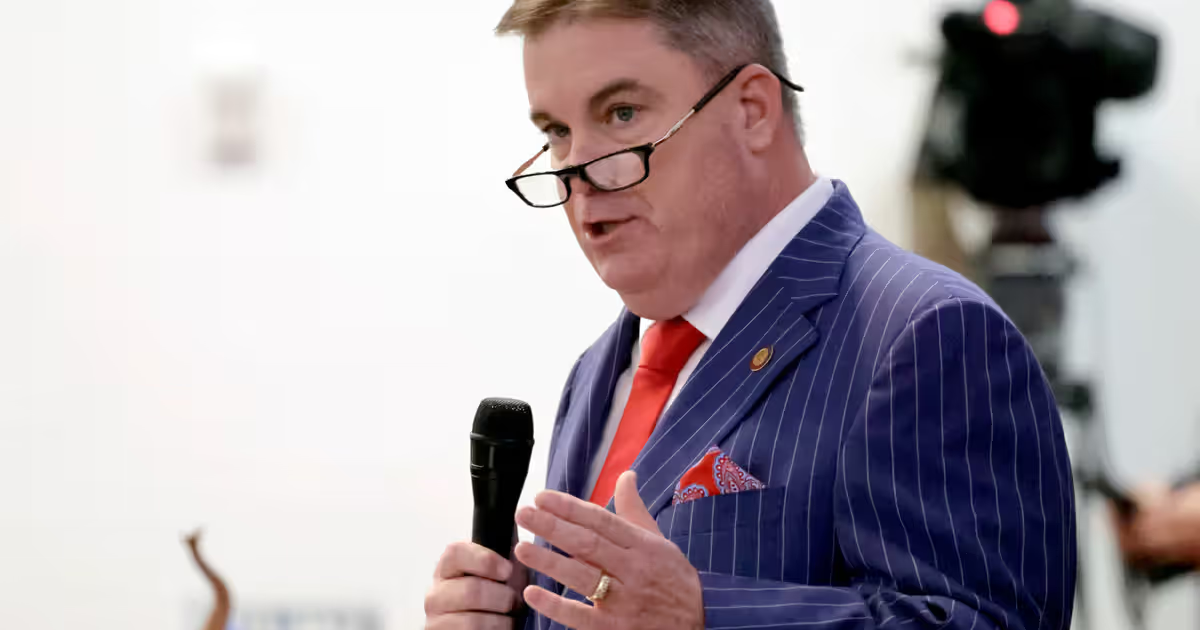
State Rep. Brenden Jones, R-Columbus, a co-chair of the committee, alleges that some of the books in the district’s elementary schools are in conflict with a 2023 law that limits instruction on gender identity, sexual orientation and sexual activity in kindergarten through fourth grade. Jones is expected to file legislation that seeks to expand the Parents’ Bill of Rights by banning books with themes of gender identity and sexuality from elementary school libraries statewide.
Jones told WRAL News his staff identified dozens of titles in Chapel Hill-Carrboro elementary school libraries that include themes of sexuality, gender identity or sexual activity. WRAL News has reviewed library database records showing some of those titles are listed as available and have been checked out recently.
In written testimony, school leaders say none of those books violate the law. Just because a book is on a library shelf doesn’t mean it violates the law, which focuses only on instruction, Trice said in his testimony. The books identified by the committee aren’t part of the district’s elementary school curriculum, he wrote, nor are they used to provide instruction on gender identity, sexual activity or sexuality to students.
“The vast majority of books in our school libraries are not part of the district’s curriculum or used for instruction,” Trice wrote. “Just as our district does not provide instruction on gender identity, sexual activity, or sexuality to K-4 students, we also do not provide instruction on how to play video games, the biographies of professional athletes, or stories about ghosts — subjects of numerous popular titles in our school libraries.”
Trice says the district has provided training and written guidance to administrators and teachers regarding how to implement the provision of the law that prohibits instruction on gender identity, sexual activity or sexuality in kindergarten through the fourth grade. He said he recently recirculated that written guidance. “Instruction in gender identity, sexual activity, and sexuality is not part of our district’s K-4 curriculum (nor has it ever been to my knowledge),” Trice wrote.
In 2025, lawmakers enacted a law that requires school library catalogs to be available to parents online. Trice says his district had been in compliance with that law long before it was enacted. “Around the state, many schools scrambled to implement this directive,” he said in his written testimony, “but no change was required in CHCCS because our school libraries had already been online and available to parents for years.”
He added: “Parents in the district have a right to identify library books that may not be borrowed by their child. Our digital book program also provides parental controls that allow parents to limit their child’s access to certain books.
“If a parent has a broader concern about a title in the school library, the district encourages parents to discuss their concern with the school librarian. If this does not resolve the concern, district procedure allows parents to file a formal challenge requesting that the title be removed from the library collection.”
McArthur, in his written testimony, said that no state funding is used to purchase library books in the district, noting that library budgets come from local funds and occasionally from supplemental grants. “Our elementary libraries each contain an average of 10,000 physical books,” McArthur said. “The majority of those titles are not curriculum-related.”
Trice and McArthur added that it’s important to have a catalog with a wide variety to spark students’ desire to learn. “The more children read, the better their long-term academic performance,” Trice said. “This is one reason why it is so critical for children to have access to books for independent reading that appeal to their personal interests and experiences. It is also deeply important for children to see themselves represented in books and media.”
Jones disagrees. He thinks it’s inappropriate for young children to be exposed to literature about sexual orientation, he told WRAL News this month. His bill hopes to put restrictions on titles in school libraries.
“We’re going to put some real teeth in this bill this coming session, so there will be no cloudy areas and no gray areas,” Jones told WRAL News this month.
He said the proposal could include “financial ramifications” for school districts that do not comply. Most North Carolina public school funding comes from the state.
In December, Jones summoned district leaders to a legislative hearing where he criticized library materials and, at one point, tossed a book titled “Santa’s Husband” over his shoulder while accusing officials of defying lawmakers.
During that December hearing, school board Chairman George Griffin said the Chapel Hill-Carrboro City Schools district was complying with state law.
Efforts to restrict school library materials have faced challenges in the past. House lawmakers passed a bill last year that sought to create review boards charged with approving books and other media for school libraries. The bill stalled in the Senate. Democratic opponents of the bill argued that the bill amounted to a book ban and could lead to expensive legal challenges across the state.
When asked to comment on Jones’s idea earlier this month, a spokesperson for the American Civil Liberties Union of North Carolina referred WRAL News to a page on the organization’s website about book bans. “Under the First Amendment, public officials may not bar access to ideas simply because they don’t like those ideas for political or partisan reasons,” the group says.
States that have passed similar laws have faced legal challenges from publishers, librarians and citizens. In Iowa, a federal appellate court ruled the state can enforce a law that restricts teachers from talking about LGBTQ topics with students in kindergarten through the sixth grade and bans some books in libraries and classrooms.
Advocates for LGBTQ inclusion say the books at issue can help students better understand a diverse society, while critics argue school materials should be limited to age-appropriate content.
Jones’s proposal has support from House Speaker Destin Hall, a Hall spokesperson told WRAL News this month. And while Jones said he expects pushback from others, he plans to move forward. “If we have to go through every one of them,” Jones said, “that’s what we’ll do.”
