


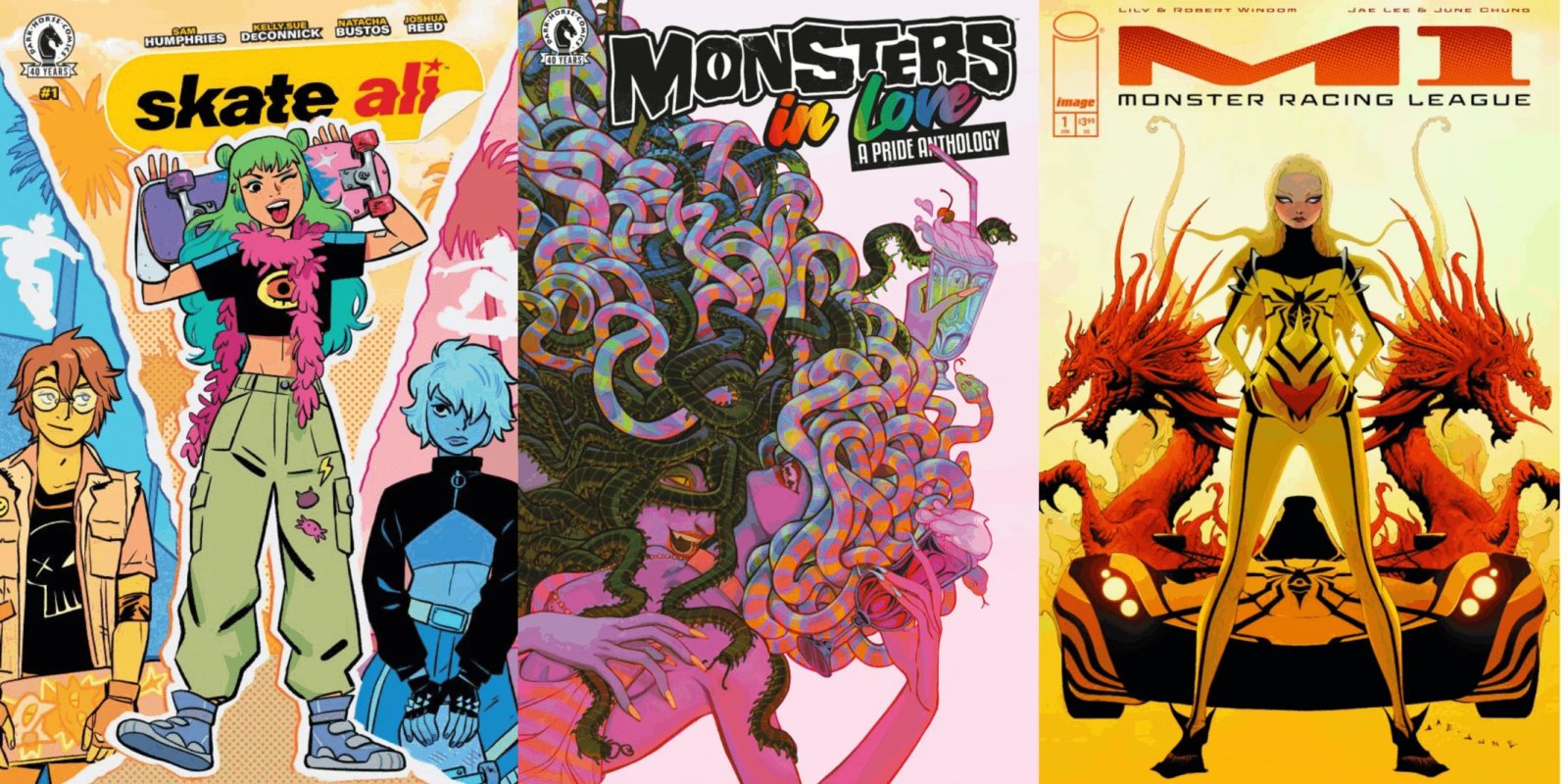
In this week’s Wednesday Comics column, M1: Monster Racing League speeds out of the gate, Bad Thoughts come into our heads, Monsters Are In Love, and much more! Plus, The Prog Report and FOC Watch!
M1: Monster Racing League #1
Writers: Lily and Robert Windom
Artist: Jae Lee
Colorist: June Chung
Letterer: Joe Sabino
Publisher: Image Comics
Review by Jordan Jennings
M1: Monster Racing League #1 is the stylish debut issue of the latest ongoing series from Image Comics. The series is billed as “Fast and Furious” meets “K-Pop Demon Hunters” and on paper that sounds fairly exciting. However, if this issue is any indication, this comic is all style no substance. I do not want to be harsh on the book, on the contrary, I wish for it to do really well because I really like Jae Lee’s art work and sure enough it’s an issue of Lee’s art. There just isn’t much else there. The plot is slow, the characters are thin, and the world is sparse.
The writing by Lily and Robert Windom isn’t bad. The dialog is brisk and attempt to propel the story forward. However, the pacing is glacial. It takes nearly the whole issue to get to the racing and we have no clue why the comic is called monster racing league. The only monster here is the dated dialog where the male characters call each other a girl as an insult. We don’t get much in terms of characterization beyond we know Dev is from the US and forces to live in Tokyo for some reason. It’s definitely giving Tokyo Drift vibes, but there isn’t much beyond the setting to be honest. There is a dash of world building regarding the underground stock car racing but not much else makes this feel like Tokyo.
The art by Jae Lee and June Chung is quiet pretty but really undercut the comic in its style. Jae Lee’s signature character work is on display and it looks great. The character designs as snappy and unique. The problem comes from the lack of backgrounds. Look, I am not one to harp about backgrounds in comics. This issue is proof why they are necessary as there’s no real weight to the character. There’s no sense of environment. Worst of all, there’s no sense of speed. Making racing look great in comics is a tough task. The static medium of comics itself makes it challenging to convey the thunder of the engines or the lightning fast speeds around the track. This comic fails at even the simplest attempts. There is no sense of motion and dignity background as we don’t have the critical frame of reference to get a feel for how fast the cars are going. It leaves the reader feeling empty.
That’s really the problem with M1: Monster Racing League #1. It is all sleek and stylish, but it’s just a race car without a motor. It honestly feels like a graphic novel pitch that’s been chopped up into an ongoing comic that didn’t really adjust for single issue pacing. The art is pretty but underserved the book and makes its flaws even more apparent. I’d sit this race out.
Monsters In Love: A Pride Anthology #1
Creators: Tate Brombal, Isaac Goodhart, Miquel Muerto, James Tynion IV, Noah Dao, Lee Ostertag, Kenny Wroten, Jadzia Axelrod, Bailie Rosenlund, Vita Ayala, Claudia Aguirre, Josh Trujillo, Ed Luce, Lilah Sturges, Vash Taylor, Jacoby Salcedo, Zoe Tunnell, Tench, and Sina Grace
Letterer: Aditya Bidikar
Publisher: Dark Horse Comics
Review by Khalid Johnson
Monsters in Love: A Pride Anthology is yet another example of why I adore anthologies. The things teams can do with self-contained short stories! This anthology uses a meta throughline in the intro and outro of Christopher Chaos discovering a love for comics that sets the scene and allows each team to do their thing.
Each story invites a new queer look at monsters and their love stories. At a time where the powers that be are intent on forcing queerness out of public life, this work and these stories are a triumphant flag staked in the ground.
This anthology is gorgeous from cover to cover; spanning moody stories of vampires, wish granting demons, summoning circles, spellbooks— from the whimsical to the tragic. Each team brings something different here from tone to subject matter, and I was delighted to see familiar names throughout and thrilled to see art from those I wasn’t familiar with.
The stories all feel triumphant, some opting for quieter introspection where others end with a bang. There are dates and budding romances, sex appeal and discussions around performance. As a complement to this, there’s gender euphoria and larger discussions of self-discovery and exploration.
The agency displayed throughout these characters and stories makes each one feel that much more real while the art throughout elevates them, making for a complete anthology that I couldn’t recommend more.
M.A.S.K. #1
Writer: Dan Watters
Artist: Pye Parr
Colorist: Pierluigi Casolino
Letterer: Rus Wooton
Publisher: Image Comics – Skybound
Review by Tim Rooney
These licensed comics of old cartoon franchises popping up all over the place have a steep task in front of them. They need to tell a story that is true to the heart of what fans clung to as kids, while, more importantly, selling the concept to readers with no familiarity with the property.
I fall into the latter camp with M.A.S.K. Mobile Armored Strike Kommand is an 80s G.I. Joe copycat cartoon and line of toys line full of gimmicky vehicles, and this new series places the franchise in Skybound’s shared Energon Universe with Transformers and G.I. Joe. The script by Dan Watters has to do a lot of set up the premise, its connection to the shared universe, and also how it is distinct from the government sanctioned G.I. Joe. Watters is a talented writer and he manages to convey the conflict and characters amidst the incredibly heavy exposition. that hints at personal relationships, bigger stories, and an X-Files-like conspiracy.
Imperative to making it all digestible is artist Pye Parr. These characters aren’t just posing figures– they act and emote with big expressive eyes and dynamic body language. Watters peppers in just enough twists and surprise reveals that Parr paces out perfectly with page turns and panel composition. The vehicles look great, too; the issue opens up with a thrilling car chase through the desert. That’s a tall order in a static medium. But Parr has the chops to make a series that is bound to be full of car chases look exciting.
Rus Wooton’s letters are perfectly in sync with the art. Pierluigi Casolino gives the story a vibrant, throwback, mod-style flair hearkening back to the old espionage thrillers. M.A.S.K. is by no means the high water mark of Watters’ terrific career but it’s a solid debut issue for a big scifi spectacle, that has made me curious to read more about its conspiracies and nesting-doll plots, even despite my trepidation about yet another nostalgia franchise revival.
Skate Ali #1
Writers: Sam Humphries, Kelly Sue DeConnick
Artist: Natacha Bustos
Letters: Josh Reed
Publisher: Dark Horse Comics
Review by Gianni Palumbo
I’ve never been a skater or part of skateboarding culture but, oddly enough, I like a lot of skateboarding related media. Growing up I religiously played Skate 3 and the Tony Hawk Pro Skater series but never actually learned how to skate. That doesn’t matter to me though. Call me a poser, sure, but the aesthetic is so sick. That’s probably why I enjoyed the first issue of Skate Ali so much. The vibes are off the charts!
Co-written by Sam Humphries and Kelly Sue Deconnick with art by Natacha Bustos, Skate Ali follows Ali, an ambitious loner skater living in a near future L.A. where skateboarding is outlawed, whose world is turned upside down when she comes face to face with the underground skater crew, the LA Skull Clan.
The most interesting narrative point introduced is the relationship between Ali and her father. Although very briefly touched on, he seems to be either negligent or in a more vegetative state with him not even acknowledging Ali. It’s interesting and I’m definitely itching to see it further developed.
For me, the art is the huge selling point. Natacha Bustos has such a kinetic and fun style that pulls from a lot of Eastern influences. Her colors are super vibrant, giving it a sort of graffiti or pop art vibe that perfectly aligns with the skater aesthetic. There’s some really fun page layouts here that take advantage of the medium to show the rush and chaos of skateboarding. This is my first time seeing Bustos art and I’m already itching to discover more of her work!
This is a fun first issue and I’m excited to explore more of this world.
Bad Thoughts #1
Writer: Ande Parks
Artist: Dave Wachter
Colors: Brad Simpson
Letters: AndWorld Design
Publisher: Ignition Press
Review by Clyde Hall
Jack Coates’ world isn’t so different from ours. There are fringe elements who constitute dangers for ordinary people trying to live a workaday life of family, friends, and if not fulfilling careers, at least work which pays the bills and allows for occasional getaways. To maintain citizen security and safety, people like Jack enter fields of law enforcement or private security. Crisis management teams train rigorously for hostage situations and special tactical response against criminal and terrorist threats.
One difference in our world from Jack’s, however, is tactical squad composition. Our world has team leaders, assistant leaders, assaulters, breachers, snipers/observers, tech specialists, and crisis negotiators. In our world, Jack might be a negotiator. The squad member who communicates with the opposing person or force and works with both sides to effect a peaceful resolution if possible. One their team, the suspects, and any innocent parties involved can walk away from.
Good negotiators can spin lots of plates as a crisis unfolds, being everything from the voice of reason that convinces a suicidal barricaded subject to seek help, to an intel gatherer who makes a successful assault possible by what they learn. Ideally one where everyone survives but at the worst, where only the violent offenders don’t.
But in the first issue of Bad Thoughts, writer Ande Parks creates a world where people like Jack have a different team position, one with elements in common with a negotiator role. Jack can read the thoughts of other people. Call him psychic, mentalist, or empath, given a brief amount of time and opportunity, he can ‘read’ the bad guys behind their barricades and, depending on how deep a dive he takes, know not only the current situation as they see it…but their pasts as well. When his team, one employed by private contractor Bishop Security, deploys, Jack must get close enough for a mentalist analysis of what’s happening on the other side of the confrontation, the mindset of the opposing force, and advise on best ways for the rest of the team to proceed.
That difference makes for quicker and more exciting resolutions as story devices go. Jack can ascertain and understand a lot more about the enemy simply by vicinity. Any crisis negotiator who’s spent hours establishing contact and working through a stressful situation would be envious. Except that from this opening chapter, it seems the easier and faster way may also mean a deadlier one. Compound it with similar bad guys fatalities in the setup of the previous Bad Thoughts #0: Cold Open and it sets a trend.
Hard to shed a tear, though, because these bad elements were…well, very, very bad. What’s very good, though, is how Parks stays grounded in ways that real people who become involved in crisis teams think and how team members interact and relate to one another. Like any form of emergency services, paramilitary workers can become as close as regular combat veterans. Especially considering that combat vets may face higher risks but for shorter stints on average than law enforcement workers facing fewer risks, but over 20 or 30 year careers.
Here we see Jack’s close relationship with team leader Bill, a man Coates considers almost a foster father. We also learn about those in other positions and Jack’s trust in group sniper Nessa, his less sterling assessment of tactical support leader Finn. There’s relatable, realistic tension in the way Parks outlines the situation of being in a dangerous profession citizens may not understand, opposing very serious threats to citizen safety, and feeling like the only ones who get it, who you can really trust, are your teammates. Some more than others.
By the same token, Jack’s not considered a front line fighter, more of a civvie support member. In other words, for some more boots-on-the-ground members of his team, he’s ‘not really one of us’. In a career where it’s difficult to relate to those not in your line of work, it’s doubly difficult when you also don’t exactly fit into that chosen profession, either.
Parks also delves into the difficulty separating the hypervigilance of being ‘a cop’ and leaving the job with the body armor to become a loving spouse off duty. In Jack’s world, electronic earbuds called blockers help people with his mindreading abilities turn down the volume of human thoughts zipping around him. In a restaurant scene with his partner, Sara, Jack foregoes using the blockers. He doesn’t seem quite able to relax and let down his guard. He needs to know if others around them pose threats. Which leads to him finding out too much regarding another patron. Again, it’s solid grounding with real life resonance regarding people who don’t say they “work as cops or security”, but that they are those professions.
Also keeping the story grounded is Dave Wachter’s art. Once again, most of the team technology, weapons, and tools are familiar, recognizable, and the art never gets fanciful in ways that forego realism. Even the blockers appear similar to normal earbuds or hearing aids. Wachter has a rare gift for rendering people and machinery with a similar level of exacting detail, and that makes him ideal for this kind of story.
Brad Simpson on the color art also earns recognition here. For scenes showing Jack’s readings of targets, events he remote views from the memories or POV of others, the coloring changes. It’s subtle. In fact, I didn’t even notice it at first. Yet, I knew precisely when the panel showed what Jack was reading from someone else, and when it depicted what was actually happening around him. Nicely done.
If there’s any flaw regarding how the creative team’s made their world mostly like ours, just with psychic individuals, it may be in how casually the world takes Jack’s gift. Security companies handle all manner of sensitive information, information clients and customers don’t want getting out. Hiring Jack, in certain situations and around certain people, would include implementing a strict protocol regarding when blockers are required, checking their functionality, and ensuring employee compliance.
It’s true we don’t yet know everything regarding how new these psychic abilities are or how they’ve come about, but a story point hinges on how they are controlled and monitored. Future issues will likely flesh these matters out in greater detail, and they should. Unless mind readers like Jack are rare and far between, the way his world works would become divergent from ours. Probably significantly. The trick will be to keep this world as grounded as it is yet explore and explain these psychic elements and the differences they create.
Once again, reading the introduction tale in Bad Thoughts #0: Cold Open helps with setting up Jack’s background and the worldbuilding leading into Bad Thoughts #1. Ignition’s making their cold open previews my favorite new way of launching a title. And if you like a great action story with sci-fi trimming to keep things interesting, you’ll enjoy Bad Thoughts.
FOC Watch
This title is currently available for pre-order at your local comic shop!
Exquisite Corpses: Rascal Randy #1
Writer: Tyler Boss
Artist: Dylan Burnett
Colorist: Jordie Bellaire
Letterer: Becca Carey
Publisher: Image Comics – Tiny Onion
Due Out: July 8, 2026
Review by Zack Quaintance
If you enjoyed the first season of Exquisite Corpses as much as I did (especially the finale), you’re likely wondering how long you’ll have to wait for more. Well, the answer is until July, which is when the spinoff series — Exquisite Corpses: Rascal Randy — launches.
The book is an origin story for one of the series most memorable killers, second in my opinion to only the Fox Mask Killer. Although, Rascal Randy in the main series proper gets arguably less time to shine, which I think is one of the reasons the visually-striking character lends itself well to being EC’s first spinoff. And the new book comes to us from a fantast creative team, with writing from Tyler Boss, art from Dylan Burnett, colors from Jordie Bellaire, and letters from Becca Carey.
If you’re familiar with my reviews, you know I regard Bellaire and Carey in particular as the best in their respective fields within comics. I’ve had less chance to write about Burnett, but I think he’s a fantastic artist, kinetic with his storytelling and unafraid to go bold with his aesthetic choices. He’s well-suited for the characters and vibes of this book, too, which are tasked with sort of appealing to an oddball nostalgia for a franchise and character (those both being Rascal Randy) that never existed.
And, of course, this is Exquisite Corpses so he also has to serve up gnarly violence well. The book does it all, and the result is a really intriguing part one to this character origin.
Finally, I won’t spoil the Exquisite Corpses finale here since it’s not out in trade, but there’s also an in-story reason this character makes a great choice for its own mini, and that gives this first issue a nice sense of propulsion as well as a great reason to read it all in full.
The Prog Report
- 2000AD #2484: I have been effusive in this space over the years (hard to believe I’ve been doing this for years now!) of Silver, an alternate universe story in which humans try to deploy vampires against aliens who conquered Earth years ago. This strip is from writer Mike Carroll, artist Joe Currie, and letterer Simon Bowland, and one thing I really enjoy about it, is that it would be somewhat easy to play it in predictable ways, serving up story arcs in which major pitched battles take place between vampires and aliens, wherein the protagonists are sort of classic action movie type heroes. But this story often feels more interested in exploring the sloppy interpersonal relationships of its vampire queen, Baroness DeSilva. That’s certainly where this arc is focused, giving the Baroness a new human friend and a sibling to play off of. This week we get a classic brother-sister fist fight out of it, and it’s great, because like everything else in Silver, the artwork remains fantastic and surprising. This week’s cover (above) is by Joe Currie. As always, you can pick up a digital copy of The Prog here. And it is also now available weekly in US comic shops! —Zack Quaintance
Column edited by Zack Quaintance.
Read past entries in the weekly Wednesday Comics reviews series or check-out our other reviews here!
