


A Hosting: Interviews with Irish Writers 1991-2026
Author: Martin Doyle
ISBN-13: 9781843519751
Publisher: The Lilliput Press
Guideline Price: €21.95
Toni Morrison spoke for many writers in expressing her dislike for interviews: “An interview is me trying to get to the end of it,” the American novelist once commented. “But a conversation, well now, that’s something. Rare and getting more so… some step forward is taken; some moment or phrase flares like a lightning bug.”
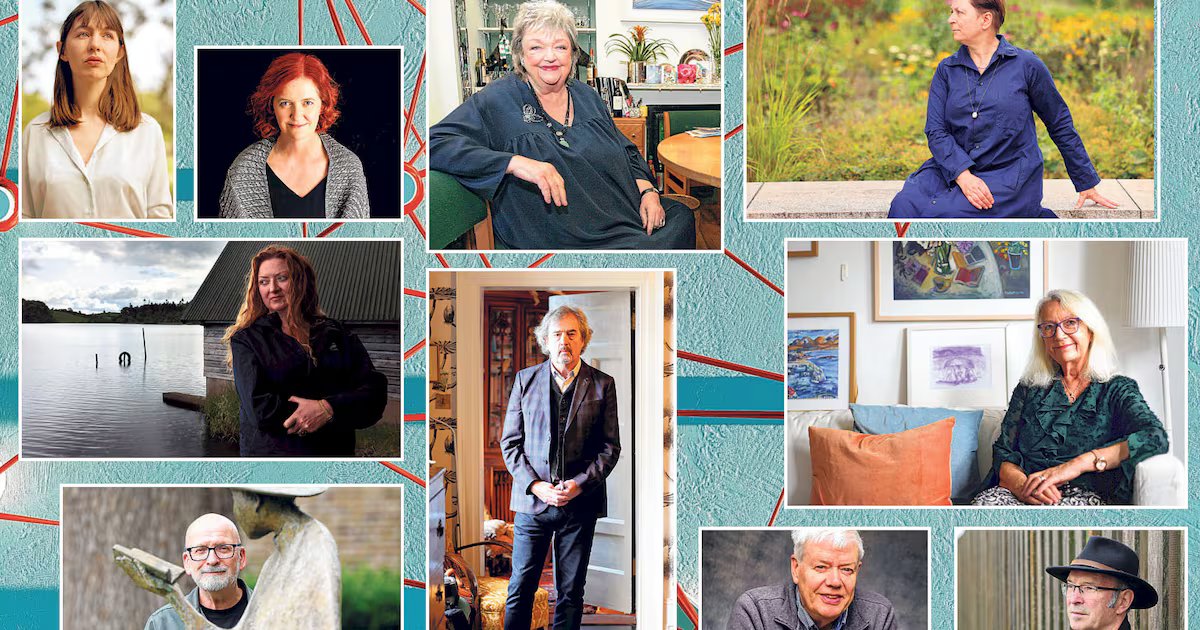
This selection from the journalism of Martin Doyle provides 60 interviews with Irish writers over four decades, from 1991 to 2026, and offers many fascinating conversations. They date from his work as a journalist in London for 15 years, many of them at The Irish Post, to his work with The Irish Times, most recently in his role as books editor. (He did not commission or edit this review.)
Most of the interviewees are writers of fiction, along with some nonfiction authors (ranging from Patricia Craig to Diarmaid Ferriter), a handful of playwrights (Martin McDonagh and Frank McGuinness) and one poet (Paul Durcan).
Moments and phrases that flare are very often to do with the practice of writing. This is from Bernard MacLaverty: “You think of a sentence and write it down, and it might please you; then you write another one beside it. It builds up like a wall. You make a house of it; then you go into the house and look out the window.”
Or Danielle McLaughlin on redrafting: “The drafting builds the fabric of a piece. The great thing about human exchanges in fiction is that we can keep revisiting them until the underlying meaning reveals itself to us, the motivations and misunderstandings or connections that lie behind the characters’ interactions. So much of real life could be improved if we were allowed redraft it.”
And Claire Keegan on rereading: “I don’t think you’ve read anything properly, understood it, until you’ve read it twice, and closely. I think the tail of the dog feeds back into the jaws.”
Claire Keegan. Photograph: Dara Mac Dónaill
The question of why writers choose the genres they use yields many engrossing answers, from Éilís Ní Dhuibhne on the long short story to Colm Tóibín on the novella. Other reflections on the arc of writers’ careers are more disquieting, especially those that describe the impact of critical responses.
Interviewed in The Irish Times in May 2021, on the eve of the publication of her novel The Rules of Revelation, Lisa McInerney recounts how “the nerves” were at her “big time”: “I’m a real hoor for attention. It has to be good attention, though. You’re not supposed to read your bad reviews but I got one and it gutted me, and that was four years ago and I haven’t recovered.”
[ Lisa McInerney: ‘I’m a hoor for attention. It has to be good attention, though’Opens in new window ]
Jan Carson, in an interview published just this month, speaks eloquently of the value of conversations with other writer friends and the difficulty of some readers’ “withering disinterest”.
[ Jan Carson: ‘I Googled what would happen if you drained Lough Neagh’Opens in new window ]
The historical sweep of the collection makes for poignant reading in the case of the interviewees now deceased; these include the writers Philip Casey, Paul Durcan, Bridget O’Connor and Deirdre Purcell. It also results in a curious double perspective whereby we are listening to authors eagerly – or reluctantly – talking about a new work from our vantage point of knowing their later success (Roddy Doyle and Paddy Clarke Ha Ha Ha, in 1993, is one example) or being surprised by their inclusion (Doyle’s championing of the United States-based novelist Michael Collins comes to mind).
It’s striking, too, to note the recurring influences and inspirations, such as the importance of the work of John McGahern for many interviewees in their early careers: he is credited by Mary Costello, Donal Ryan, Claire Keegan, Colm Tóibín and, more ambivalently, Anne Enright (“I was in a state of contention with writers like John McGahern, a kind of argument, which is also a very strong connection”).
Anne Enright. Photograph: Dara Mac Dónaill
The shaping significance of the life, work and career of Edna O’Brien is cited by a long list of writers that extends from Maeve Binchy to Sally Rooney, and also features Eimear McBride and Mary Costello. Other connections are more recent; some are fun to notice, such as the importance of the Castlebar arts centre – run by Rooney’s mother – for a young McBride; others, such as Michael Magee’s comments on his contemporary Lyra McKee, the late journalist, are deeply sad.
It will not be a surprise to readers familiar with Martin Doyle’s earlier publication, Dirty Linen: The Troubles in My Home Place, that his interviews, and conversations, with Northern writers are particularly insightful. In addition to Jan Carson, recent instances are Anna Burns, Ronan Bennett, Wendy Erskine and Magee, but the chronological sweep of the volume extends back to interviews in The Irish Post with the Ulster-born writers Patrick McCabe and Brian Moore in 1992 and 1993.
[ Why I wrote Dirty Linen: recording the toll the Troubles took on my parish, the long tail of traumaOpens in new window ]
The interview with Burns, from October 2025, is a welcome opportunity to hear from the Booker Prize winner seven years after her award, and it moves with sensitivity through a discussion of her continuing physical pain, her writing process, her inspirations and her influences. Naming Julia Cameron’s bestselling The Artist’s Way, first published in 1992, as a key resource, Burns’s concluding recommendation is to “just commit and turn up and let whatever wants to come, come. This works well for me as I can’t really write any other way.”
[ Anna Burns: ‘When I got damaged in surgery, nothing else mattered. I’ve always lived in survival mode’Opens in new window ]
The lengthier chapters in this volume are also, unsurprisingly, the most rewarding to read. A fine example is Doyle’s interview with Rooney, published in September 2024, on the eve of the publication of Intermezzo, which is among the longest and most informative in the volume.
It steps forward into the realm of poetry and ethics, such as the comforting power of the poetry of Gerard Manley Hopkins, to unflinching observations on present events – “The horrors unfolding in Gaza feel to me like a turning point in history” – and on novel writing: “Some of the project of a novel is coming to understand your characters and, through that process, allowing them to understand themselves, but it’s also allowing them to make peace with not understanding themselves.”
[ Sally Rooney: ‘There is something Christian about my work, even if I would not describe myself as religious’Opens in new window ]
Many of the most memorable, and quotable, observations in this collection emerge when authors lay bare their own coping strategies. Brian Moore’s response to the question of how he handles the prospect of death is powerfully understated: “People used to tell me when I was younger I was always saying I was old, and now they tell me that since I’ve become old I’ve stopped saying that. I think I’ve had a good life and would just like to go out happily.”
That reflection resonates in turn with the words of Maeve Binchy, interviewed in 2008, when she recollects her response to a question posed to her during a French television interview “with twenty-one million people watching”.
The question was: “What, madam, is your philosophy of life?”
“Your best friend wouldn’t ask you that,” Binchy tells Doyle.
Her actual TV reply was, “You’re only dealt one hand and you’ve got to play it as well as possible while you’re here,” and, “Oui, c’est juste”, was the response of her French interviewer.
The late Maeve Binchy. Photograph: Eric Luke
A moment such as this shows the skilled layering in Doyle’s compositions. He is clearly a good listener. Just once, in the course of an interview with Sebastian Barry when Barry speaks of the importance of the writer getting “yourself out of the picture”, Doyle’s self-injunction is made explicit: “It’s part of the art of the interview too, to know when to shut up, to sit back and listen.”
Sebastian Barry. Photograph: Alan Betson
And his selections from his interviewees’ responses are well-judged, with many substantial direct quotations allowing the writers to speak for themselves. The questions asked are often implicit, and even more so the questions left unanswered.
This moment from his interview with Enright, which continued into a subsequent email correspondence, is likely to be a representative one: in her words, “Your questions are more personal and my answers are more social: I talk about the environmental, social factors in my life at the time… In a way because the personal is too personal and also in a way not fully true, or not enough.”
As Doyle observes in his short introduction, the gathering of writers is “a career retrospective, so is not intended to be canonical or comprehensive”. Inevitably some readers, including many contemporary writers, will be disappointed by the omissions, but it would be a disservice to this volume to treat it as a referendum of who’s in or who’s out.
A chronological rather than alphabetical ordering of its contents might have signalled more clearly what it presents: conversations with authors at key moments of publication over the past 35 years that continue to illuminate and engage.
Margaret Kelleher is chair of Anglo-Irish literature and drama at University College Dublin. Her biography Mary and Padraic Colum: Lives and the Dream will be published by UCD Press in the autumn
Further reading
Women at Work: Interviews from the Paris Review, two volumes (Paris Review Editions, 2017)
Interviews first published in the quarterly journal have been collected in a series of paperback editions. Highlights of these volumes are interviews with Margaret Atwood, Dorothy Parker and Toni Morrison.
Impermanence, edited by Neil Hegarty and Nora Hickey M’Sichili (No Alibis Press and Centre Culturel Irlandais, 2022)
This collection of essays originated in a series of conversations hosted by the Irish Cultural Centre in Paris. It features 12 absorbing essays by Brian McGilloway, Carlo Gébler, Gail McConnell, Henrietta McKervey, Jan Carson, Kerri ní Dochartaigh, Maria McManus, Nandi Jola, Neil Hegarty, Paul McVeigh, Susan McKay and Susannah Dickey.
Literature and the Rise of the Interview by Rebecca Roach (Oxford University Press, 2018)
This is a scholarly examination of how authors have engaged with the interview form, and how interviewing has developed as a literary practice, over the past 150 years.
