


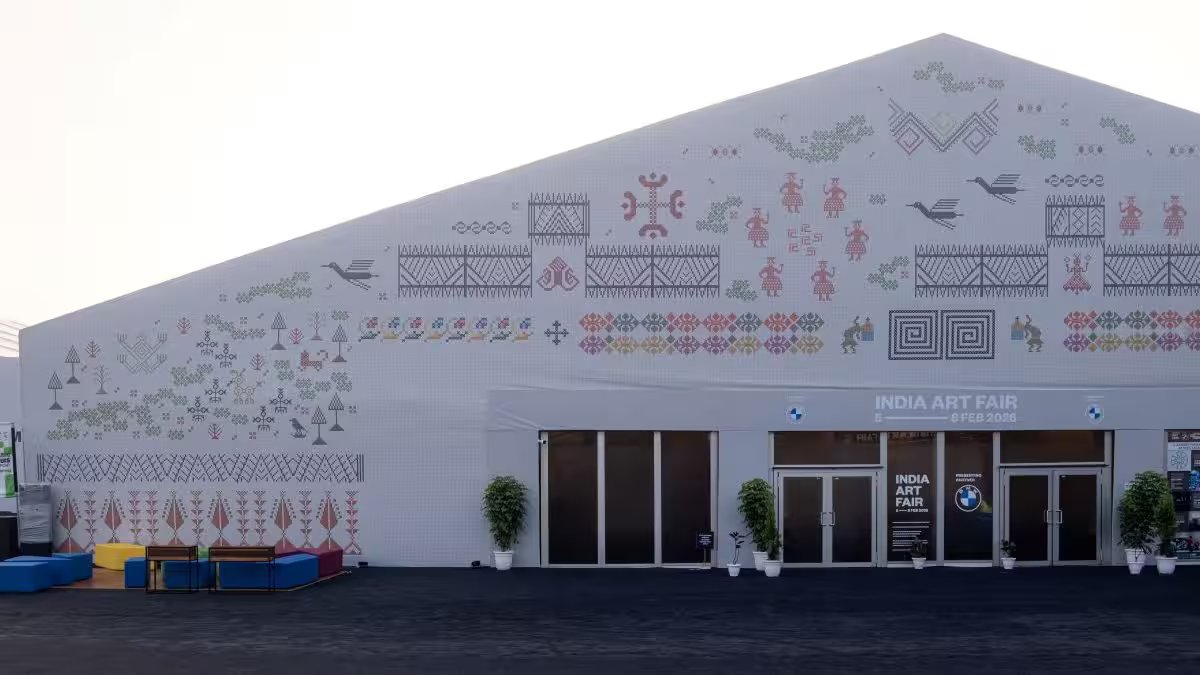
Now in its 17th edition, the fair, which runs from 5 to 8 February 2026 at the NSIC Exhibition Grounds, untangles against sustained international attention across museums, academic research, and cultural institutions towards art histories and contemporary practices from the region.
Led in partnership with BMW India, India Art Fair 2026 is the largest edition in the fair’s history. With 135 exhibitors, comprising 94 galleries and 24 institutions, alongside an expanded design section and an extensive programme of talks, performances, and public initiatives, the fair continues to reposition itself not simply as a multi-layered cultural platform.
STORY CONTINUES BELOW THIS AD
The current edition reflects this transition. Its scale is about bringing together artists, institutions, patrons, educators, and publics within a shared temporal and spatial frame, all about networking and a cultural ‘who’s who’.
Is it a marketing event or an institutional ecosystem?
One of the defining features of the 2026 edition is the expanded presence of institutions. Sixteen museums, foundations, and cultural organisations from India and abroad are participating this year, foregrounding long-term cultural work rather than individual artworks.
Indian institutions such as the Museum of Art & Photography, the Gujral Foundation, Serendipity Arts, the Sabyasachi Art Foundation, and the Birla Academy of Art & Culture appear alongside international organisations including the Australian High Commission, the Korean Cultural Centre India, Britto Arts Trust, and The Arts Family.
This emphasis signals a change within India’s art-fair landscape, where institutional engagement has historically been secondary to commercial exchange.
By foregrounding museums, foundations, and cultural organisations, the fair positions itself as a site where questions of education, research, philanthropy, and policy can be addressed alongside collecting and display. At the same time, it raises unresolved tensions about how such institutions operate within the temporality and economics of a fair, rather than independent public mandate.
STORY CONTINUES BELOW THIS AD
These questions are taken up more explicitly within the fair’s discursive programming. The Talks Programme, supported by JSW and curated by independent researcher and curator Shaleen Wadhwana, is structured around the theme What Makes Art Happen? — Rising to Challenge. The framing shifts attention away from individual artistic success towards the conditions that enable or constrain artistic practice such as funding structures, institutional responsibility, labour, and access.
Speakers include artists, museum directors, curators, scholars, and patrons from India and abroad, reflecting an attempt to place South Asian cultural production within broader global conversations. Interestingly, the programme emphasises accessibility: all talks are conducted in English and Indian Sign Language, with select sessions in Hindi, Punjabi, Odia, and Saura, supported by live translation. While such measures do not in themselves resolve structural exclusions, they point to an awareness of language and access as central, rather than peripheral, concerns.
STORY CONTINUES BELOW THIS AD
Access, public space, and the limits of expansion
Design has, in recent editions, become an increasingly prominent strand of the fair’s identity. The expanded Design section brings together studios and galleries working with limited-edition and hand-crafted objects, foregrounding material knowledge, labour, and authorship.
This focus aligns with wider conversations across South Asia around craft economies and sustainability, even as it raises questions about how such practices are absorbed into elite consumption circuits.
India Art Fair’s engagement with public space is also more visible this year. Large-scale outdoor installations and architectural interventions activate the fairgrounds, while collaborations with museums and galleries extend the fair’s presence across the city through parallel exhibitions. These gestures suggest an ambition to move beyond the enclosure of the exhibition hall. However, they also highlight the uneven geographies of access in a city like Delhi, where cultural participation remains shaped by class, language, and mobility.
Learning and inclusivity are positioned as key priorities. With the Kiran Nadar Museum of Art returning as Learning Partner, the fair hosts workshops, guided tours, and participatory programmes aimed at visitors across age groups and abilities. The introduction of the Art Tour Guides Training Programme reflects a longer-term investment in cultural mediation, acknowledging that interpretation and access are not neutral processes but learned skills within an art ecosystem.
STORY CONTINUES BELOW THIS AD
The 2026 edition also follows a year of expanded regional engagement. In November 2025, India Art Fair launched IAF EDI+IONS, a programme intended to extend the fair’s cultural presence beyond Delhi and into other parts of South Asia. Its inaugural edition in Hyderabad marked a move towards decentralised engagement, signalling an awareness of the limitations of a single, annual concentration of cultural power.
Reflecting on the moment, Fair Director, Jaya Asokan has described the current global attention on South Asian art as an inflection point. The fair’s response has been to broaden its scope, placing greater emphasis on infrastructure, discourse, and public engagement alongside artistic practice.
As India Art Fair continues through the week, its significance lies not only in what is shown but in what is being tested. At a time when South Asian art is being actively re-evaluated on the global stage, the fair functions as a site of negotiation.
End of Article
