


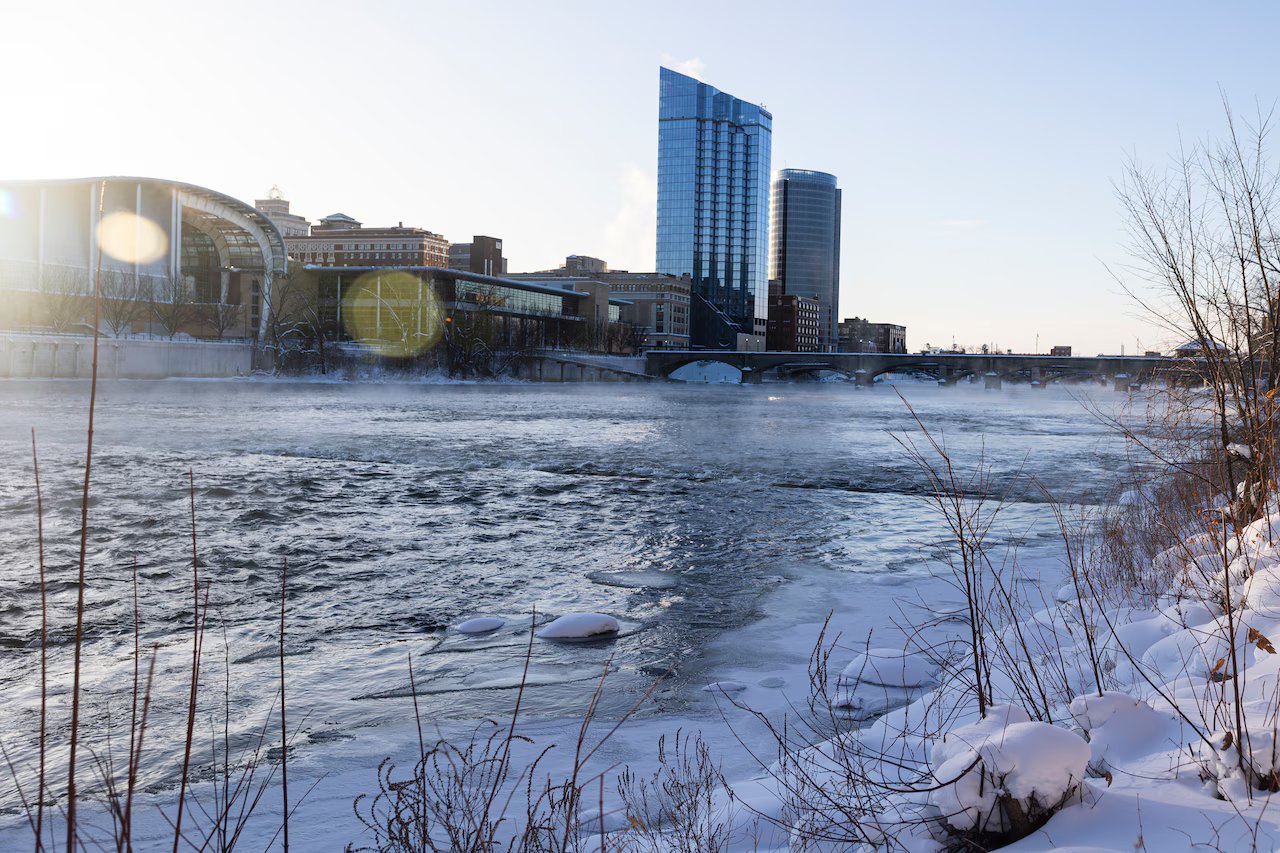
GRAND RAPIDS, MI —A riverfront stroll or bike ride might not be the only activity that draws residents to new and renovated parks and trails planned along the Grand River in Grand Rapids.
Sculptures, murals and interactive public art could one day rise along a stretch of the Grand River Greenway between Riverside and Millennium parks, creating vibrant public spaces and cultural destinations.
“If you’re going up and down the Grand River Greenway, not only will you be able to enjoy a pretty incredible recreational amenity, it will feel even more unique because there will be some really beautiful art along the way,” said Bill Kirk, a spokesman for Downtown Grand Rapids Inc.
DGRI is working with arts groups, the city of Grand Rapids, Kent County and Grand Valley State University to develop a public art plan for the roughly 10-mile stretch of the greenway between the two parks. The Grand River Greenway is a planned pedestrian trail between Lowell and Grand Haven, part of which passes through Grand Rapids.
The art plan is still in the early stages and hasn’t been finalized.
Where the art would be placed, what installations would be commissioned, and how the effort would be funded are expected to be discussed in the coming months, Kirk said. Final decisions aren’t expected before portions of the greenway begin to open later this year.
“We haven’t had discussions about specific dollar amounts yet,” Kirk said.
This map shows the stretch of the Grand River Greenway where public art could be paced as part of a public art plan being led by Downtown Grand Rapids Inc. (Map provided by DGRI)Courtesy
A timeline for the completion of the full Grand River Greenway hasn’t been finalized. The project is being funded and built through a partnership between governments and other groups in Kent and Ottawa counties.
However, new and renovated parks and trails that tie into the greenway in Grand Rapids are under construction now.
That includes a pedestrian path next to Acrisure Amphitheater and the expansion and renovation of Oxford Trail, which connects Grand Rapids’ Roosevelt Park neighborhood to downtown. Canal Park, on Monroe Avenue NW, is currently being rebuilt as well.
In addition, construction is expected to start in April on a new trail, south of Riverside Park, between Leonard and Ann streets in Grand Rapids.
Work on the Grand River Greenway Public Art Plan is happening in tandem with those projects.
The Grand Rapids Downtown Development Authority, which is managed by DGRI, agreed in 2024 to spend up to $150,000 to hire MIG to develop the public art plan with input from residents and local arts groups. MIG is an architecture and planning consultant based in Berkley, California.
In November 2025, MIG presented the DDA with an overview of its draft report, which outlined broad goals for the public art plan such as the type of installations art that could be placed along the greenway.
Options range from sculptures and murals to interactive installations, light-based works and gateway pieces at key points along the greenway. The presentation included examples of public art for inspiration, including Chicago’s “Cloud Gate” sculpture, commonly called “the bean.”
Art would be placed on the greenway on a permanent and rotating basis, with an emphasis on including works by local, national and international artists, according to the presentation.
An excerpt of the draft Grand River Greenway Public Art Plan describes a focus on aspirational installations that would define the corridor. (DGRI)Courtesy
In addition, the report provided recommendations on fundraising, potential sites for art, and the creation of an organization to maintain and oversee the art.
Ann Berchtold, director of public art and placemaking at MIG, told the DDA the plan aims to lay “the foundation for a unified cultural identity, transforming the Riverside to Millennium corridor into a vibrant civic, cultural and economic destination.”
“We’re not just placing art,” she said. “We’re weaving creativity into every layer of investment that is currently underway to really make this corridor a world-class public art cultural destination.”
The potential sites along the greenway where the art could be placed include:
•Riverside Park
•Canal Park
•Fish Ladder Park
•Ah-Nab-Awen Park
•Oxford Trail
•Millennium Park
•Leonard Street to Ann Street
•Fulton Street to Wealthy Street
The draft plan emphasizes commissioning art that creates a “distinct and connected riverfront identity” and celebrates the city’s history, culture and traditions.
Berchtold said she and her colleagues solicited community feedback on the art plan, and that during those discussions, they heard “loud and clear” that currently “there’s no unifying identity between” Riverside and Millennium parks.
“The existing artworks often feel disconnected, lacking visibility, interpretation and cohesion,” she said. “High traffic parks and public spaces aren’t being used currently as cultural corridors.”
An aerial image of the U.S. 131 “s-curve”, Grand River and downtown Grand Rapids, Mich. on Tuesday, September 30, 2025. Joel Bissell | MLive.com
Steff Rosalez, CEO of Grandville Avenue Arts & Humanities, is a member of the local advisory group that is helping create the Grand River Greenway Public Art Plan.
In an interview, she echoed Berchtold’s comments, saying “what we need more of in Grand Rapids is that sense of place,” and that art that reflects the city’s “history and identity” could help accomplish that.
“Art tells that story of identity and place,” Rosalez said. “We learn about other people and other people’s stories through art.”
Once the Grand River Greenway Public Art Plan is complete, next steps by DGRI would include creating a Grand River artworks committee, developing a long-term fundraising plan and hiring a public art curator.
Once that work is accomplished, the plan calls for launching five or six temporary public art installations to “build momentum, test logistics, educate the public and attract funders.” From there, officials would focus on fundraising and outreach for the first two to three permanent installations.
Rosalez is hopeful the plan comes to fruition but said doing so will be challenging.
“The plan lays out a lot of really ambitious things,” she said. “If we’re going to actually implement the plan, we need support from a lot of different sectors. We need government support, corporate support, local artists, local art organizations.”
Looking forward, Kirk is hopeful that the community will support the public art plan. If it comes to fruition, it would elevate the greenway, providing residents and visitors with an even more memorable and unique experience.
“I think we’re a community that’s very familiar with the power of public art to transform the experience of a space,” he said.
