
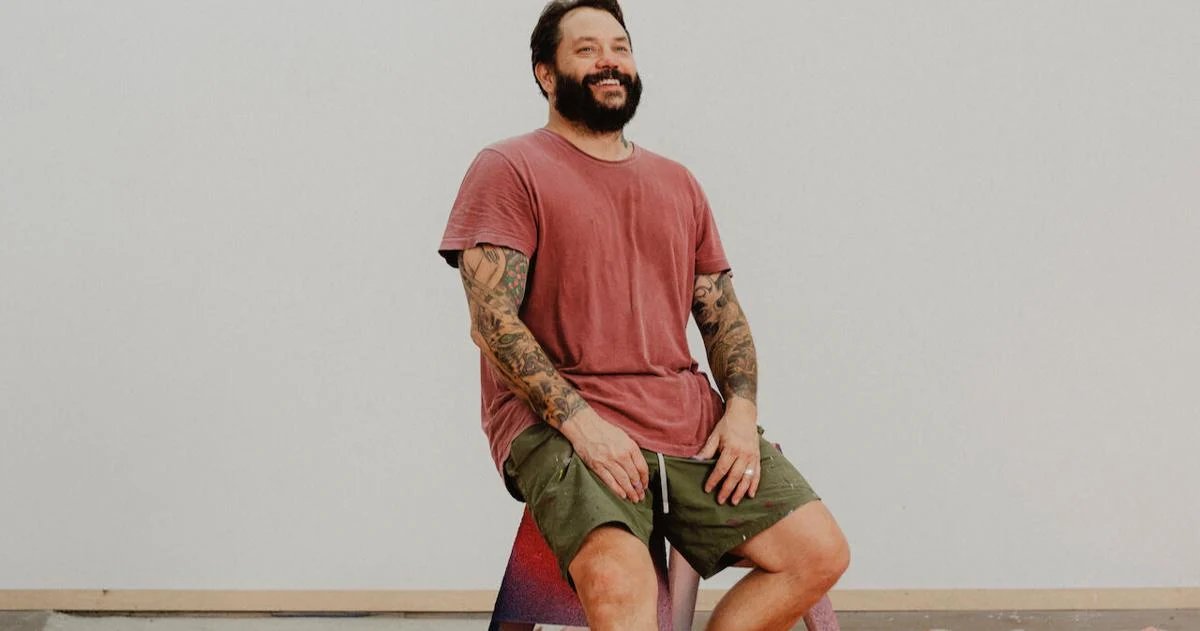
Jason REVOK is a self-taught artist who started his career in graffiti and is known for his hand-built spray painting machines. Jason REVOK, headshot. Courtesy of the artist and Library Street Collective. CONTRIBUTED
“I think graffiti art is the most important American art that has ever existed,” said Jason Williams, better known by his graffiti name, REVOK.
Seven new large-scale paintings by the Detroit-based artist are currently on view at The Contemporary Dayton (TCD), alongside the works of Paul Verdell and Jamea Richmond-Edwards.
REVOK has developed a mark-making process which involves huge hand-built spray painting machines like giant spirographs. His “instrument frame drags” hold eight spray paint cans at a time and pull paint across surfaces. The effect is calibrated yet spontaneous.
A spirograph piece by Jason REVOK, acrylic and synthetic polymer on canvas. CONTRIBUTED
Young and hungry
“Nothing has been practiced by more young, hungry ambitious artists,” said REVOK of graffiti art.
Born in 1977 in Southern California, he came up in the 1990s graffiti scene. Dropping out of school at 15, he was inspired by comic books, skateboarding culture, and his father’s record collection.
He changed his name and started tagging walls. The more subversive the environment, the better. At 12 he would sneak out to steal spray paint from neighborhood garages.
“How much materials can you obtain without means? How committed are you? I dare you to name any other art movement with that kind of risk,” he questioned.
He experienced peers getting arrested — one serving over 10 years — and others even shot and killed for trespassing to graffiti.
“These people have died making paintings a certain way. You have to accept major challenges,” he said.
Artists have used their tools as a form of resistance since time immemorial. Queer artists during the AIDS epidemic, Soviet performance artists, and Iranian filmmakers are just a few examples of creators who have faced censorship and persecution for challenging their right to freedom of expression during politically-charged times.
At TCD, three of REVOK’s paintings incorporate Donald Trump — his portrait repeated in a grid like an Andy Warhol screen print. The face is then concealed with strips of black paint. REVOK cited the redacted Epstein Files as inspiration.
TCD is marking its 35th anniversary alongside the nation’s 250th birthday by centering the theme of Freedom of Expression.
“We as an organization are neutral. We neither support nor condemn any political figure, but we are really invested in allowing the First Amendment,” said curator Heather Jones.
“You can have a group of people in a room presented with the same information, interpreting it totally differently,” said REVOK of the politically-charged work.
Hence the title of the exhibit — “Mutually Exclusive”.
Detroit’s little sister
All three artists on view are Detroit-based. Jones thinks of Dayton as Detroit’s “little sister”, considering “intertwined legacies as industrial centers shaped by The Great Migration, economic upheaval, and profound cultural innovation.”
“By presenting these exhibitions, we open a space to reflect on the resilience and creativity that continue to define both cities.”
Paul Verdell presents a body of gestural paintings that combine paint and collage into textural landscape-like compositions. The results are reminiscent of a topographical map, or the aerial view out an airplane window.
Leviathan is a film by Jamea Richmond-Edwards that explores Detroit’s layered histories, spiritual traditions, and evolving landscapes, evoking the mythic sea creature as a metaphor. Don’t miss the dancing hype man with his freestyle moves.
The American dream
Abandoned by his mother and growing up with little means, graffiti culture, for REVOK, provided a way to build self worth.
“I was never seen, heard or valued,” he said of his childhood.
“I always felt alone. I wanted to take ownership over my identity.”
He built a following based on writing his created name over and over because he wanted to “be a big deal”. Then, desiring a legacy, he developed a successful studio practice.
“I didn’t want to be a nobody. Art making seemed like a conduit to transcend caste. I didn’t accept being powerless.
“That’s kind of the American dream.”
If You Go
Hours: 11 a.m.-6 p.m. Wednesday-Saturday
Where: The Contemporary Dayton, 25 W. 4th St., Dayton
More info: Current exhibitions up through June 6. For artist talk and guided tour dates, visit codayton.org.
