


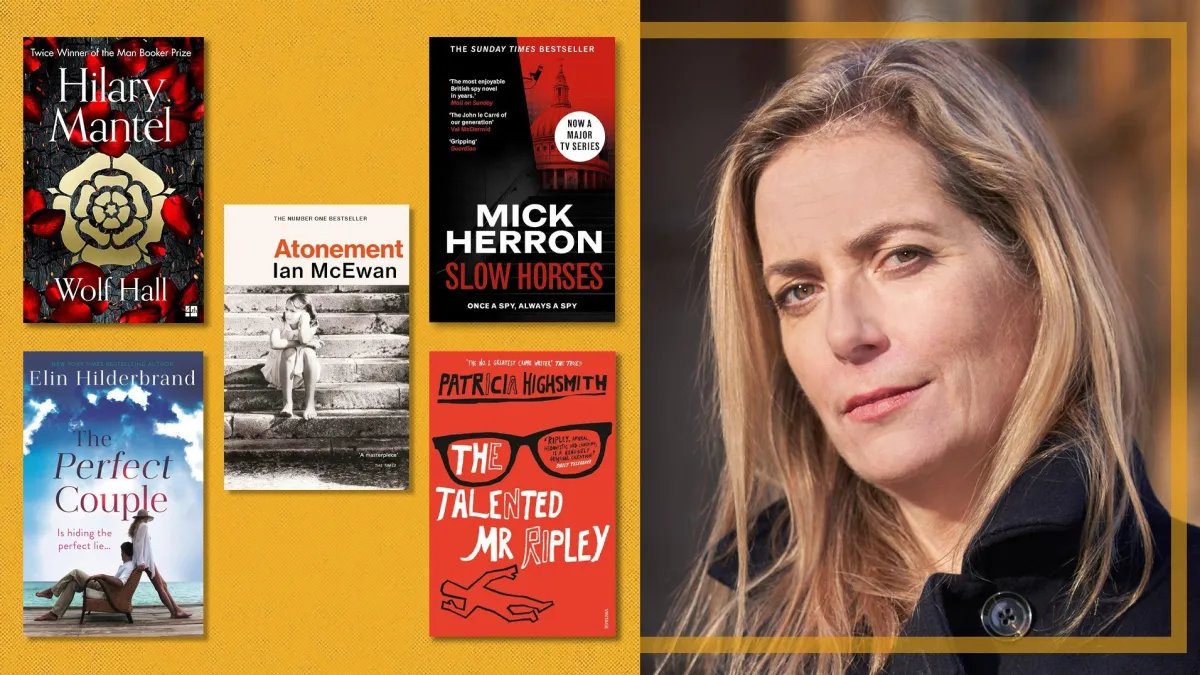
There are few debates a bibliophile enjoys more than the age-old question: was the book better than the screen adaptation? Whether it’s about dog-eared paperbacks passed between friends, or glossy, big-budget series, the conversation tends to circle back to the same conclusion: that while a great adaptation can bring a story to new audiences, it rarely captures the full richness of the original.
No one understands that balance better than Sarah Vaughan. Her bestselling courtroom drama Anatomy of a Scandal became a hit Netflix series in 2022, introducing her work to millions, while her novel Little Disasters was reworked for Paramount+ last year. Here, she picks her five favourite books that, even in the face of much-loved adaptations, offer something deeper or more affecting on the page…
Slow Horses by Mick Herron
“The Slow Horses TV adaptations are terrific. I’m a huge fan and can’t now think of Jackson Lamb without seeing Sir Gary Oldman, Diana Taverner without thinking of Kristen Scott Thomas, or River Cartwright, Jack Lowden. The series also feel very faithful in tone to the books, with tweaks often made only to increase jeopardy or sympathy.
“But much as the show brilliantly and faithfully brings that liminal part of London and cast of misfits to life, any fans should read the books not just to see quite how much of the uproariously funny dialogue derives from it, but because of Mick Herron’s wry and razor-sharp prose. In particular, they’re worth reading for his close observation, his wordplay – ‘Books, unlike spies, can’t be judged by their covers’ – and my favourite part, for the deluded Roddy Ho’s internal monologues, which have me laughing out loud.”
John Murray, £10.99
Atonement by Ian McEwan
“Nominated for seven Oscars, the Bafta Best Film-winning Atonement is a faithful and emotionally affecting adaptation of Ian McEwan’s novel, with a stellar cast – Keira Knightley, James McAvoy, a 12-year-old Saoirse Ronan, Romola Garai, Benedict Cumberbatch, Harriet Walter and Vanessa Redgrave – exquisite cinematography, and an Oscar-winning score. Knightley’s poison-green dress and her diving into the fountain, or the eroticism of the library scene, observed by a precociously brilliant Ronan, and the five-minute, one-take Dunkirk scene are all acutely memorable.
“But in stark contrast to a film that can only offer exterior shots, the Booker-shortlisted novel provides so much more nuance and complexity because it offers such a detailed exploration of the characters’ inner worlds – particularly Briony’s. It’s also a more extensive exploration of the act of writing. It came out in 2001, when I was on my honeymoon and preoccupied with love and the fear of loss. I’ve never forgotten it.”
Vintage, £9.99
The Perfect Couple by Elin Hilderbrand
“Producers love developing novels because they’ve already proved themselves: the narrative arcs work and the characters’ psychology has been tested. But TV requires more plot, and because we don’t explore a character’s inner world in the same way, considerable nuance might be shorn. Such is the case with Netflix’s adaptation of Hilderbrand’s thriller: while the Hamptons high-luxe feel is maintained, the show is a different beast with a different killer, a different backstory for the wife in the not-so-perfect couple (Nicole Kidman), as well as different characters.
“The main reason I preferred the book, however, was because the bride about to be married, Celeste (Eve Hewson’s Amelia in the show), is more complex. The book also explores her father’s doubts about his sexuality, and unrequited historic love for a male colleague – something the show jettisoned.”
Hodder, £9.99
Wolf Hall by Hilary Mantel
“If you loved the BBC’s sumptuous adaptation of the first two books of Mantel’s Cromwell trilogy (Wolf Hall and Bring Up the Bodies), you should definitely read the books, and not just to understand who all these courtiers are, but to gain a more nuanced depiction of Cromwell. Because while the series is superb at depicting the colour and tensions of the Tudor court – Damian Lewis is a tremendously charismatic Henry VIII and Mark Rylance a suitably thoughtful chief courtier – the books reveal the complex inner workings of Cromwell’s mind.
“Allowing the reader this access means that, inevitably, we’re flattered and seduced even as it becomes clear the Cromwell of the book is more ruthless than Rylance’s more sympathetic Crum. It came as a visceral shock then to read a line I later used as an epigraph to Anatomy of a Scandal, which indicates his willingness to stitch up men – or preside over miscarriages of justice. ‘He needs guilty men. So he has found men who are guilty. Though perhaps not guilty as charged’.”
Fourth Estate, £10.99
The Talented Mr Ripley by Patricia Highsmith
“My introduction to this was the 1999 Anthony Minghella film with its golden trio of Matt Damon, Jude Law, Gwyneth Paltrow, and exquisite Italian settings. I didn’t read Highsmith’s psychological thriller until perhaps five years ago, when I learnt that the film and book are different, but complementary, beasts.
“Highsmith’s Ripley is the ultimate unreliable narrator – a cold and manipulative sociopath who is already a conman at the start of the book – whereas Damon’s Ripley is more vulnerable, less calculating, and as such much more sympathetic. Highsmith’s Ripley is alluring, though, because we read his fears so frankly and matter-of-factly: ‘He mustn’t do that again,’ he thinks after one murder, and of another: ‘It had been so unnecessary.’”
Vintage, £9.99
Based on a True Story by Sarah Vaughan is published by Simon & Schuster, £16.99
