


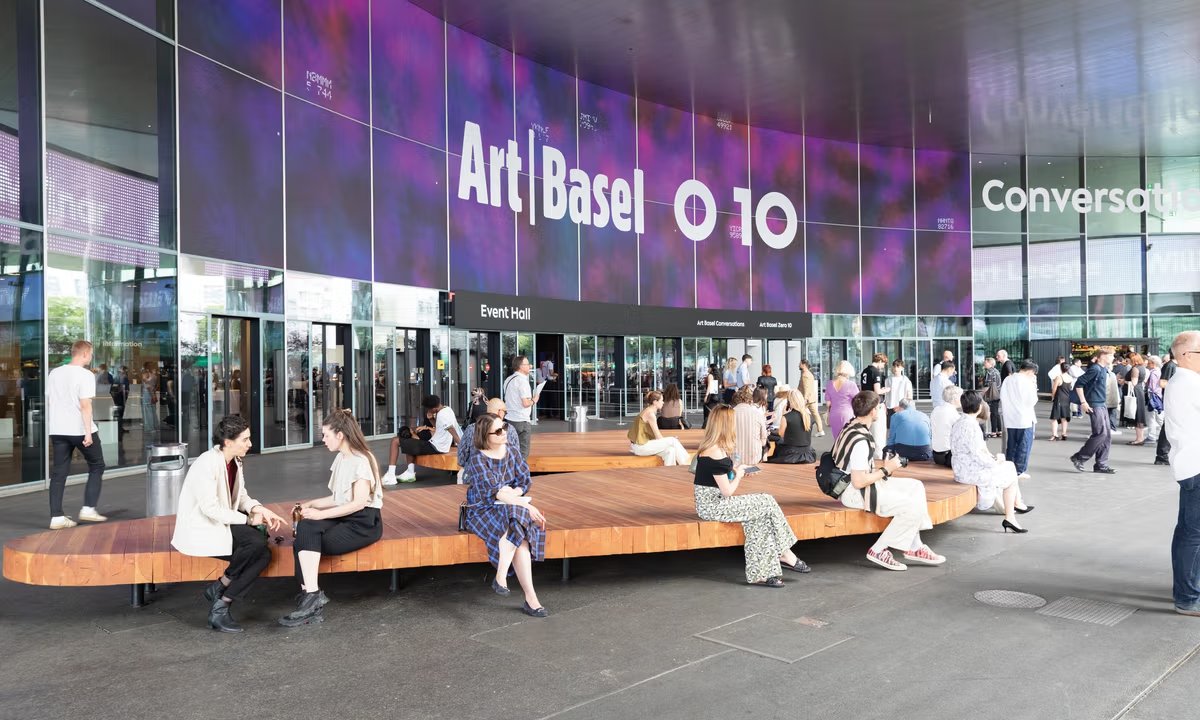
Art Basel’s digital art initiative, Zero 10, is making its Swiss debut after it was launched at Art Basel in Miami Beach in 2025, before taking place at Art Basel Hong Kong earlier this year. A fair within the fair, the basic premise of Zero 10 is to display digital art. But the US artist Trevor Paglen, who is co-curating this edition of Zero 10, argues that it is more complicated than that.
“The argument of the exhibition is that most of the art you’ve been looking at for the last 20 years is digital art, whether you know it or not,” Paglen says. He is referring to the fact that even so-called traditional artists working in mediums like sculpture or painting use digital methods in their processes, while conversely art that is displayed on screens requires an analogous process of converting something made out of zeros and ones into a physical manifestation. “I just find the scepticism [of digital art] silly, because I think that that comes from a place where people are not really necessarily understanding how that work gets made.”
Works on show include Vera Molnár’s 25 Carrés (1990) Courtesy Galerie Oniris
The previous two editions of Zero 10 have been curated by Eli Scheinman, who came into the art world via NFTs (non-fungible tokens). Formerly the director of art at Yuga Labs, which launched the popular NFT franchise Bored Ape Yacht Club, Scheinman took on his role as senior adviser in digital art at Art Basel in order to launch Zero 10. For the Swiss edition, Paglen was brought on as a co-curator.
Both Scheinman and Paglen want to address the scepticism that surrounds digital art head on, whether it is leftover doubts that have lingered after the speculative bubble of NFTs or the fear around the use of artificial intelligence (AI). Scheinman has found that people have a “visceral” reaction when they find out an artist is working with AI as part of their practice. The London-based Uzbek artist Aziza Kadyri, for example, uses a custom-trained AI model to examine authorship and collective memory in her piece A Borrowed Hand (2026), on show at Zero 10 with eastcontemporary gallery.
“There’s this [notion] that this is a shortcut or it is offloading the work to a machine. Why do you even need the human if the machine, the algorithm, the model, the agent can produce work?” Scheinman says. “I think at this moment in time it’s more important than ever to present work that interrogates that exact question.”
Historical arc
For this edition of Zero 10, Scheinman and Paglen wanted to focus on both these kinds of contemporary questions while giving the work historical context. Art Basel being a more “serious” fair, as Scheinman puts it, the co-curators saw this edition of Zero 10 as an opportunity to present a longer historical arc of digital art, with roughly a third of the artists on display having been active in the 1950s, 1960s and 1970s.
DEAFBEEF’s Glitchbox (2021-25); the artist, who began making NFTs in the early 2020s, started out as a blacksmith Courtesy of the artist and Asprey Studio
Artists like the Hungarian-born Vera Molnár, who died in 2023, represent an emerging canon of digital art. Her early experiments in algorithmic art are being presented by Oniris.art and Interface Gallery. (An exhibition of Molnár’s work is also on at the Kunstmuseum Basel, until 26 July.)
That Zero 10 has emerged as a space where the canon of digital art is being formed has rubbed some people up the wrong way. In a LinkedIn post, Kate Vass, a Web3 and AI adviser as well as digital art gallerist, wrote that instead of presenting digital art in conventional formats like the art fair, people should be “nurturing new ones—spaces where every voice can contribute, every artist has a chance to be seen and every idea can flourish without fear”. Vass’s post was typical of the anti-gatekeeper position that accompanied the NFT craze.
But for artists like DEAFBEEF, who was introduced to the art world when his NFTs made it big in the early 2020s, these traditional institutions are not a threat to different ways of engaging with people but live alongside them. “I have respect for the conventions and traditions and institutions [of the art world], that they’ve persisted,” he says.
Like many artists who came up during the NFT mania, DEAFBEEF does not fit the traditional profile of the kinds of people who end up with their work in Art Basel. He has never lived in a major city like New York and he did not go to art school. Before he started making NFTs, he was a blacksmith who made custom steel wedding rings and sold them on Etsy. Now, he still releases NFTs direct to his collectors online, but he also exhibits his works in institutions like the Toledo Museum of Art or the Los Angeles County Museum of Art (Lacma). “This fair, it’s just another [way of] communication,” he says. “[Although] it’s certainly more expensive.”
