


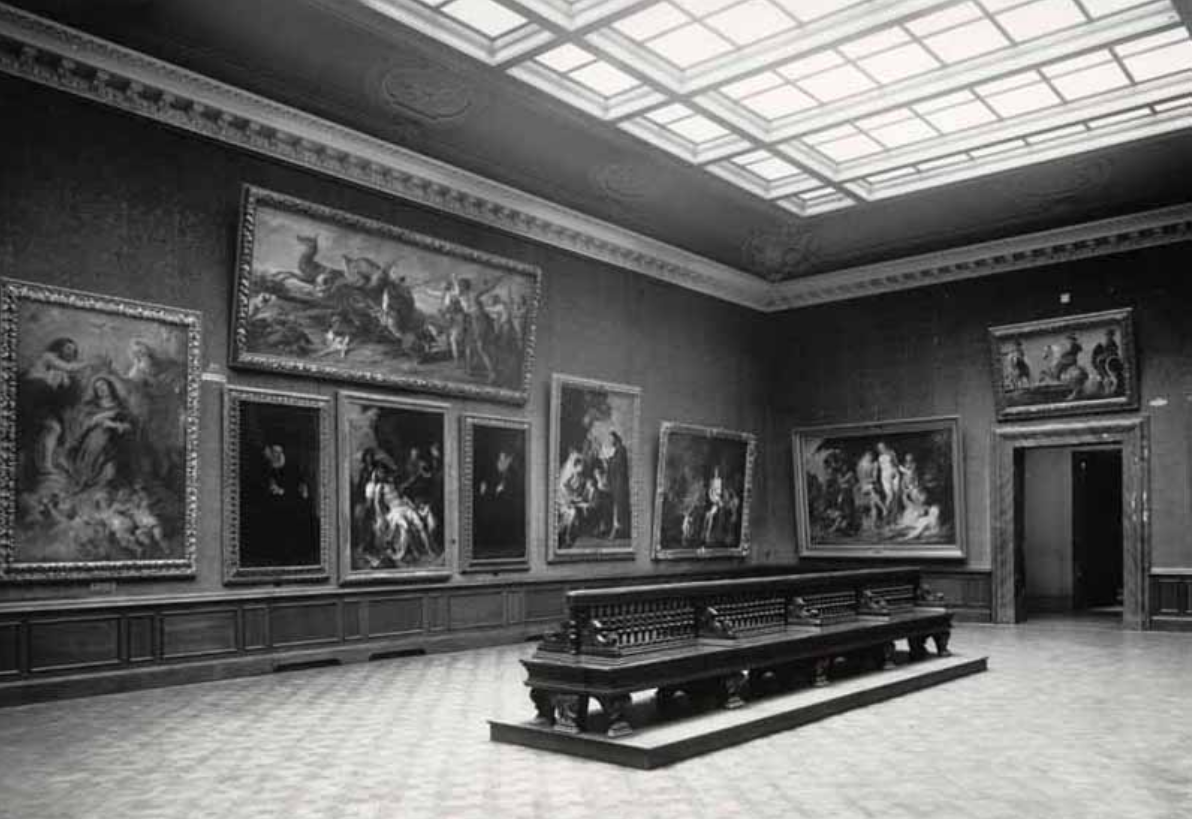
A proactive effort to document the collection of the Gemäldegalerie will pay off a century later as negatives of lost paintings by Rubens and Caravaggio are digitized and published online
Christian Thorsberg
|
April 27, 2026 4:25 p.m.
A photograph taken in 1926 depicting paintings by Peter Paul Rubens that likely burned in a fire in 1945
Staatliche Museen zu Berlin, Zentralarchiv
In 1925, following the destruction of artworks and cultural artifacts across Europe during World War I, a photographer named Gustav Schwarz took an assignment in Berlin systematically documenting precious museum holdings in case another catastrophe threatened them in the future.
Schwarz’s efforts to photograph the collection of the Gemäldegalerie—an art museum in the German capital recognized for its European paintings from the 13th century through the 18th century—proved prescient just a few decades later, when World War II reached its climax in 1945. Many of the museum’s most valuable paintings were too large to move to the safety of underground mines miles away in the state of Thuringia. Instead, they remained in the control tower of an air-raid shelter in Berlin, where two subsequent fires—their causes unknown—destroyed roughly 430 paintings.
Today, the details of these lost masterpieces—including works by Peter Paul Rubens, Anthony van Dyck and Caravaggio—survive on Schwarz’s glass negatives, which for decades were kept in good condition in museum archives. Now, for the first time, these works will be given a new life, online.
“They have tremendous documentary value—not only for the museum and the collection itself but also for the public,” Katja Kleinert, deputy director of the Gemäldegalerie, tells the Art Newspaper’s Nathan Eddy. “By digitizing the glass negatives, the significance of the collection can be understood in a completely new way.”
Christ on the Mount of Olives, Caravaggio, c. 1603, shown as a glass negative photographed by Gustav Schwarz and presumed destroyed in a fire in Berlin in 1945
Staatliche Museen zu Berlin, Gemäldegalerie / Gustav Schwarz
To prepare the images for publication via the museum’s online database, a team used high-resolution cameras to photograph the black-and-white negatives over the course of six weeks. The collection contains a few color photographs, too, but those were not part of this project because reproducing them is more complex.
“There is a certain relief once they are digitized because then they are preserved digitally,” Kleinert tells the Art Newspaper. “When you hold the glass negatives in your hands you realize how fragile they are. You’re thinking: I must not drop this.”
Orpheus and the Animals, Philipp Peter Roos, c. 1700, shown as a glass negative photographed by Gustav Schwarz and presumbed destroyed in a fire in Berlin in 1945
Staatliche Museen zu Berlin, Gemäldegalerie / Gustav Schwarz
Fun fact: Home at last
In 2006, a correspondent for BBC News returned to the Gemäldegalerie a portrait of Eleonora of Toledo, who was married to Cosimo de Medici. The painting had been looted from the Berlin museum during World War II. The journalist received it from a German farmer when he worked in Berlin after the war, reported Luke Harding for the Guardian.
The new digitized copies may help scholars study the details of these paintings and glean insight about their meaning, provenance and influences. That was demonstrated in 2015, when museums in Berlin hosted an exhibition, timed with the 70th anniversary of the end of World War II, that explored the fires that destroyed so many Gemäldegalerie paintings.
A story published via Google Arts & Culture accompanying the exhibition analyzed a preserved glass negative of a circa 1614 Rubens painting titled Flussgott und Erdteil, which once hung in the Gemäldegalerie before it was presumably lost in a blaze. At first glance, the painting appears to portray the Roman god Neptune and his lover Amphitrite, but a closer look at the painting’s enlarged glass negative reveals details contrary to this narrative: “wild beasts” like a rhinoceros that have little to do with the ocean; a crown of fruit and flowers, rather than seaweed and shells; and gushing springs at the feet of the subjects, rather than roaring waves. The museum determined the artwork instead represented the Asian continent and Ganges River.
“With the help of plaster casts and photographic reproductions of works in their original size, masterpieces of the Berlin sculpture and painting collections are brought back into public consciousness,” said a museum statement from that 2015 show.
This c. 1614 artwork by Peter Paul Rubens, shown here as a glass negative photographed by Gustav Schwarz, was thought to portray Neptune, but new analysis suggests it represents the Ganges River.
Staatliche Museen zu Berlin, Gemäldegalerie / Gustav Schwarz
People in the 21st century still have strong emotions about the Gemäldegalerie’s Old Master collection. In 2012, a plan to relocate 3,000 artworks to a smaller building in Berlin to create room for 20th-century pieces in the museum’s main galleries sparked an outcry, and some 7,400 figures from the art world signed a petition criticizing the proposal.
“These plans … rob one of the world’s finest and, despite its wartime losses, most comprehensive collections of Old Master paintings of its unique capacity … to present more than 500 years of European painting history in encyclopedic scope in works of the very highest quality,” read an open letter from the Association of Art Historians to Germany’s culture minister, reported the Guardian’s Kate Connolly.
In the face of widespread criticism, the move was abandoned in 2013.
