


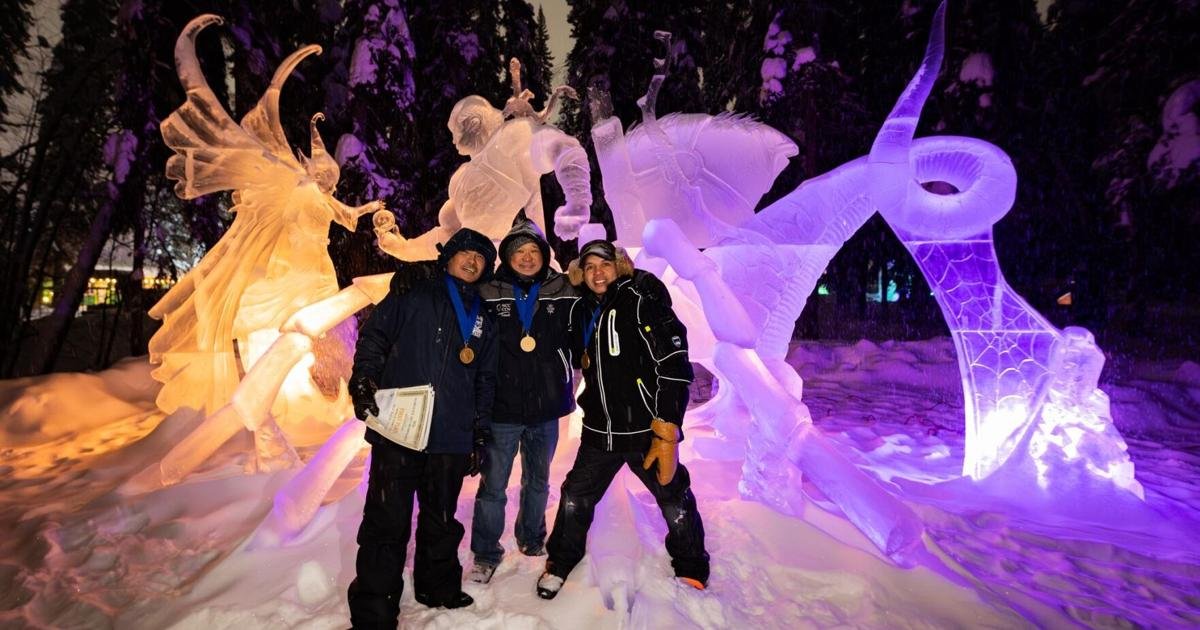
Filipino ice carvers Ross Baisas, Angelito Baban, Antonio Baisas and Victor Dagatan captured first place in the multiblock division at the 2026 World Ice Art Championships for the second year in a row.
The annual event brings elite carvers from around the globe to Interior Alaska, where towering blocks of crystal-clear ice are transformed into frozen masterpieces. This year’s event tested even the most seasoned teams, as heavy snowfall early in the week was followed by temperatures that dipped 35 degrees below zero.
When the awards were announced, the artists gathered alongside competitors from around the world, uncertain of where their piece would land. As second place was announced, anticipation built.
“Still excited halfway because you might be never called at all. When they call us, it’s like we’re jumping and happy,” Baisas said.
“It’s a fulfillment of excitement,” Dagatan said. “It’s a moment that all the hard work that we’re putting on, all that dedication time that we’re planning, it paid off.”
Preparation began months after winning the 2025 competition.
“We actually plan it as soon as we get back,” Baisas said. “We had some ideas in the beginning and moving forward closer to the competition, it changed the process until it changed totally the concept.”
But translating a sketch into ice was difficult from the start. Snow reduced visibility and required constant clearing to keep lines crisp. When the cold snap arrived, Dagatan said the ice turned brittle, raising the risk of cracks at critical connection points.
“The first couple of days we are in snow,” Dagatan said. “All the snow is pouring us and it’s hard to pick. It’s hard to see the sculpture. Then suddenly it dropped to negative 35, which is extremely hard to carve ice because the ice was so brittle.”
Dagatan described the challenges of assembling and bonding ice in extreme cold.
“Once ice is super cold, it cracked,” he said. “If you put a little bit of water, it doesn’t stick together. It may shatter the whole sculpture.”
Even with frozen hands and long days outside, the team leaned on communication. Baisas said it’s his responsibility as team captain to get everyone on the same page.
“It’s my job to put everyone in a certain work because we cannot work in the same place,” he said. “We have to work every corner of sculpture because we don’t hurt each other. Especially in crucial time, when the time is finishing, those things and always communication is very important.”
Dagatan said the harsh conditions did not phase them.
“In this extreme weather, it’s easy to get tired and frustrated because once you hit your limit, it’s crazy. If one person is not performing well, we get some rest, we adopt what he needs to do and we have always a good time. This thing is the team. We always make a joke and it’s just to have fun.”
The victory marked another milestone after winning in consecutive years, a milestone that carries deep personal meaning to them.
“It’s a very big deal,” Baisas said. “It’s actually the greatest achievement that I had in my career. I can put my diploma in my house, that’s for sure.”
Members of the Filipino-American Society of Fairbanks were present to celebrate the win.
“This community is amazing,” Dagatan said. “Everybody’s welcoming, they bring us some food, they offer us to have like Mary Jo (Skaggs). She’s a really amazing leader of this community. We really appreciate that.”
As for a possible three-peat, the team said their busy schedules at home can make planning difficult, but the draw of Fairbanks remains strong.
“We’re gonna come back because the artists, the atmosphere, the ice is here,” Dagatan said.
For now, “The Pack of Silk & Starlight” stands as proof that even in brutal subzero conditions, preparation, creativity and teamwork can carve out another golden moment in Fairbanks.
