


Modern Folk horror has become a great vehicle for stories about the cruelties men have always subjected women to. Much is owed to Robert Eggers’ The VVitch (2015). Its focus on a Puritan family in New England that thinks their daughter Thomasin (Anya Taylor-Joy) has strayed into witchcraft brought the power imbalance between men and women to the forefront in a masterfully terrifying manner. Eggers frames devilry as something the family lets in due to their treatment of Thomasin, suggesting that witches are made by those who fear them the most. The Devil comes later.
Movies that followed after The VVitch stayed within its framework, resorting to character studies that ultimately showed how easy it is to find in blind faith and superstition the means to control both the female body and its public perception. Hagazussa (2017) and the more recent Heresy (2026) are but two of a much larger body of work that highlights this phenomenon.
Theo Prasidis and Staša Gačpar’s The Girl, The Priest, and The Devil follows in the same footsteps, taking from Greek folktales and recent horror movies alike to craft a graphic novel that puts a wronged woman between a corrupt priest and the Devil. It’s colored by Yasmine Pond and lettered by Buddy Beaudoin, published by Dead Sky Publishing.
The story follows a Greek girl called Daphne. Her brother’s passed away and his body must be laid down according to tradition so he can cross over peacefully. The town where she lives in is basically run by a corrupt priest that uses his influence to ask for steep tax payments and gold for funeral rites. By making it a matter of faith, he’s framed the act of donation as conducive to salvation.
Daphne hates life in this town. She’s constantly shunned for allegedly consorting with the Devil, which brands her as a witch. At home, her father laments her inability to get married, giving rise to the idea of sending her to a convent. At one point, with the help of a friend, she gets the money to pay for her brother’s burial. And then the Devil appears, looking to collect a fee of his own.
Prasidis keeps the story brisk and dynamic. Dialogues are sharp and to the point, lending the read a more urgent feel. It comes at the cost of authenticity, though, if only to an extent. The text forgoes old English or old Greek formulations to capture the times as they were. In a sense, where Eggers goes for period-specific detail in crafting his folk horror movies, Prasidis prioritizes accessibility.
As such, the storytelling can come across as more modern. This isn’t a knock on the writing, as it were. If anything, it explains why The Girl, The Priest, and The Devil feels so aggressive and so angry. It’s not here to play nice. There’s little doubt as to who’s on the wrong side of things and who isn’t, both from a character and a societal point of view. Prasidis minces no words in taking the church and its history of corruption to task.
Gačpar balances beauty with menace in building the world Daphne traverses. Forests, rivers, and houses all look idyllic, like intimate slices of utopia. It makes the abuse Daphne receives from everyone around her hit harder. Gačpar finds tension in this contradiction. Innocence, religion, and hate make strange but unsettlingly compatible bedfellows that can turn the most perfect and visually striking of places into its own kind of hell.
The characters receive the same attention to detail. They’re expressive and they wear their fears and anxieties on their sleeves. Daphne is the living embodiment of frustration. She’s presented as strong and unrelenting in the face of a small but loud population that’s decided she’s one of Satan’s concubines. Every instance in which her perseverance nets her a win is felt thanks to Gačpar’s generous facial expressions.
Daphne’s father deserves special recognition. Gačpar imbues him with a sense of dreariness that makes it look like the weight of the world was just dumped on his shoulders and that it was his daughter who put it there. A sense of doom permeates in every scene he’s in, which works to further flesh out Daphne’s attitude towards him given the influence he seemingly holds over her future. The character becomes even more important because of the things he reveals about being a father at a time when daughters were seen as socially sanctioned bargaining chips.
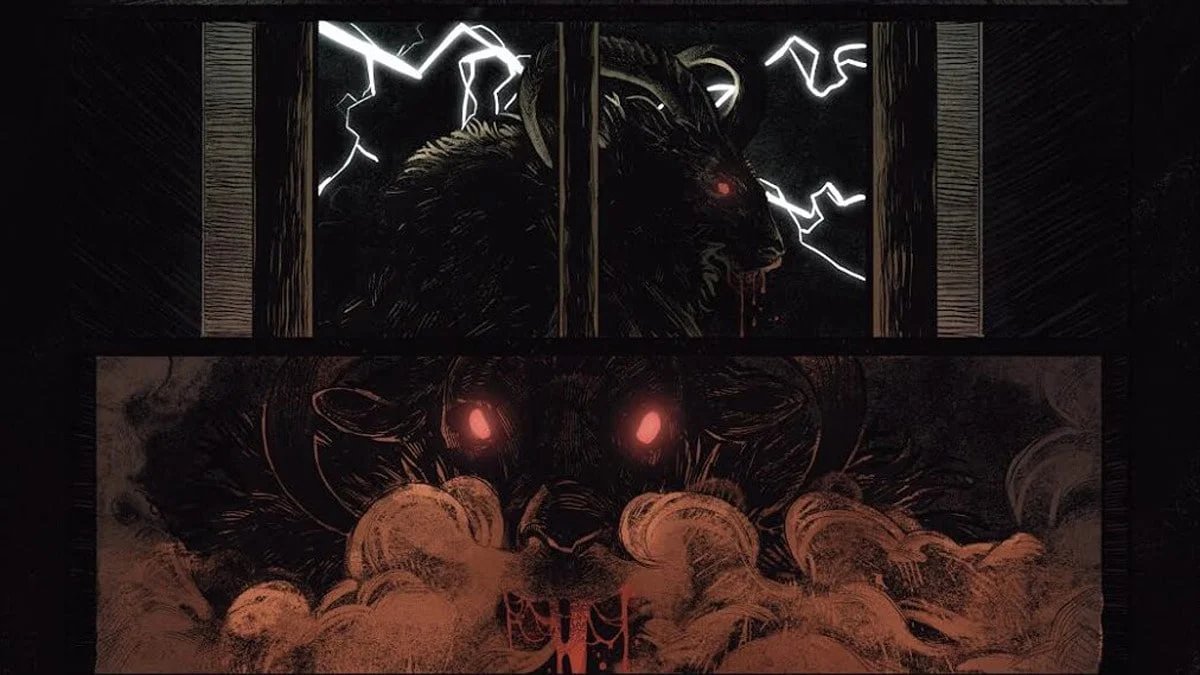
And then there’s The Devil. Prasidis and Gačpar present him as a mythical goat beast that changes the very atmosphere he inhabits. Dark magic swirls all around him, making his arrival feel momentous. His design points to a being that traffics in secrets and lies, that considers selfishness a redeeming quality. The Devil stops everything in its tracks to become the center of attention. Gačpar illustrates him with a sense of physicality that accounts for all of this. He produces the most impressive visual in the comic.
The Girl, The Priest, and The Devil taps into current folk horror trends to have its say on the evils of men and the subjugation of women. It confronts religion head on in the process, laying bare the contradictions inherent in religious institutions by focusing on how much damage a single corrupt priest can cause. Prasidis and Gačpar have crafted a nasty tale that terrifies on the basis that things haven’t changed as much since the time people believed the Devil was real.
