


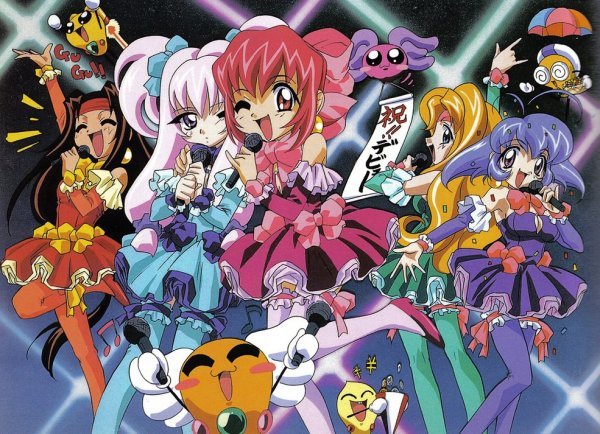
The Cyberteam series comes to a close in a way that only banging your head on a desk repeatedly will allow you to enjoy.
What They Say:
Akihabara is under attack! As the Primum Mobile enters Japanese airspace, Hibari and the Cyber Team find themselves forced to choose between two devils. Humanity’s future rests on their shoulders! The mystery, comedy, and intrigue come to a thrilling close in this final chapter!
The Review:
Audio:
The audio presentation for this release brings us the original Japanese language track in stereo, while the English dub got the 5.1 mix thrown at it. The show has a very simple mix to it that’s listed as stereo but is more of a full-feeling soundtrack than anything else. There’s a fair amount of action and sound effects throughout the show, but there isn’t much in the way of real depth or directionality to it. Dialogue is clean and clear throughout, and we had no problems with dropouts or distortions during regular playback.
Video:
Originally airing in 1998, the transfer for this series is presented here in its original full-frame aspect ratio. Done in the traditional animation style and avoiding most of the obvious bad digital animation that was cropping up at that time, the transfer here looks good for the most part, with a clean set of materials to work with. The main problem that some will see throughout will be the aliasing during some of the action sequences, but otherwise, it’s fairly problem-free. Cross coloration is very minimal, with only some slight sight of it in a few scenes. Colors look good and maintain a solid feel throughout, and you can see a good amount of detail in the animation when it’s there.
Packaging:
Though it looks a bit cartoonish and not quite the same as the in-show artwork, the final cover goes with Hibari in her Densuke-transformed more along with Crane in a more elegant outfit than he wears in most of the series with the standard circuit board background. The style of the artwork mixed with the sleek logo gives it a really current feel and overall looks pretty sharp. The back cover has only a couple of very small animation shots and is instead filled with lots of pastel colors that hold the sizeable summary and the large section of production information. The disc’s technical features and extras listings are easy to find and are all accurate. The insert goes for a simple look with a listing of the episode numbers and titles, and most of the technical information on one side, with some Pata-pi artwork, while the other side has just boxart advertisements.
Menu:
The menu layout continues to use the same design and colors as other parts of the release, with a static background of a Pata-pi lined across it several times that changes color as it goes along to the music. On top of that, there’s the usual selections and a cute image of her Pata-pi on top of a stack of books that sort of dances along. While not the most amazing menu, it’s nicely in theme and gets the job done without slowing you down in getting to the sections you want. Access times are nice and fast, and the disc reads our players’ language presets without issue.
Extras:
The extras for the final volume include a round of the standards with a new set of sketches and the clean opening and closing sequences.
Content: (Please note that content portions of a review may contain spoilers)
In watching the final volume of this series, there were so many places where it was just so bad I had to laugh. Unintentional comedy is sometimes the best, but even that was outweighed by the general awfulness of how this is all playing out. The series has done a very mixed job overall of trying to do whatever it is that it’s trying to do, and the worst thing they could have done was to provide that flashback to the beginning where Hibari thinks to herself, “I never thought it would turn out like this.”
Such are the words echoing through the minds of the fans of the manga and probably the show’s sponsors as well as the last dozen or so episodes have strayed so far from the origins of shoujo that it probably alienated most of its core audience and ended up with the completely wrong one. The last volume had us laughing along as it brought about the centuries-long plan that Rosenkreutz had been involved in up through the time that Crane took off in a V2 rocket for the stars in order to build his space castle in order to achieve world peace and harmony in a future paradise. But mankind has proven itself over and over to be completely selfish and self-destructive, so the arrival of his Anima Mundi doesn’t mark the beginning of a new era but rather an abandonment of what humanity has become.
I’m sure all the little girls in the audience got that.
Rosenkreutz’s pure happiness is expounded upon as Crane’s floating fortress has finally descended to Earth, and it has a connector that plugs right into the center spire of the school. Removing his old look and returning to his youthful nature, Rosenkreutz is eager to welcome back what he loves the most only to find that Crane is disgusted by what’s going on. In fact, he abhors the way that Rosenkreutz is essentially the same as he always has been and hasn’t grown at all. From killing his able assistant at the end and still wanting to rule the world, he hasn’t learned from his mistakes at all, according to Crane, and simply isn’t worth his time. He’s more interested in the Diva’s and what’s going on there and simply pushes the main villain of the series offstage within a few minutes time.
It just gets even sillier from there. After a bit of grappling because the city is in a power loss zone due to the castle and how it works the other girls make their way in through some positively laughter-inducing means. The end result is that Crane informs all of the girls that he’ll be back in 165 days to take them up with him to a new paradise and that if they don’t come with him he’ll do to the world what he’s done to Akihabara in terms of the power loss. So for the next five months, the world prepares for this day and gets everything in place to handle it. The show skips all of this and takes us to the day before Crane’s return and…
And it’s almost insulting. The five girls are all known, but they get to live at home under zero protection. All five of them walk the streets at night all alone. I mean, I know Japan is considered safe, but if you know there are five girls who, if they don’t do something, the world will be destroyed, don’t you think there’s at least one or two crackpots who will do their best to kill them? It gets better, though. The girls are all considered ambassadors from Akihabara to the UN, and they’re going there on the day Crane comes back, so they can deal with it by going up. What does this mean? That’s right, Hibari’s father is lucky to get that day off from work to deal with it. But he spends the night before out drinking with people from work!
The absolute best, though, is that on the day of Crane’s return, as the castle starts to descend, the government then starts an evacuation of Tokyo and its main suburbs. Maybe it’s hindsight having seen how badly an evacuation just went with plenty of notice, but I’d like to think this would be insulting even before that. I’d say it all falls apart from there as Hibari and her friends decide to stand up to what’s essentially a little boy with unrealistic expectations of the world with his self-centered view of how he wasted a hundred years, but honestly, it fell apart a long time ago and it’s been painful and alternately comical watching it trying to hold itself together. There’s no real satisfaction with the ending of this series since one of the pieces it pushed forward was Hibari finding her prince. With the prince being an ass, we’re left with a choice of final images. Either that of Hibari finding good friends being the best thing in the world or that her Pata-pi will provide for all of her needs.
Yeah, the mind is in the gutter, but so was that of the people behind this show that over-exploited a girl’s show into what became a bizarre male-oriented fanservice heavy piece with lots of conflicting ideas and innuendo.
In Summary:
The less said, the better, really. Most series have at least something interesting to offer at times, and there are precious few series that are painful to watch and get through, but Cyberteam in Akihabara is just that. I’m sure it has its audience and its fans but this is one of those times I wish I could have bailed out at the first volume like any other person.
Released By: ADV Films
Release Date: July 12th, 2005
MSRP: $29.98
Running Time: 100 Minutes
Video Encoding: 480i/p MPEG-2
Aspect Ratio: 1.33:1
Review Equipment:
Sony KDL70R550A 70″ LED 1080P HDTV, Sony PlayStation3 Blu-ray player via HDMI set to 1080p, Onkyo TX-SR605 Receiver and Panasonic SB-TP20S Multi-Channel Speaker System With 100-Watt Subwoofer.
Chris Beveridge
http://www.fandompost.com
Chris has been writing about anime, manga, movies and comics for well on twenty years now. He began AnimeOnDVD.com back in 1998 and has covered nearly every anime release that’s come out in the US ever since.
He likes to write a lot, as you can see.
