


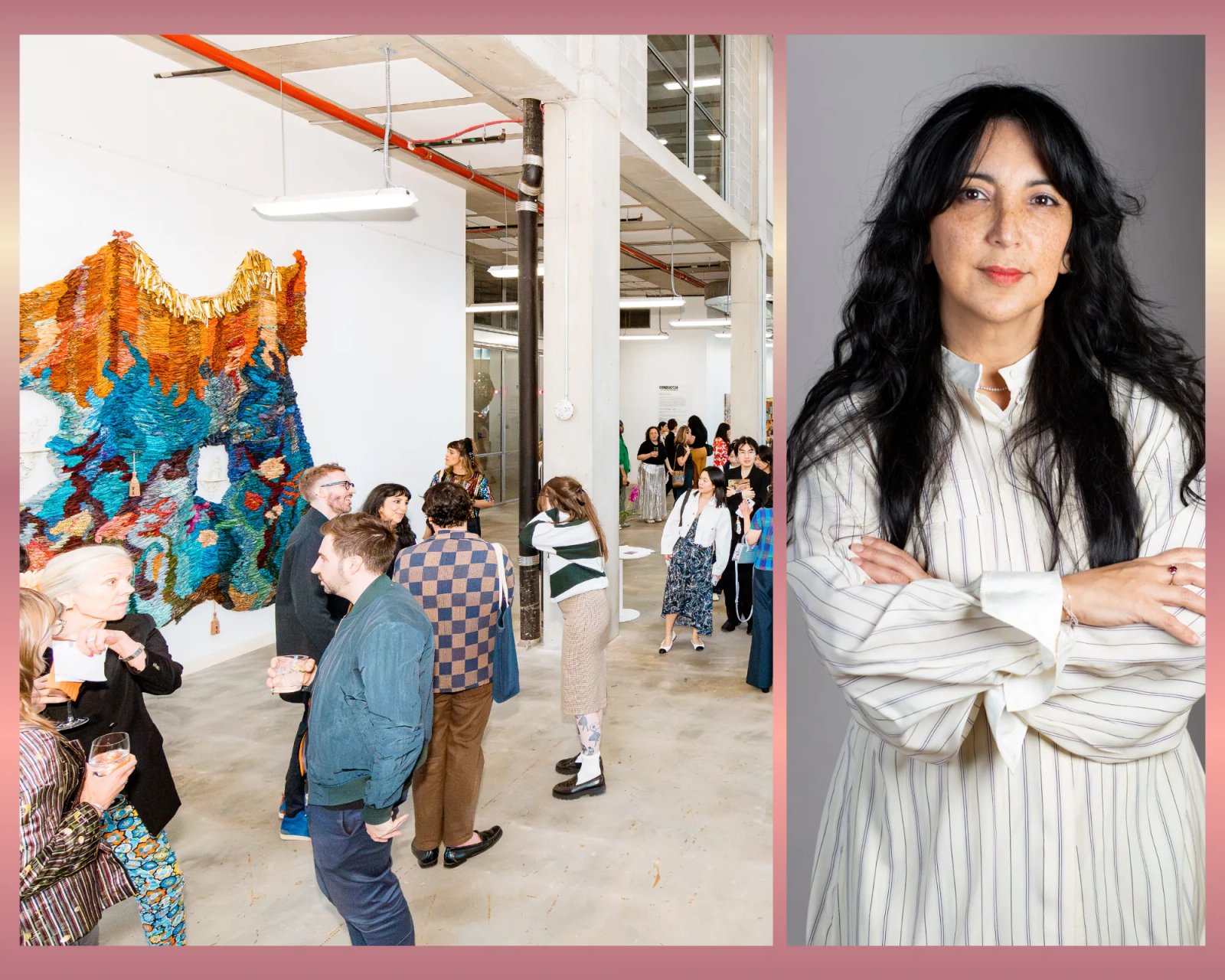
CONDUCTOR will offer an exclusive preview of a select group of artists presenting at the Venice Biennale: Annalee Davis (Main Exhibition); Tammy Nguyen (Main Exhibition); RojoNegro (Mexico Pavilion); Beya Gille Gacha (Cameroon Pavilion); and Bugarin + Castle (Scottish Pavilion). Portrait: Willamain Somma, courtesy CONDUCTOR
This week, New York City sees the launch of a brand new art fair: CONDUCTOR, at Brooklyn’s Powerhouse Arts. In an art world that seems to be reevaluating all its previous business models, CONDUCTOR is one to watch, “featuring individual artists and galleries across Africa, Latin America, the Caribbean, South Asia, Southeast Asia, the Middle East, Oceania and Indigenous Nations around the globe, foregrounding critical perspectives from the Global Majority at a decisive cultural moment.” More remarkable is the fact that some of the work for sale this weekend will have been made on site. The fair was curated by Adriana Farietta in collaboration with Powerhouse Arts, and we caught up with her to hear about the practicalities of this ambitious model.
The onsite fabrication model is a major structural innovation at CONDUCTOR, one that has become increasingly prescient in recent weeks as global trade has become a vulnerability for all kinds of investment. Could you walk us through what that actually looks like for a gallery coming from Dhaka or São Paulo? Who makes what, where, and how far in advance does the conversation start?
This is one of our main strengths at CONDUCTOR. Powerhouse Arts has uniquely robust fabrication facilities all housed within one facility: three premier print shops, a state-of-the-art ceramics program, and an ambitious Public Art department that supports artists fabricating large-scale, technically ambitious artworks, all in a more cost-effective way than most other facilities. These resources offer an incredible opportunity to vertically integrate and fabricate work locally—mitigating a host of shipping, logistics, and customs contingencies.
As the fair is in its very early stages, we’ve had the benefit of working on fabricating one presentation this year: a limited-edition print for artist duo Bugarin + Castle to support the interactive video installation Sore Throat, which they will display in the Special Projects section. That conversation started months ago, back in the fall of 2025. In the future, galleries and artists who plan to exhibit with CONDUCTOR should consider speaking with our fabrication teams 6 months in advance. We recognize that this means galleries and artists will need to commit a bit earlier to the fair, but the upside is worthwhile.
A fair centering artists from Palestine, the Amazon, Indigenous nations and the wider Global Majority is opening into a U.S. moment defined by tightened visa rules and aggressive border policy. How has that environment shaped planning, and have any participating artists had trouble getting into the country?
As we organized the fair over the past year, stressors from the administration, whether policy based or rhetorical, added new challenges and vigor to the fair’s mandate. Many of the regions we sought to welcome were facing new travel restrictions and visa limitations. These barriers to entry inspired us to double down on the opportunities we were affording through our platform. PHA wrote several letters in support of visa applications for galleries and artists seeking to participate. I personally know several artists who were denied entry to the country based on their gender identity. As of early 2025, U.S. immigration policies required visa applicants to use gender markers matching their sex assigned at birth, effectively blocking many international transgender artists whose documents show their identifying gender.
Twenty-eight galleries plus 20 Special Projects across Powerhouse’s facility is a serious buildout. What’s the operational problem nobody sees from the VIP line—the logistical issue you’ve been proudest to solve on this first time out?
PHA is no stranger to ambitious build-outs. Over the past year, the organization hosted two art fairs and a multi-month performance festival that at one point transformed the space into a skatepark, followed by an 800-person theater. I am fortunate to be working with their talented Operations team. That being said, for CONDUCTOR, we are contending with artworks composed of a wide range of materials: textile and fiber, organic materials, found objects, digital media, bronze and metal, etc. If you also consider that many of these works are monumental in scale, traditional art handling logistics certainly amplify.
While booth exhibitors will present in the traditional walled booths, the Special Projects section sprawls out across the Grand Hall, Lobby, and other public spaces at Powerhouse Arts. PHA’s Operations and Curatorial team has worked tirelessly to find the best spaces to celebrate these works across the building, with the added challenge of navigating the integrity of the building’s extant graffiti-clad walls and poured-concrete passageways. It has taken many innovative minds and ingenious rigging systems to display the out-of-the-box, ambitious projects mounted at PHA. It’s a good thing we have an industrial hoist that can lift sculptures directly into the 3rd Floor Grand Hall, if need be.
Powerhouse Arts President Eric Shiner has described CONDUCTOR as a PHA-exclusive fair, meaning it stays put at Powerhouse rather than traveling or scaling into a convention-center model. What does that permanence enable curatorially?
The idea to have a fair centered around Global Majority artists sprung from a need that I identified when I served as deputy director of the Armory Show. We received an abundance of applications for the “young” sections of the fair (the most affordable), and our committees often selected only the more established and well-known applicants, leaving so many out of the game.
CONDUCTOR is not revenue-driven, but curatorially-driven, which I think is a positive byproduct of being produced by a mission-driven nonprofit like Powerhouse Arts that is so committed to access, equity and a healthy dose of radicality in the arts. During the course of CONDUCTOR’s planning, I have had the pleasure of working with Diya Vij, prior to her appointment to NYC’s Department of Cultural Affairs, and Jackie Veliz, PHA’s Program Manager, to program the fair’s Conversation Series, for example. The team felt it imperative that we undertake programming that was rigorous and additive to the narrative about the Global Majority—programming that created a scaffolding for the public to engage with the Global Majority in an informed, thoughtful way.
Recently, Liz Munsell, VP of Curatorial and Arts Programs, and PHA’s Associate Curator Constanza Valenzuela joined the team, adding yet another layer of curatorial oversight for the Special Projects section and contributing thoughtful institutional critique. And it goes without saying that having a built-in community of artists, arts workers, fabricators, and enthusiasts already working in and around the organization (committed to this mission) allows us to debut to a values-aligned public from the onset. This is an all-hands-on-deck program for Powerhouse Arts, and the fair is in great hands
Annalee Davis and Tammy Nguyen are in the 2026 Venice Biennale’s main exhibition, and Beya Gille Gacha is in the Cameroon Pavilion—all three are also showing at CONDUCTOR. Was that overlap actively sought out, a coincidence of timing, or something in between?
We actually have six artists at CONDUCTOR participating in Venice this year. Across the leadership of the fair, we had some insider intel as to what artists and galleries were generating a buzz ahead of the Venice Biennale announcements. With artists like Tammy Nguyen and Ebony G. Patterson, PHA has had a longstanding relationship and the pleasure of collaborating in other capacities in the past. The organization had already been in discussions with them about forthcoming projects, and thus the connection to CONDUCTOR came very naturally.
With others, like RojoNegro (María Sosa and Noé Martínez), Beya Gille Gacha, Bugarin + Castle, and Annalee Davis, the Venice Biennale connection was serendipitous. We were already seeking the best and the brightest to represent their respective regions, so it was a welcome validation that they were identified as ambassadors on such a global level through Koyo Kouoh and the Biennale. Between Eric Shiner and I, we were able to secure three artists who will go on to represent their countries in Venice! I believe this speaks to the rigor we’ve undertaken in seeking out artists whose works resonate fundamentally across borders.
ARTnews described CONDUCTOR as offering work at “approachable price points.” What range should collectors actually expect on the floor, and how does that square with having Biennale-bound artists in the mix?
Because our artists are intergenerational both in age and in market, we will have works ranging from the thousands to the high five figures. What I love about this concept is that emerging collectors will not be shell-shocked by prices. I wanted to create an environment where people like me can afford to buy a work before an artist’s prices double or triple. If you consider that these escalating prices typically result from galleries exhibiting at international art fairs that can cost upwards of $40,000 for a booth (not to mention international shipping and logistics), CONDUCTOR’s price points are evidence of the power of keeping entry costs low.
The 2025 preview included work made through Powerhouse’s Artist Subsidy Program, including Khaled Jarrar’s piece and Amanda Phingbodhipakkiya’s installation fabricated with the public art team. What did that preview teach you about this model ahead of the first proper edition of the fair?
Perhaps first and foremost, in planning the 2025 preview, it became clear that PHA as an organization has a global reach already. Even before CONDUCTOR materialized, the organization had been undertaking its Artist Subsidy Program, committed to artists of color or self-identifying as LGBTQI+, to lower barriers to entry for traditionally underrepresented voices. This allyship attracted diverse artists from the onset and was how the relationship with Khaled Jarrar was established. With artists like Amanda Phingbodhipakkiya, PHA’s Public Art team had collaborated with them in the past and thus immediately knew the fit would be right for a fair like CONDUCTOR.
The preview was almost solely curated from within PHA’s community of artists and friends, alongside my extended network of international galleries. In contrast, this inaugural edition required a significant, global R&D campaign that involved ample travel and new discovery, expanding our knowledge of the Global Majority significantly. The preview also taught us that we don’t need to be on the same schedule as all the other fairs competing for the same 200 top collectors. Most collectors that I know are not purely market-driven and enjoy having real conversations with gallerists and meeting artists, but in the frenzy of going to all the fairs, that can be lost.
Differentiating ourselves in terms of our timeline has also welcomed other collaborative opportunities that may not have arisen during the saturated fair weeks. I’m excited that PHA is hosting the Association of Art Museum Curators’ 2026 Art Curator Conference, which will coincide with CONDUCTOR on Thursday, April 30 and provide curators a forum to see work from these broad geographic regions in one place in New York. We will also have Noah Horowitz, the CEO of Art Basel, speaking on a panel.
What are you hoping that other art fairs learn from CONDUCTOR?
We hope to serve as a pipeline for real discovery, fostering connections for these artists and galleries not just with collectors but with curators, arts workers, and the arts ecosystem in NYC. We want to act as a conduit for galleries from these regions and help them enter the U.S. markets. I think some of the larger fairs have forgotten that their clients and main stakeholders are the exhibitors and ultimately the artists. It’s no doubt a costly undertaking to produce large art fairs, but they’ve become hyper-focused on sponsor partnerships and not on the actual spirit of discovery that should be at the heart of the art and programming.
