


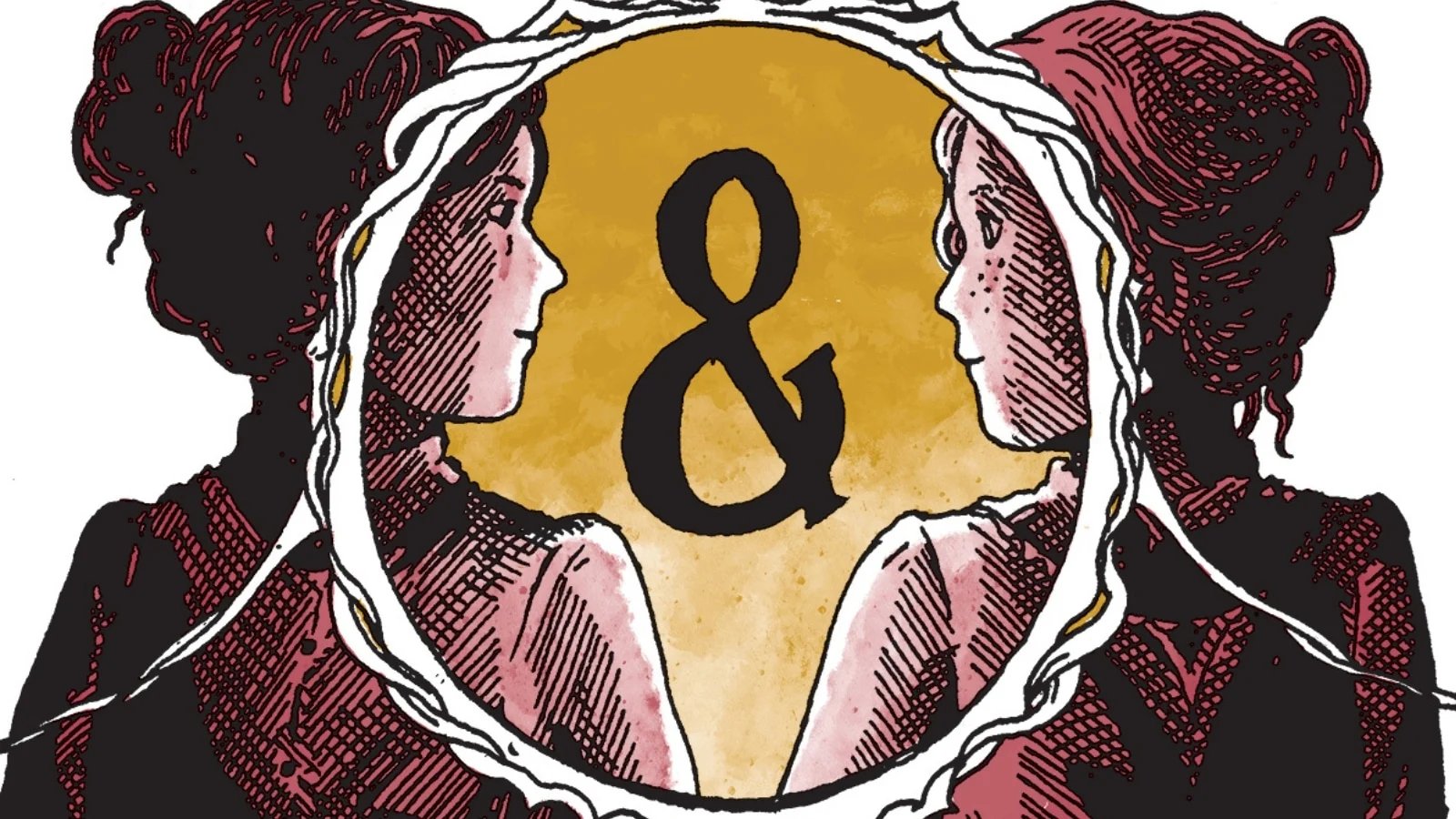
On June 15, Drawn & Quarterly published Vermont Cartoonist Laureate Tillie Walden’s adult graphic novel debut, Charity & Sylvia, chronicling the lives of Charity Bryant and Sylvia Drake, a lesbian couple who lived together as a married couple (minus legal documentation) and ran a tailoring business in Weybridge, Vermont in the 19th century.
On June 30, Professor Rachel Hope Cleves—who published a biography about Bryant and Drake, also titled Charity & Sylvia, through Oxford University Press in 2014—issued an open letter on social media calling out Walden and D&Q for failing to appropriately credit and compensate her for what she calls an adaptation of her work.
During a Zoom call with The Beat on Tuesday, Cleves said Walden first contacted her about the graphic novel in August 2024, and explained that she posted her open letter on Monday after hearing from a colleague that Walden had claimed in at least one interview to have pieced together Bryant and Drake’s story exclusively from her own research at the Henry Sheldon Museum of Vermont History, without mentioning Cleves’s biography.
This is in contrast to Walden’s acknowledgment of Cleves in the afterword of her graphic novel and does not align with the extensive bibliography and process website she created for the book, where she mentions Cleves by name upwards of 50 times.
Following the publication of Cleves’s open letter, a heated debate broke out on social media between academics, researchers, comics creators, editors, and publishers about how to appropriately cite historical research, especially when it comes from a secondary source. On Wednesday, Walden’s publisher, Drawn & Quarterly, released a statement that read, in part,
Drawn & Quarterly stands by Tillie Walden’s research for her graphic novel, Charity and Sylvia, and asks people to refer to her afterword where she explains how the book came to be, and cites Charity and Sylvia: A Same Sex Marriage in Early America (2014, Oxford University Press) as “the formidable, endlessly informative history on their lives by Rachel Hope Cleves” and explains how indebted she is to Cleves’s research.
As of press time for this piece on Thursday, July 2, Cleves has shared a public response to D&Q’s initial statement; D&Q has posted a second, longer statement to its social media channels; and the Henry Sheldon Museum has posted its own statement on its website.
Here is what has been said by each party.
Professor Rachel Hope Cleves responds to Drawn & Quarterly
On Wednesday, July 1, Cleves posted a statement on social media responding to D&Q. Here is that statement in full:
D&Q packaged and marketed Walden’s book as an independent work with no acknowledgment that it was an adaptation of my book. There is exactly one sentence in the notes at the back that acknowledges the existence of my book. Walden has repeatedly presented the work as based on her research, even going so far as to claim on CBC that she’s the only person who’s read all the letters, and saying in a video she made for the Henry Sheldon Museum that she worked exclusively from the diaries and letters. Readers of reviews, people who’ve listened to her CBC interview, and readers of the book have no way to know that she adapted my work. Many people who bought Walden’s book have commented exactly that on social media.
Additionally, D&Q took my title, and cover image. I’ve heard from readers that when they tried to buy my book, bookstore owners have pointed them towards Walden’s graphic novel. In the future when people search for “Charity and Sylvia” on the internet the algorithm will point them to Walden, who has a far bigger platform as a cartoonist than I will ever have as an academic.
In short, Walden and D&Q are profiting off eight years of my labor and pretending otherwise. It pains me to have to correct the record this way. Walden was initially given a grant to work exclusively from the papers at the Sheldon. Instead, as her website makes clear, she read my book twice closely and outlined and drafted, then went to look at documents to supplement the story I had written. My book is based on research at over 20 archives and historical sites. I am the author of the story. Walden took that story and illustrated it beautifully, but she and D&Q should have acknowledged the adaptation and they should compensate me.
The origins of the graphic novel project have also been examined. In February 2024, independent Vermont publication Seven Days reported that Walden would use the “more than 900 pages of letters, poems and journal entries” archived at the Henry Sheldon Museum as source material for her graphic novel, which she would research as part of a yearlong residency with Vermont Humanities. According to Seven Days, the book was commissioned with help from a National Endowment for the Humanities grant of $50,000. Vermont Humanities allocated $20,000 for the project, with Walden receiving a $15,000 stipend to complete her graphic novel and give talks around Vermont about queer representation in comics, with the remaining $5,000 going to the museum.
Seven Days further reported that Vermont Department of Humanities executive director Christopher Kaufman Ilstrup, who commissioned Walden, learned about Charity and Sylvia through Cleves’s book when he was the senior philanthropic adviser of the Vermont Community Foundation. Upon learning about the couple, he awarded a grant to the Henry Sheldon Museum to sponsor an exhibition of the Bryant-Drake archive and invited Cleves to give a lecture about the couple and their history at Middlebury College. When Walden was named Vermont Cartoonist Laureate in 2023, he told Seven Days, “it was like a bolt of lightning for me, frankly.”
“I would have been happy with a 32-page comic book that we’d printed ourselves down the street,” Ilstrup continued, but Walden “elevated our thinking. She’s envisioning a real book that’s going to be distributed nationally.”
“A Statement from the Henry Sheldon Museum of Vermont History”
In a statement posted on its website, the Henry Sheldon Museum describes its Bryant-Drake collection and how it has been used, including by Cleves and Walden for their research. Here is the statement in full:
In 1897, Asaph Drake Willard and his sister Lucy donated dozens of books to what is now the Henry Sheldon Museum, along with what museum founder Henry Sheldon recorded as “one old trunk containing letters to Charity Bryant including some from her nephew [William] C. Bryant and some silhouette pictures of the Drake family.” Over the ensuing decades, indefatigable catalogers, archivists, and researchers have fleshed out this account, bringing order to the “old trunk” and illuminating its actual contents and their significance. Subsequently, the Charity Bryant and Sylvia Drake Papers have become one of the museum’s most treasured collections. This repository of personal and household records, letters, poems, and diaries (primarily from the period 1797-1865) is now carefully inventoried in a finding aid that notes the archive’s potential to “provide insight into gender roles, health and sickness, education, marriage and death customs, religious and social commitments, sewing and tailoring, economics, the barter economy, and other aspects of rural women’s lives from the unique perspective of a same-sex couple.”
Indeed, generations of researchers have now consulted and benefitted from this collection. Charity and Sylvia’s example was invoked during debates about both civil union legislation (2000) and Vermont’s Marriage Equality Act (2009). Selections from the archives were featured in the 2014 exhibition “Charity and Sylvia: A Weybridge Couple” at the Henry Sheldon Museum, curated by archivist Eva Garcelon-Hart, while the double-portrait silhouette of the couple has been included in prominent exhibitions such as the National Portrait Gallery’s “Black Out: Silhouettes Then and Now” (with an accompanying catalogue, published by Princeton University Press, 2018) and The Getty Museum’s “Queer Lens: A History of Photography” (catalogue via Getty Publications, 2025). Today, the collection also serves as the core primary source material for a recently developed curriculum unit, “Charity and Sylvia: Identity, Community & Love” (2024).
One of the most renowned explorations of and expansions upon the collection is the work of historian Rachel Hope Cleves. In public and scholarly talks, articles, and the award-winning book Charity and Sylvia: A Same-Sex Marriage in Early America (Oxford University Press, 2014), Cleves argues for the depth of Bryant and Drake’s relationship and the central role the two women played in their home community of Weybridge. Cleves’s account draws not only on the Henry Sheldon Museum’s collection but also reflects her many years of deep historical research, which included the examination of additional archival repositories, interviews, site visits, and the scrutiny of period legal, medical, and theological texts, while also bringing a vast array of secondary scholarly sources and the rich literature of queer theory to bear upon her analysis. Cleves’s research has brought deserved national and scholarly attention to the story of Charity and Sylvia and has helped countless readers recognize the significance of both their lives and their surviving archives. The Henry Sheldon Museum is deeply appreciative of Cleves’s discernment, dedication, and the scholarly rigor with which she interpreted the story of Charity and Sylvia, convincingly arguing for their recognition as a married couple and surfacing many details of both their historical moment and their individual lives.
In 2023, award-winning, Vermont-based cartoonist Tillie Walden also began researching the lives of Charity and Sylvia, consulting historical scholarship (including Cleves’s book) and poring over the couple’s extensive archives at the Henry Sheldon Museum. This research inspired Walden’s latest graphic novel, Charity & Sylvia (Drawn & Quarterly, June 2026). In interviews, press releases, a detailed website on sources and process, and the book itself, Walden repeatedly cites Cleves’s work as a significant and generative source for her imaginative rendering of the stories of Charity and Sylvia. Far from claiming a narrative of “discovery,” Walden has generously and effusively praised Rachel Hope Cleves’s scholarship and has directed audiences (and her large fan base) to the 2014 book.
Walden’s book is an empathically imagined and sensitively rendered story of the world of Charity Bryant and Sylvia Drake, daring to evoke not only the textures of their daily lives, but also their hopes, dreams, fears, prayers, annoyances, exhaustions, and desires. As part of her creative process, in addition to consulting Cleves’s publication, Walden also immersed herself in the archives and primary sources of the early nineteenth century, attuning both her eyes and her ears to imaginatively explore early Weybridge: developing a sense of what turns of phrase the women or their neighbors might have used in order to script their dialogue, sketching the kinds of clothes they might wear or sew, the crockery that might populate their kitchen, the meals they might cook or pies they might bake, the lamps they might read by– and in turn, reading what they were reading. In a series of vignettes that acknowledge the gaps of the archival record and her own subjectivity, Walden invites readers to imaginatively inhabit the world of Charity and Sylvia with her words, illustrations, wit, humor, and historical empathy. Walden’s Charity & Sylvia is a richly illustrated work of historical fiction that is rooted in her own rigorous research process. It is a work of art.
As stewards of the Charity and Sylvia collection, the Henry Sheldon Museum believes that archives exist to be studied, interpreted, questioned, and reimagined. Community members, students, scholars, artists, and writers have long found inspiration in the letters, journals, and material traces preserved in our care. This openness is one of the great strengths of archives. They allow successive generations to encounter the past on their own terms and with their own forms of inquiry and expression, and to build on the work done by others before them. The Henry Sheldon Museum also recognizes and reiterates the importance of citational practices, crediting the contributions and labor of interpreters, collaborators, and predecessors, across disciplinary fields and methodologies, as both Cleves and Walden have done.
We are grateful for the conversations sparked by both Professor Cleves’s scholarship and Tillie Walden’s creative work. Together, they demonstrate the enduring power of Charity and Sylvia’s stories to inspire artistic expression and to strengthen the visibility of queer history in a time of increasing threats of erasure– and in a historical moment in which the arts and humanities more broadly also face funding cuts, threats of censorship, and piracy by Large Language Models and “generative” AI.
We welcome and encourage all who are able to come to Middlebury, Vermont and visit the Henry Sheldon Museum to see the new exhibition “Drawing on the Archive: Tillie Walden’s Charity & Sylvia” and to support the arts, humanities, museums, libraries, and independent bookstores in their home communities.
Drawn & Quarterly releases a second statement
On Thursday, Drawn & Quarterly posted a nine-slide statement to its social media with the caption, “In defense of Tillie and Comics.” Here is that statement in full:
Shortly after sending our official comments to inquiring press, citing the many times Rachel Hope Cleves had been credited in Tillie Walden’s Charity and Sylvia—as well as online, on air, and in print—the accusations changed from no credit to charges of the Drawn and Quarterly book being an unauthorized adaptation.
We would like to put forth a couple of points in defence of Tillie Walden, cartoonists, and comics scholarship in regard to the online mob that has formed this week on Bluesky who are currently sending us threatening emails, demanding that people destroy Tillie’s career, negative review bombing at various sites, telling stores and librarians not to carry the graphic novel, and more.
1. Tillie did not “illustrate” Cleves’s 2014 book, Charity and Sylvia: A Same-Sex Marriage in Early America
2. Comics are not a “derivative” form
3. Nonfiction graphic novels are not “illustrated adaptations” of source materials
4. Cartoonists do research of a scholarly nature
5. Nonfiction cartoonists are protected by the same copyright provisions as academics and nonfiction writers, provisions that account for facts and the expression of facts
6. Tillie was in touch with Cleves in April 2025 as she sent her a manuscript a year before publication stating the Museum had already made edits, to which Cleves replied with a single edit/comment as well as words of praise: “I’m already blown away by the historicity of it, and by the fullness of the characterization, and by the art, of course.”
7. Please see the Henry Sheldon Museum of Vermont History statement on Tillie’s book and research on their website
When Walden speaks of piecing together fragments, she is referring to the researching and piecing together to create a visual world for their lives and time period, as the only known image of Charity Bryant and Sylvia Drake is their silhouette portrait, which served as the inspiration for the cover designs of both Walden and Connie Gabbert, who is credited by Oxford University Press as the designer of Cleves’s book cover. This image was found among the donated papers at the Henry Sheldon Museum of Vermont History who are the official stewards of the “Charity Bryant and Sylvia Drake papers, 1797-1890” and with whom Tillie worked.
Tillie’s book is told in the language of comics, which, as cartoonists and readers know, is a form markedly different from non-fiction prose. There is no way the two books can be mistaken for the other. Rachel Hope Cleves’s book is the foremost researched and laboured book on the lives of Charity Bryant and Sylvia Drake, as Tillie has stated multiple times. Because the visual medium of comics always requires creative license of the artist, nonfiction graphic novels are rarely considered the academic book of record like the work of Cleves will justifiably be. Tillie has created a meaningful, beautifully drawn treatise of love and synthesis of her own research and the archives, where the power of comics uses carefully drafted dialogue and extended silent sequences to viscerally show the claustrophobia and beauty of life in a rural community in 1800s Vermont.
We are asking for the recognition of the labour of a cartoonist. Tillie’s “platform” is due to more than a decade of work doing a physical art form, creating more than fifteen books and being quite successful at it. Anyone in comics will tell you how remarkable this output is.
Maybe Tillie is preternaturally productive, or maybe as a thirty-year-old who has been drawing and writing professionally since she was a teenager, it is out of necessity. Tillie is a contract-to-contract worker in central Vermont who pays out of pocket every month for her family’s healthcare and survives with no benefits or job security. She and her wife live in Trump’s America, which is currently rolling back protections for the LGBTQ+ community as well as for artists, specifically federal funding for artists via the NEA and via federal support for fine arts masters programs, such as the Center for Cartoon Studies where Tillie studied and where she teaches on a contract basis.
As an Ivy league, UC Berkeley graduate, and UVic professor who has dedicated her academic career to gender, sexuality, and history, Cleves understands copyright for scholarly and nonfiction works. And we would have to think Cleves understands that scholarly work serves to inspire as well as inform. We trust that Cleves, as a tenured professor in Victoria, British Columbia and thus a fellow Canadian, understands the stark reality and danger of being queer and being an artist in America right now, of being a queer couple and parents, and the general day-to-day economic and societal differences between the two countries for every American.
Drawn and Quarterly’s “marketing” is the work of one person, who works 40 to 60 hours a week deeply believing that our cartoonists deserve sustained, sincere promotion in mainstream media. She is good at her job, and this book has been in the New York Times, Boston Globe, and CBC Q, all of which cited the importance of Cleves’s 2014 book, with the New York Times interviewing and quoting Cleves.
It seems that very few people making accusations, if any, have read Tillie’s Charity and Sylvia from beginning to end to understand what Tillie has created. We suggest that if you care, read Tillie’s Charity and Sylvia, and also read Cleves’s Charity and Sylvia: A Same-Sex Marriage in Early America. And if you’re in Middlebury, Vermont, visit the home of the Charity and Sylvia collection, the Henry Sheldon Museum, and the “Drawing on the Archive: Tillie Walden’s Charity & Sylvia” exhibit. If you’re a teacher, use the museum’s “Charity and Sylvia: Identity, Community, and Love” curriculum.
We will close this by stating while pitchforks and hay bales are appropriate imagery for the time period in which Charity Bryant and Sylvia Drake lived, we are asking for people to put down their pitchforks and consider the remarkable lives of Charity Bryant and Sylvia Drake and their story, which is their own that they created together as pioneering historical women, and to enjoy the remarkable separate and distinct contributions by two contemporary pioneering women, Rachel Hope Cleves and Tillie Walden.
May the lives of Charity Bryant and Sylvia Drake continue to be told and shared in a myriad of ways.
Walden has not responded to emails from The Beat requesting comment.
