


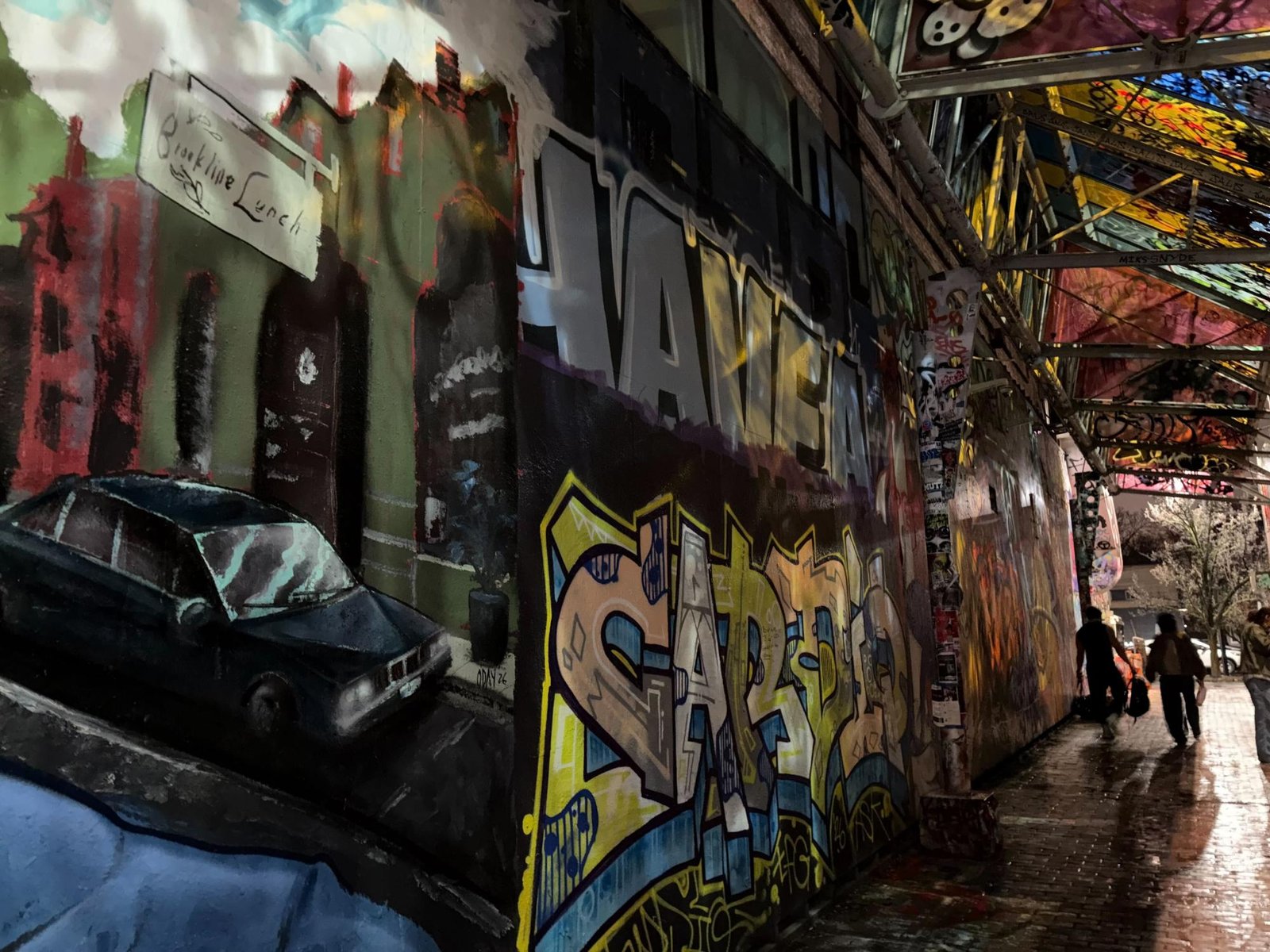
When thinking about Boston, people think about the brownstones, historical buildings, and the robust academic scene. But what is discovered upon arrival is that the city is also home to an abstract culture as well, featuring murals that stretch the length of buildings and graffiti covering the sides of freeways, transforming public spaces into open-air galleries for the community to enjoy.
Street art impacts Boston culturally and visually, with neighborhoods such as the South End and Lynn featuring large murals, and Graffiti Alley in Cambridge offering a legal space for graffiti to those looking to pick up a new hobby and established artists alike. But what about the rest of the artists in the area? Those who are unable to express themselves outside of this one location and the bounds of laws regulating public art? Whose voices are elevated through creativity in the streets of Boston?
The public art scene in Boston differs from that of other major cities in the United States and around the world. Graffiti can be a rare sight in the inner city, and due to the number of historic buildings, there are fewer locations for murals. Regardless, there are many artists in the area, and those who look closely will find a multitude of murals to admire.
“Street art and public art show the personality of the city; it’s ultimately the people that live in the city, and give to the city, that are inspired by what happens. And a lot of the art here reflects that,” said David Olsen, a professor of new media art at Wellesley College.
Olsen’s path towards public art consisted of trying to incorporate as much of his personality within his art that he was able to within the constraints of getting paid. He started in high school by painting friends’ cars, then moved on to painting murals with friends in college, taking on small commissions.
He never got into graffiti like his friends did. Instead, Olsen learned from them while focusing on legal work. The one time he tried to paint something illegally, he was arrested.
“I learned very quickly that wasn’t for me,” he joked.
For decades, Olsen has painted murals, but it was only around 10 years ago — at age 40 — that he began receiving a livable wage for his work. Before that, he often lost money on projects, continuing as a way to break into the art scene.
Without a professional commission, graffiti is classified as vandalism or defacement of property, resulting in fines up to $1,500 — or three times the damage value — and up to three years in prison.
As Olsen has experienced in his own life, there are only so many legal opportunities to create art in public spaces.
“Graffiti has always been an opportunity for people without the means to go about expressing themselves,” said Olsen. “If it were up to me, I would say any public space should be open for people to express themselves.”
(Evanthia Chapman / Beacon Staff)
Because Boston has never been a street art hotspot, the Mayor’s Office of Arts and Culture hopes to grow more of their programs to spread public art throughout neighborhoods.
In the past, the city had the mayor’s mural crew, which trained muralists and created art around the city. The Mayor’s Office of Arts and Culture at Boston City Hall hopes to grow their new, similar program called A Canvas of Culture. This initiative focuses on long-term mural installations at Boston Public Schools.
Outside of Boston’s city hall initiatives, there are also numerous nonprofit organizations that support street artists and local culture. Boston Public Art Triennial, Now + There, and Boston Art and Music Soul Fest are among the organizations working to connect artists with their communities by creating opportunities for artists and raising awareness for creative spaces.
The ‘80s and ‘90s gave rise to big names in the community including ProBlak, Click, Maze, Hang, Ryze, and Alert. There are also artist collectives in the city such as Street Theory, a BIPOC-organized collaborative for street artists that has been operating for over two decades.
“There’s a really active community of muralists in Boston, and I think the more experienced artists are able to support each other, and the emerging artists are able to work on their crews and develop,” said Birgit Wurster, Boston’s Interim Director of Public Art.
Caleb Neelon is a graffiti artist and the co-author of the book “The History of American Graffiti,” which dives deep into the country’s biggest street artists, some of whom were Boston-based. He became interested in graffiti as a teenager growing up in Boston in the early ‘90s, but said the ‘90s was not a great time for graffiti in Boston, with stricter policing arising in the city.
“It’s not a very friendly culture. It’s never been a very friendly city to public art in general, and I think there is that sort of forged-in-the-flames aspect to a lot of the art that happened here and a lot of the graffiti that happened here,” Neelon said.
Travelling to cities around the world allowed him to connect with other artists and experience the local culture in each location. Working in places like Brazil and Nepal, he has seen the way street art shapes different locations and communities.
“It’s really what gives a place its sense of self,” he said. “Those are the people that give a city the sense of ‘you can only get that here.’”
(Evanthia Chapman / Beacon Staff)
There are very few locations in Boston that allow “legal graffiti,” — a term that remains oxymoronic. One of these locations is the aforementioned Graffiti Alley in Cambridge, where artists have 24/7 access to two 80-foot-long walls. The ephemeral nature of this space is part of its appeal; murals are constantly painted over, reworked, and transformed, making each visit a completely different visual experience. What exists one day may be gone the next, replaced by new voices, styles, and statements layered over the old.
“It is a sketchbook that belongs to the neighborhood, to the city,” said Boston-native artist Luke Barosky.
Barosky relocated from Boston to Austin, Texas in October 2024, and has spent most of his time there since, citing its stronger sense of overall integration and diversity, but also its greater scope for public art jobs that he can pick up. He believes Boston’s substantial funding should be intentionally directed more toward historically neglected neighborhoods — particularly nonwhite neighborhoods — and he believes that he is not the person to take those projects.
“It’s tough for me to write a proposal and be like ‘how am I going to connect to this neighborhood?’ when there are other artists that are great and are of that descent,” said Barosky. “It would almost be like I’m taking away from them for their own neighborhood.”
(Evanthia Chapman / Beacon Staff)
Neighborhoods like Roslindale, East Boston, and West Roxbury are home to murals that honor community, history, and education. Examples include pieces such as the 2024 mural “Together, We Rise” by Thomas “Detour” Evans at the Joyce Kilmer K-8 School. Inspired by conversations with students at the school, the mural features a vibrant image of children gazing off in the distance with the words “respect, responsibility, empathy, inclusion, equity.” The 2017 piece “To Immigrants with Love: Roslindale” by Heidi Schork, located on the side of Atlas Wines and Liquors in the Roslindale neighborhood, features portraits of three immigrants of different descents, with the phrase “You will always be welcome in the city of Boston” written in Spanish and Yiddish.
“To Immigrants with Love” is a project launched around 2017, founded by the Mayor’s Mural Crew and the Mayor’s Office for Immigrant Advancement. The intention behind it was to celebrate immigrants in Boston and share their stories through public art in each neighborhood.
“I think that public art and messaging placekeeping through murals in general is just a very powerful and profound way that artists can quickly implement placekeeping in certain neighborhoods for support,” said Wurster.
Public art is something that Wurster finds to be extremely important. She said that it is a way to improve not just the city’s overall look, but also impact the means for a healthy community.
“There’s a lot of research and statistics about how it informs and improves public safety, how it can improve and develop workforce and skills development for artists,” she said. “It’s also a very direct way to uplift stories that haven’t always been shared and histories, and have this visual storytelling community.”
