


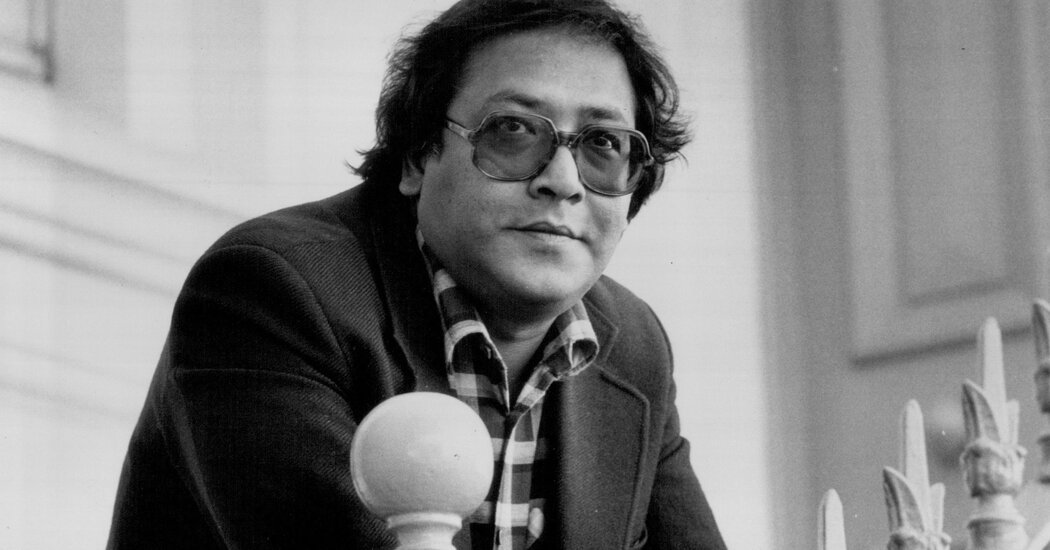
It wasn’t easy for Shiva, of course, who grew up with an “intimidating burden of expectation” and, early on, knew his brother only as a distant, shadowy abstraction. And yet when Shiva embarked on his own writing career, it turned out to be freeing. “I was doing anything but following in my brother’s footsteps when I started to write,” he explains in his essay “My Brother and I.” “Rather, I had taken the first step on the road to independence, to the autonomy that had always been denied me.”
“In the end,” he continues, “it is the work that matters, not the relationship.”
This month, a new imprint of Doubleday will reissue Shiva’s nonfiction book JOURNEY TO NOWHERE: A New World Tragedy (Outsider Editions, 406 pp., paperback, $22), which was originally published as “Black & White” in Britain in 1980. The “tragedy” in the subtitle refers to the deaths of more than 900 followers of Jim Jones’s People’s Temple in Jonestown, Guyana, on Nov. 18, 1978. Yet Shiva’s book is also about the deeper maladies of the time, both in America and in the emerging postcolonial societies then referred to as the Third World.
A fledgling novelist and intrepid reporter, Shiva, 33, sets out just two weeks after the Jonestown massacre, intent on delving deeper into the story. What does he encounter on arriving in the South American country? For starters, a media feeding frenzy, with writers and journalists congregating at the Pegasus Hotel in Georgetown, Guyana’s capital. As one reporter gushes about the case: “Sex. Race. Suicide. Murder. Corruption. A hot Third World country. That’s a classic mix. Pure Graham Greene.” (Greene himself apparently enjoyed Shiva’s book, praising its sometimes “amusing” critique of American life.)
But Shiva isn’t out to sensationalize or rehash preconceived notions. He is a curious, skeptical guide — never quite as caustic or dismissive as his brother — who goes to great lengths to form a more complete picture of the People’s Temple and its adherents. The book is full of testimonies of surviving witnesses as well as references to documents and reports that grew out of the events. Jim Jones himself emerges as a mercurial figure, an iconoclastic faith healer from Indiana who stressed the ideals of racial justice and socialism. “His had been a patchwork of messianism,” Shiva writes, “thrown together from the odds and ends of a dozen disparate therapies of mind, body and soul.”
In the mid-1960s, Jones moved his congregation from Indianapolis to San Francisco, where they established an affinity with the Black Panther Party and other radical groups. But by the ’70s, as political winds shifted, Jones was feeling more and more isolated and under attack in the United States. In Guyana, he saw the opportunity to build a utopian, agricultural community far from prying eyes (and meddling relatives) as the guest of the country’s triumphant “Cooperative Socialist Republic.”
