


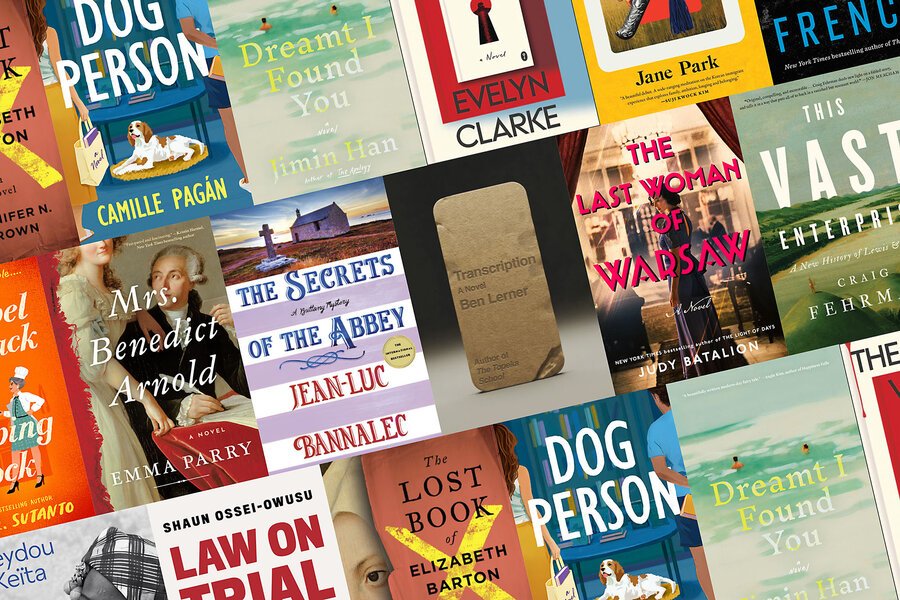
These are the fiction titles our reviewers liked best this month.
Inheritance, by Jane Park
In Jane Park’s poignant debut novel, Anne Kim, a successful Korean Canadian lawyer in New York, returns home to the Alberta prairie following the death of her father. Memories, frustrations, and surprises await. In flashbacks to the 1980s and ’90s, Anne’s childhood struggles and sacrifices become clear – from living in the shadow of her spoiled older brother to navigating school as one of the lone Asian students. It’s an affecting story of honor, tradition, and expectations sometimes buoying – but nearly burying – one immigrant family. – Erin Douglass
Why We Wrote This
April’s top nonfiction titles include a revelatory take on Lewis and Clark’s Corps of Discovery expedition and a memoir with deep roots in West Virginia’s Allegheny Mountains. Fiction favorites cover the latest from Tana French and Ben Lerner, plus a canine charmer and a transformed “trophy wife.”
Transcription, by Ben Lerner
When a magazine writer inadvertently destroys his smartphone on his way to interview his former mentor, he’s left with nothing to record their vital conversation. In this succinct 144-page novel, Ben Lerner explores the impact that our ubiquitous devices have on our ability to connect with one another. Are they a barrier or do they help bridge our shortcomings? Do they shape our memories or demand authenticity? – Joan Gaylord
The Keeper, by Tana French
Tana French has described her Ardnakelty trilogy as “mystery software running on western hardware.” That’s a perfect description of “The Keeper,” the final outing starring retired Chicago police officer Cal Hooper, his wary fiancée Lena Dunne, and their adopted teen Trey Reddy. Cal moved to the Irish village looking for peace. Instead, he discovered a peat bog’s worth of secrets – dark, dank, and potentially deadly. A young woman is found dead in a river. Was it suicide? French, one of the greatest mystery writing talents, ratchets up both the menace and the stakes as Cal and Lena break Ardnakelty’s prime directive: Talk plenty … but say nothing. – Yvonne Zipp
The Lost Book of Elizabeth Barton, by Jennifer N. Brown
A page-turner interweaving historical and detective fiction, “The Lost Book of Elizabeth Barton” toggles between the Reformation, when Elizabeth lived, and the present day when scholars are hot on her trail. Through Elizabeth’s rise from servant to visionary who resisted Henry VIII’s break with the Roman Catholic Church to gain a divorce, Brown explores historical women’s stratagems for self-determination. These themes are mirrored by the brilliant but hapless professor Alison Sage, and scholars around her, who may be more interested in uncovering material – rather than intellectual – treasures. – Elizabeth Toohey
Ms. Mebel Goes Back to the Chopping Block, by Jesse Q. Sutanto
Self-described trophy wife Mebel lives the high life in Jakarta – that is, until her longtime husband decamps into the waiting arms and apron strings of their 20-something chef. Miserable Mebel, determined to win him back, enrolls ASAP in a fancy European cooking school. The only problem: The Paris program is full, so Mebel gets shunted to the satellite campus in an English backwater. Bestselling author Jesse Q. Sutanto serves up a snappy fish-out-of-bouillabaisse tale that will leave readers grinning. – Erin Douglass
Dreamt I Found You, by Jimin Han
Cousins Dahee and Channing – Korean American young women born hours apart – are lifelong besties, but near opposites. Cautious Dahee works as a teacher in New York; impulsive Channing has a summer babysitting gig in her coastal New England hometown. After Channing complains about a creepy local politician, Dahee decides to visit with their beloved grandfather, Harabeoji. Mirroring a famous Korean love story, Jimin Han’s immersive, winning story grapples with community loyalty, courage, and devotion. – Erin Douglass
Mrs. Benedict Arnold, by Emma Parry
Emma Parry’s fresh rendition of the country’s most notorious act of treason involves patriot Gen. Benedict Arnold and his loyalist wife, Peggy Shippen. Told in Peggy’s enthusiastic voice, the novel details family life, friendships, politics, parties, and war. Come for the banter, stay for the intrigue, and enjoy this fascinating tale of the American Revolution. – Stefanie Milligan
The Ending Writes Itself, by Evelyn Clarke
If a reclusive author invites you to his private island, send regrets. In “The Ending Writes Itself,” Evelyn Clarke, the pseudonym for authors V.E. Schwab and Cat Clarke, strands a half-dozen writers on a Scottish island. Their task: Finish bestselling author Arthur Fletch’s final mystery and score a $1 million publishing contract. They are firmly midlist writers, or, as the horror author puts it, “disposable.” How disposable becomes apparent over the weekend. The novel is a darkly comic satire of the publishing industry and an elegy for formerly idealistic storytellers who are “unable to break out, only to break even.” – Yvonne Zipp
The Last Woman of Warsaw, by Judy Batalion
In 1930s Warsaw, two young Jewish women from different backgrounds must work together to solve a disappearance. Fanny, daughter of an elite family, dreams of life as a photographer. After Zosia escapes violence in her village, she works with a youth movement protesting for social equity. When a Jewish professor vanishes, Fanny and Zosia defy danger to search for her. – Stefanie Milligan
Dog Person, by Camille Pagán
Floundering Michigan bookstore owner Miguel is stuck, grieving the death of the love of his life, novelist Amelia May, and worrying about the potential closure of their beloved bookstore. Harold, their devoted mutt, doggedly narrates his mission: help Miguel heal and fetch him a second love. Camille Pagán’s novel uplifts with enormous canine charm, a twisty plot, and an endearing cast. – Stefanie Milligan
These are the nonfiction titles our reviewers liked best this month.
Small Town Girls, by Jayne Anne Phillips
Jayne Anne Phillips’ memoir in 22 linked essays makes clear how her family’s deep roots in the Allegheny Mountains in West Virginia shaped her as a writer. Phillips left her hometown after college, but its stories and local history have continued to fuel her fiction, including her powerful Pulitzer Prize-winning novel, “Night Watch,” set in the aftermath of the Civil War. (Her town sided with the Union.) “Small Town Girls” encompasses a detailed recap of the infamous Hatfield-McCoy feud, and a lament for the environmental devastation wrought by mining and fracking. Phillips’ tributes to her hardworking mother – a grade school teacher who made sure all her students were fed and warmly clothed – and to West Virginia writers Stephen Crane and Breece D’J Pancake are particularly moving. – Heller McAlpin
This Vast Enterprise, by Craig Fehrman
Historian Craig Fehrman offers a revelatory take on Lewis and Clark’s Corps of Discovery expedition. The chapters alternate among characters, presenting the arduous journey from different perspectives. In addition to Meriwether Lewis and William Clark, Fehrman highlights Sacajawea, the Native American teenager who joined the corps as interpreter and guide, and York, the Black man enslaved by Clark who was compelled to join the trek. The deeply researched account also foregrounds lesser-known figures, including soldier John Ordway and Lakota leader Black Buffalo. – Barbara Spindel
Law on Trial, by Shaun Ossei-Owusu
The words “Equal Justice Under Law” are engraved on the front of the United States Supreme Court. But according to law professor Shaun Ossei-Owusu, the legal system is far more likely to deliver inequality and unfairness than justice, especially among the nation’s most vulnerable populations. He argues that at every level – from law school to the highest court in the land – the legal system favors the rich and powerful. Aimed at average readers as well as lawyers, the book is evenhanded, eye-opening, and authoritative. – Terry W. Hartle
Seydou Keïta: A Tactile Lens, exhibition catalog edited by Catherine E. McKinley
The master portraitist of Mali, Seydou Keïta, gained Western fame for his midcentury photographs – on a par with Richard Avedon – in the 1990s. His images of Africans as they wished to be seen, referencing their own personalities and tastes, reflect both his clients’ aspirations toward a modern, urban identity and their reverence for African traditions. This extensive catalog shows, through the eyes of a premier portrait photographer, a society in transition. (See full review here.) – Carol Strickland
