


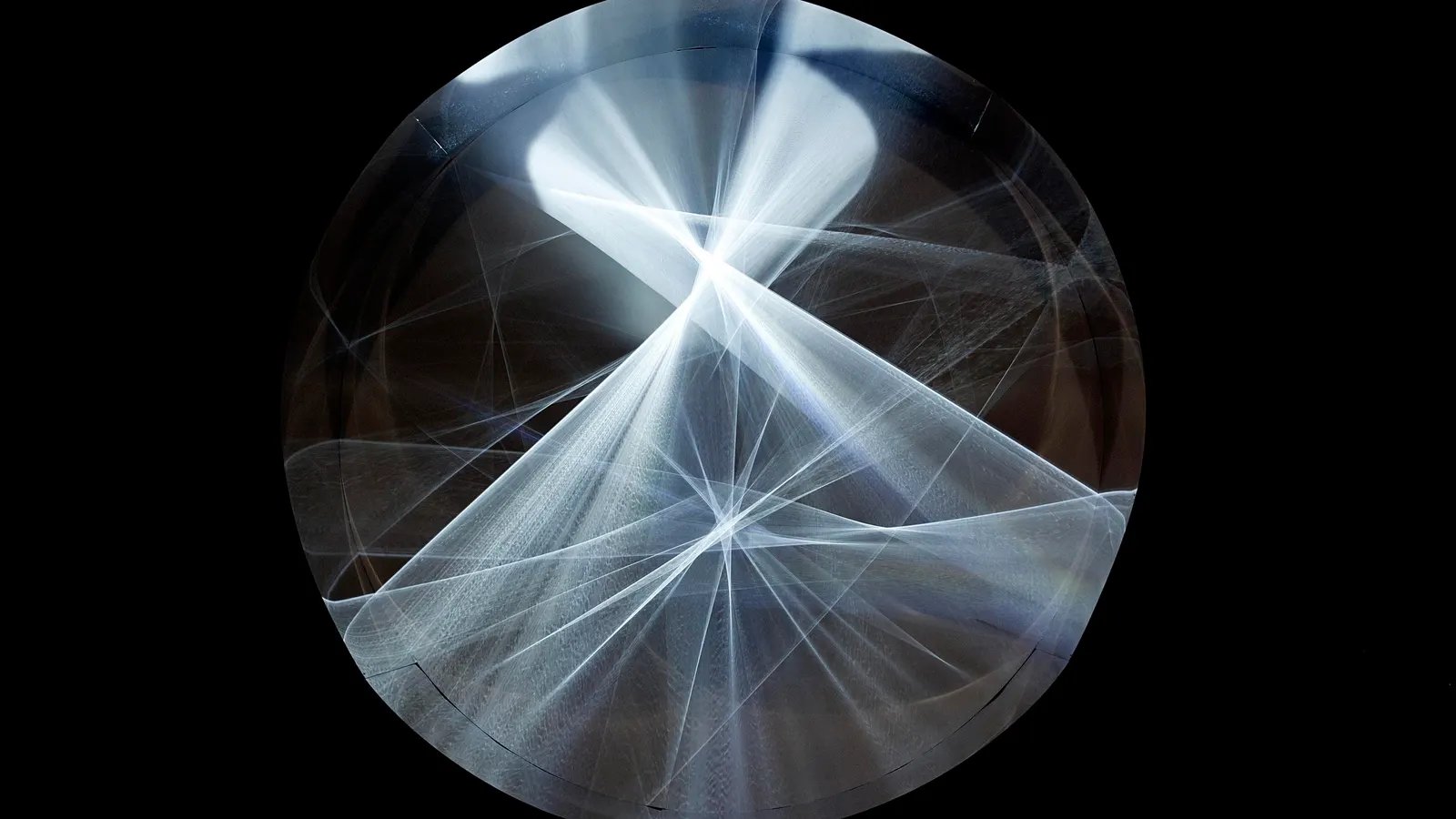
Julio Le Parc, Unique Continual Light Cylinder, 1962-2012
Photo Everton Ballardin. Courtesy of Galeria Nara Roesler, 2013. ADAGP, Paris and DACS, London, 2025
With the passing of Julio Le Parc on May 30 in Paris—on the eve of a major retrospective entitled “Julio Le Parc. Light. Color. Action” featuring his striking interactive installations, shimmering light sculptures and large-scale geometric paintings at the Tate Modern in London, running from June 11, 2026 to May 3, 2027—I look back on the life of the Argentinean artist, a pioneer of Op Art and Kinetic Art, who used color, light, space and movement as primary materials. “Through my works, I have always sought to get spectators to behave differently,” he stated. “I wanted to find ways to fight passivity, dependency and ideological conditioning by helping viewers develop their ability to think, compare, analyze, create and act.”
Le Parc’s limited-edition table centerpiece collection for French porcelain manufacturer Bernardaud is a good example. Covered with a band of color and textured lines that gradually progress in steps, Déplacement sur Plateau (Displacement on a Plateau) recalls his “Displacement” series sculptures with reflective blades that fragment and multiply the image to offer bewildering optic effects as a viewer walks around them. Then there’s his signature “Continual Light Cylinder”, of which he has been making variations since 1962. Visitors have the impression of directly stepping inside the mesmerizing and contemplative construction of wood, superimposed rotating metal discs, lamps, Plexiglas mirrors and motors, which diffuse fractioned light rays in a circle within a pitch-black space.
Julio Le Parc, Series 14 – 14 Permuted, 1970-2020
Photo courtesy of ADAGP, Paris and DACS, London, 2025
At the heart of Le Parc’s immersive, interactive and multi-sensory works was the viewer experience in contrast to art for a passive audience maintained at arm’s length and obliged to accept an artist’s propositions. “My early discussions with artists such as Francisco Sobrino and François Morellet led us to question why the public remained largely passive in the exhibition experience,” he said. “We wanted to test the idea that audiences were incapable of understanding contemporary art. By focusing on the viewer’s visual and optical experience, we gradually encouraged more active participation and discovered that people were perfectly capable of engaging with, appreciating or rejecting new artistic propositions. They looked, reflected and formed their own opinions.”
With increasing interest in the active involvement of the spectator and a goal of making art more accessible, he always injected the notion of playfulness and visual instability into his pieces. Take for instance his labyrinthine installations featuring black-and-white striped floors, ceilings and walls with mirrored structures that disorient viewers and challenge their spatial perception, or his “Alchemy” paintings, where multicolored dots of pigment fan out across black or white backgrounds. “Optimismo siempre” (Optimism, forever), he always uttered and wrote. The man himself was filled with childlike energy and a cheeky sense of humor, creating daily in his light-filled atelier in Cachan, a Parisian suburb.
Julio Le Parc with Reflective Blades
Photo courtesy of Atelier Le Parc, 2026, ADAGP, Paris and DACS, London
There, a historical room showcasing 1960’s works resembles an arcade, encouraging all to have fun. Noisy machines whir, vibrate and rotate, mixing light and shadow, sound, movement and optical illusions. A slatted box hiding a mechanism casts light into horizontal lines on the wall, while projected light bouncing off hanging mirrored discs creates countless disco ball reflections. Le Parc’s own smiling face projected on the wall jumps in and out of focus in “Vibrating Image, Self-Portrait”. The motorized “Ensemble of Surprise Movements” establishes a connection with audiences, who push different buttons to activate spinning wheels, bouncing strips and shaking beads made of different materials, each moving part also creating a sound.
Born in 1928 in Mendoza before moving to Buenos Aires at the age of 14, Le Parc was the son of a steam train driver. Attending the city’s School of Fine Arts, with Lucio Fontana as one of his teachers, he engaged with the avant-garde ideas of Neo-Concretism popular in South America, whose practitioners saw geometric abstraction as a political statement in opposition to the harsh reality of the military regimes of the period. Leaving for Paris in 1958 on a French government scholarship because it was “the center of the contemporary art world”, he met Op artist Victor Vasarely and began intimate painting studies in form, color and movement with abstract compositions of geometric shapes that seemed to dance across the surface. He used pre-determined systems and repetition to create infinite combinations, and limited his palette to 14 colors that summed up the full spectrum of all possible variations of chromatic mixtures, as well as black, white and gray. In 1960, he cofounded the Groupe de Recherche d’Art Visuel (GRAV) with fellow artists like Morellet, Sobrino and Yvaral, and made his first reliefs and “Continual Mobiles”, taking his research into three dimensions and introducing movement and light. His light works—projected, reflected or pulsating—developed from his painting practice, as he was looking for new ways to show the constantly shifting character of depth and perception.
Julio Le Parc, Blue Sphere, 2013
Photo courtesy of Museum of Art Pudong. ADAGP, Paris and DACS, London, 2025
Although Le Parc may be known as a forerunner of Kinetic Art and Op Art, he detested this simple classification. “The trouble with labels like these is that they become so broad they can mean almost anything,” he explained. “I am sometimes grouped with artists whose work may resemble mine on the surface but who approach their practice very differently. Some have built a recognizable style largely to gain visibility or commercial success, becoming deeply embedded within the system. It is certainly easier for the market, museums and the wider art world when an artist can be identified with a single, consistent esthetic. My own practice, however, has always been driven by a spirit of research and exploration that has evolved over time, rather than by a desire to spend four or five decades repeating variations of the same idea.”
Having been involved in the denunciation of totalitarian governments in Latin America since the 1940s, Le Parc didn’t consider himself a political activist either. “I see it as part of being a citizen—we can all contribute,” he insisted. “If viewers leave my exhibitions feeling even slightly more optimistic, that is enough. Art that exposes suffering and injustice has its place, but it can also foster resignation. I believe optimism can be more constructive, helping people confront their challenges and perhaps inspiring a small sense of resistance or change.”
View of Julio Le Parc’s solo exhibition “Light – Mirror” at Perrotin Hong Kong, 2019
Photo Ringo Cheung. Courtesy of Julio Le Parc, ADAGP, Paris, SACK, Seoul, Perrotin
Less focused on commercial success, all Le Parc had ever been concerned about was keeping a little freedom for himself to make the art he desired, whether it was a work on paper, painting on canvas, sculpture or even a virtual reality piece. Working with an artist-as-researcher approach, he was happy as long as he could continually experiment in the creation of total environments using form, space, light and movement as his materials of predilection. His advice for up-and-coming artists? He replied, “I have no advice to offer because everyone must find their own path. But if young artists reflect on their circumstances and the contradictions of contemporary art, then through hard work, freedom and time, they can uncover and express what is inside of themselves.”
