


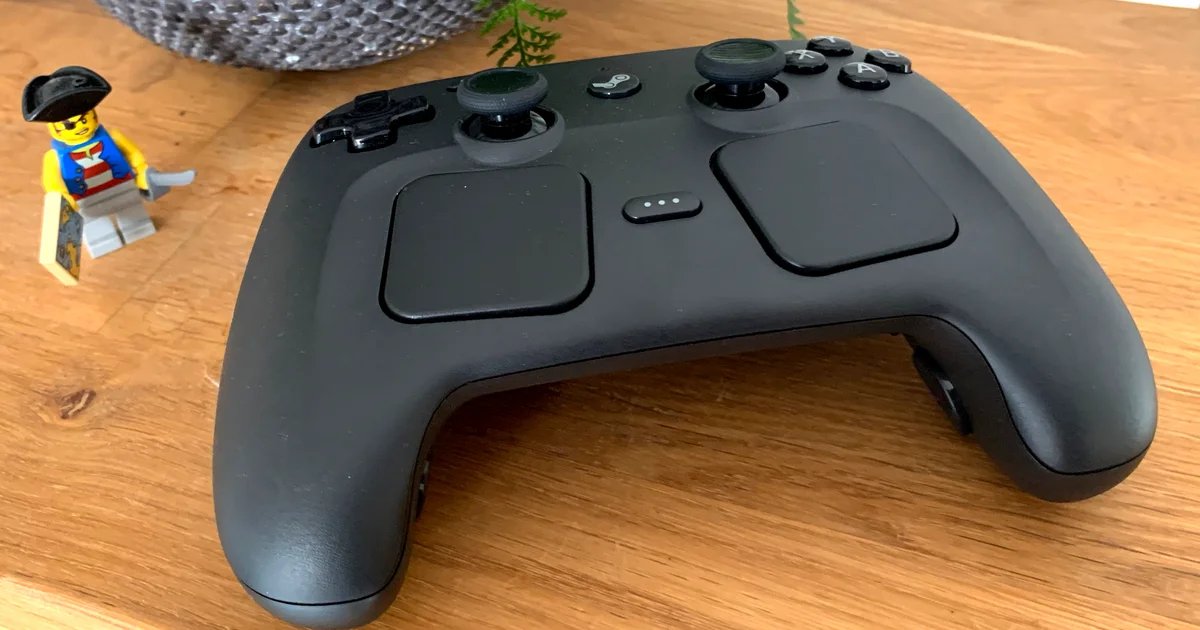
Perhaps the greatest compliment I can give Valve’s new Steam Controller is that in the week or so I’ve been using it, I haven’t really thought about it much at all. With its heavily Steam-Deck-inspired design, it improves on the original Steam Controller in almost every way – and it’s certainly vastly more convincing as an everyday controller – but the things it does best are specific enough that, even with those upgrades, it remains a bit of a niche proposition.
Steam Controller (2026) review
- Manufacturer: Valve
- Platform: Works with PC, Mac, Steam Deck
- Availability: Out 4th May
- Price: £85/€99/$99 USD.
Just like the original Steam Controller, released in 2015 and discontinued four years later, Valve’s latest iteration caters to a very specific kind of user. And that user is, essentially, me; someone who uses their PC like a console, shoving it under the TV and playing from the horizontally reclined comfort of my sofa. The original Steam Controller was designed to complement Valve’s ill-fated Steam Machine concept; wherein the company would partner with third parties to create Steam-powered console-like PCs for the living room, and thus required a device that could accommodate the many, many mouse-driven experiences on Steam at the time, as well as controller games.
Valve’s Steam Machines project was short-lived, of course, leaving the orphaned Steam Controller to justify its existence on its own. And it’s testament to Valve’s vision that while the controller, with its single thumb stick, ultimately proved pretty rubbish for anything demanding proper twin-stick controller support, it remains an essential part of my home PC set-up to this day. It still strikes me as something of a miracle I can comfortably play the likes of Crusader Kings and Planet Zoo with my feet up and zero need for a mouse and keyboard. For all its faults, I genuinely love it. With manufacturing now discontinued, I’ve dreaded the day it might finally die, so last year’s announcement the Steam Controller was making a comeback had me thrilled.
Image credit: Eurogamer
Six months on, the Steam Controller finally goes on sale on 4th May, and it’s a funny sort of moment really, like a little bit of history repeating. Just like its predecessor, Valve announced its new Steam Controller alongside another stab at creating a Steam Machine, albeit this time – buoyed along by the success of Steam Deck – to be designed and shipped in-house. But once again (thanks to the AI-driven SSD and RAM crisis) the new Steam Controller finds itself alone in the wild, very much orphaned from the delayed machine it’s intended to complement.
The first bit of good news, then, is it’s a far better everyday controller than its predecessor, addressing almost every complaint hurled at Valve’s original attempt. It’s rechargeable for one, coming bundled with a small “puck” that serves as both a wireless receiver (bluetooth and USB connections are also supported) and charging station. You plug the USB 3.x end of the included 1.6m cable into your PC, the USB-C end into the puck, and away you go. The immediate advantage is the wire helps reduce potential interference caused by your PC chassis; an issue I’ve run into with the original controller’s dongle numerous times. But it also means you can charge the controller while playing, either connecting it directly via USB-C or attaching the magnetic puck to the controller’s underside – the latter option usefully preventing the controller from being whisked out your hand by wayward legs crossing your field of vision. Valve, incidentally, suggests a single charge should last 35 hours, and while I’ve not had a chance to test that claim precisely, I’ve yet to run out of juice in my week or so’s playtime.
Moving onto the minutiae of the controller itself, the immediate impression is of a device both sturdier and weightier in the hand compared to its rather flimsy predecessor. And while it doesn’t feel quite as premium as, say, Nintendo’s Switch Pro (a controller I’ve grown increasingly fond of recently) it certainly isn’t shoddy. The new design borrows extensively from Steam Deck, and that includes a similarly solid black plastic body finished with all-over texturing that’s likely sufficiently grippy for anyone not prone to finger sweats. Also mirroring Steam Deck, Valve has gone a bit boxy to accommodate the controller’s expansive input options. It feels a little bigger than its Xbox, PS5, and Switch Pro counterparts thanks to its substantial front face, but the concealed rear grips are ergonomic enough – keeping digits from scrunching up against the extended body – that it remains comfortable to hold.
Image credit: Eurogamer
And those input options are expansive. You’ve got a proper d-pad on the upper left mirroring the controller’s standard array of four face buttons on the right, all of which has a similar feel to Steam Deck – which is to say adequate but unremarkable. A circular Steam button in the middle gives access to the platform’s various guide features, and that’s flanked by a View and Menu button. Directly below those sit the twin (yay) thumbsticks, aligned horizontally and squished surprisingly close together, while the two track pads sit below them, a Quick Access Menu button position in between. Up top you’ve got L/R triggers and bumpers, while on the back, replacing the previous Steam Controller’s paddle, there are four grip buttons, two on each side. I’m a big fan of the chunky, clunky click of these. So once you throw in the clickable thumbsticks and trackpads, you’ve a lot of buttons to play around with when it comes to Steam’s wonderfully extensive customisation tools.
There’s other more technically minded stuff that more technically minded people have highlighted elsewhere (the twin sticks now use TMR sensors, for instance, supposedly boosting precision and durability), but for me the proof is in the prodding. And in that regard, the new Steam Controller does the job, surpassing its predecessor in almost every regard. Over the last week or so, I’ve happily switched between Masters of Albion and Mouse: P.I. – one a more traditional mouse-and-keyboard-driven PC game, the other a fast-paced retro shooter with built-in controller support – without ever feeling impeded.
I’ve fiddled around with my ancient custom Steam Controller profiles in an attempt to take advantage of the new device’s extra buttons for the very heavily mouse-and-keyboard-focused likes of Planet Zoo. And while the button count isn’t substantially higher, just the fact the d-pad is its own thing now – rather than the original Steam Controller’s fussy, fuzzy touchpad hybrid – has opened up a bunch of possibilities. I don’t love the new Steam Deck-style touchpads compared to the previous model if I’m honest – as with the Steam Deck, I find them too small and too awkwardly square, requiring I reposition my fingers far more than I’d like, even with the sensitivity ramped up – but I can happily live with them given the improvements elsewhere.
Image credit: Eurogamer
I realise, though, that my demands – for a controller that comfortably supports mouse games without the need for additional peripherals awkwardly balanced on my chest, arm rest, or coffee table – are pretty unique. And if we’re looking at the device as a controller more broadly, I think it still falls a little short. For me, someone with what I’d probably describe as medium-sized hands on the end of their wrists, that comes down to thumbstick placement. They’re close together, sitting a relatively long way into an already chunky controller in a way that forces me to extend my thumbs beyond a natural resting position just to reach them, let alone push them. And while in motion, my thumbs are often close enough to clash. It’s not a disaster, but I’ve found it just awkward enough that, increasingly, I’ve been subconsciously reaching for the Xbox pad when settling down for longer sessions with a game designed for a traditional controller.
So as much as I do genuinely love the new Steam Controller – and it has unquestionably and irrevocably replaced its much-loved predecessor on my shelf for mouse-driven games – it remains a fairly niche proposition. Probably more so in 2026, given the seismic increase in the number of PC games with built-in controller support since 2015. All of which is to say, you’ll probably already know if there’s room in your gaming set-up for Valve’s latest effort, and if that’s you, it’s a rock-solid upgrade. But for everyone else, at £85, it’s unlikely to be the best choice compared to traditional controllers.
A Steam Controller was provided for this review by Valve.
