


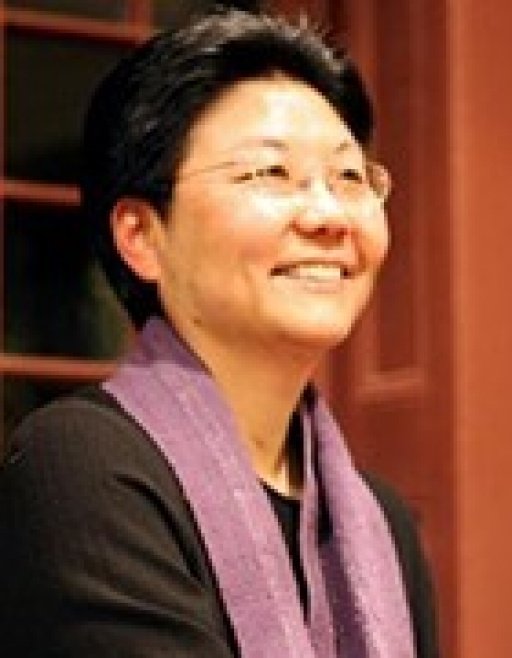
BUFFALO, N.Y. – The American Academy of Arts & Sciences announced that Myung Mi Kim, professor of English in the University at Buffalo College of Arts and Sciences and James H. McNulty Chair Emeritus, is among its new members in 2026.
Founded in 1870, the academy has for more than 200 years celebrated excellence in all fields to advance the common good and preserve democratic ideals. The organization’s charter members include George Washington, John Adams and Benjamin Franklin, part of a distinguished group expanded through the decades by poets and writers such as Louise Erdrich, Amy Tan, Jamaica Kincade and Ralph Waldo Emerson. Other notable members include Albert Einstein, Margaret Meade and Madeleine Albright.
“I am grateful and honored by this recognition,” says Kim, who retired from her faculty position in 2024. “It is accepted with humility and purpose.”
Kim’s 1991 collection of poems “Under Flag” won the Multicultural Publishers Exchange Award of Merit. She is also the author of other innovative works like “Penury,” “River Antes,” “Commons,” “DURA,” and the “The Bounty.”
Kim is an expert in 20th-century American poetry and transcultural poetics and is regarded as one of the most influential figures in the field of contemporary experimental poetry. She described her poetics, following the publication of her collection “Civil Bound” in 2019, to the Georgia Review as listening to “the event of language.” She said that her work pushes back against “normative cultural practices,” telling the journal that “As a poet, I am constantly thinking about this intrinsic problem and exploring modes of relating to and generating language that pluralize sense-making.”
In addition to the groundbreaking body of avant-garde work Kim has contributed to the field of poetry exploring themes of colonization, diaspora and trauma, she remains particularly proud of her role as a teacher.
A letter from a student Kim worked with more than 30 years ago, who had no idea of her election to the academy, arrived coincidentally shortly after news of the honor.
“I find myself returning to something that has stayed with me: the way you worked with language atom by atom, attending to the smallest possible unit of meaning as if the whole architecture of a poem depended on getting that one thing right – because it did,” said the student.
“What I didn’t know then was where that attention would take me. It led me into the desert again, the hardest material I carry – the Gulf War, combat, the long aftermath – and it gave me a way to plumb those experiences without sentimentality or evasion.
“And now, many years later, I have four completed manuscripts that would not exist without what I learned from you.”
Kim says the academy’s mission is something that “strikes me as especially urgent at a moment when volatile harm, diminution of mutual regard and violations of human rights are rampant.
“By proposing the interanimation of arts and sciences as crucial intellectual and cultural sites retexturing the known and the emergent, the academy accompanies me in my abiding commitment as a poet: to register alterity and plurality, to attend the liberatory potential of language.”
