


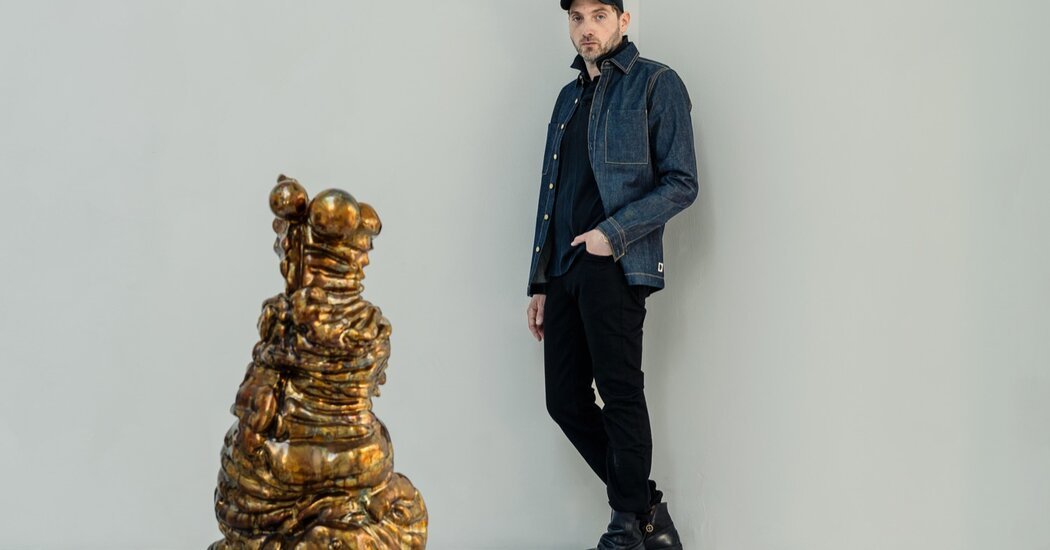
Unlike Allen, who is still relatively unheralded, Uslip was for most of his career a well-regarded art-world insider. He has held high-level curatorial jobs at PS1 (part of the Museum of Modern Art) and the Santa Monica Museum of Art (now known as the Institute of Contemporary Art, Los Angeles). In 2005, at Artists Space, a beloved venue in Lower Manhattan, he put together a group show that examined “the impact of neo-conservatism on queer representations in America” — in other words, he was perfectly in step with the progressive politics of the art world.
He became the chief curator at the Contemporary Art Museum St. Louis in 2014. In September 2016, he opened a show at CAM by Kelley Walker, a white Southerner whose art explores racism and violence. Walker’s work appropriated images of social unrest, which he would then rotate and blur, turning them into what looked like abstract paintings. The show came just after the second anniversary of the killing of Michael Brown by a police officer in nearby Ferguson, Mo., and amid the nationwide protest movement it inspired.
Walker’s work was difficult and confrontational, at a time when people seemed to be looking for something else from the arts. “There were many people who thought I should not open that show,” Uslip said. But “we thought that it was really a very good opportunity to create dialogue, debate, and have the conversation.” Walker gave a talk at the museum the day after the opening, which had been a lively party. He arrived exhausted. Uslip recalled preparing Walker, telling him that he would inevitably be asked about his investment as a white artist in Black bodies and police brutality. “And the answer was actually quite easy and true,” Uslip said, “which is that he’s a civil rights activist from desegregated Georgia.”
When questioned about his positions on race, mostly by local Black artists, Walker appeared defensive and overwhelmed, declining to answer and saying that he shouldn’t have to justify his work. The response from the audience “was very aggressive,” Uslip recalled. His attempts to defuse the situation effectively put an abrupt end to the talk, which didn’t help matters. Attendees took to social media, calling for a boycott of the show, and the story spiraled out from there.
Several weeks later, CAM announced that Uslip had “unexpectedly accepted a new position at another institution.” It was a job at the Bass Museum of Art in Miami Beach. But that job never materialized. By this point, the media had crafted its own narrative about what happened. “St. Louis Curator Quits Amid Charges of Racism, Debate Over Who Controls the ‘Black Body’ Narrative,” an article in Forbes said. Uslip now denies that the Walker incident had anything to do with his departure, but at the time he declined to correct the record. Until speaking with me, he said, he hadn’t talked to a journalist in 10 years.
