


Held online with participants from around the world, the discussion – Art Remembers: Culture as Witness and Prevention – explored how creative expression can either normalize hatred or help defuse it. Participants spoke through their expertise in the trade in enslaved Africans and slavery, the Holocaust, the 1994 genocide against the Tutsi in Rwanda, and the 1995 genocide in Srebrenica.
Chaloka Beyani, Special Adviser on the Prevention of Genocide and Under-Secretary-General, speaks at the event Art Remembers: Culture as Witness and Prevention.
Opening the event, Chaloka Beyani, UN Special Adviser on the Prevention of Genocide, described hate speech as an “early warning” sign of atrocity crimes. Such rhetoric, he warned, often precedes and accompanies “crimes against humanity, war crimes and genocide,” underscoring the need for vigilance and responsibility in how narratives are shaped and shared.
Left to right: Marie Josèphe Angélique (1705–1734), an enslaved woman accused of arson in Montreal, depicted by Marilyn Carr Harris (courtesy of Dr. Afua Cooper); Brothers Emanuel and Avram Rosenthal, victims of the Holocaust, Kovno Ghetto, Lithuania (US Holocaust Memorial Museum, courtesy of Shraga Wainer); Innocente Nyirahabimana, survivor of the 1994 genocide against the Tutsi in Rwanda (Myriam Abdelaziz); Mirzet Hrustić, survivor of the 1995 genocide in Srebrenica (Srebrenica Memorial Center, courtesy of Mirzet Hrustić).
Reframing history through culture
Valika Smeulders, Head of History at the Rijksmuseum in Amsterdam, noted that many cultural institutions are rooted in histories of domination but can also play a role in confronting them.
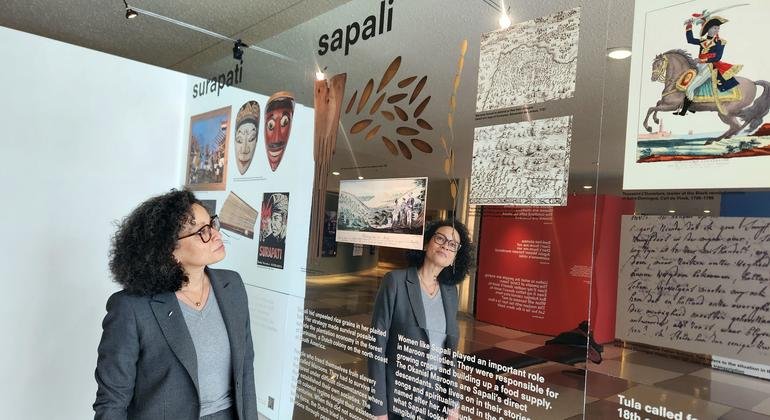
Drawing on the museum’s exhibition Slavery: Ten True Stories of Dutch Colonial Slavery, which was hosted at the United Nations in 2023, she highlighted the story of women who hid rice in their hair before being forced across the Atlantic.
Their actions, she said, reflected foresight and resilience, helping audiences recognize enslaved people “as individuals who had agency, who had names.”
She noted that in museums, the history of transatlantic trade in enslaved Africans has long been separated from European history by making distinctions between what was written and what was remembered.
By highlighting such stories, the museum was able to assemble the story for all of the Netherlands and countries affected by Dutch colonialism. “Because ultimately, it is one single history that forms the crucible for our societies of today,” she added.
The panel was held on Juneteenth, the 1865 emancipation of enslaved people in the United States, and was centered in the United Nations’ programming for the International Day for Countering Hate Speech.
Israeli clarinetist and co-creator of Lebensmelodien or Melodies of Life, Nur Ben Shalom, speaks at the event Art Remembers: Culture as Witness and Prevention.
Music from the Holocaust
Israeli clarinetist and co-creator of Lebensmelodien or Melodies of Life, Nur Ben Shalom described music as a form of remembrance and resistance.
Inspired by a letter from his great-aunt Salomea Ochs Luft, a pianist murdered during the Holocaust who urged his family to avenge her death, Ben Shalom said music “is a witness for the extermination of the Jewish people. When we perform these melodies, we also fight.”
“Art is not neutral,” he said, speaking from southern Poland where his students had performed the same songs at Auschwitz Birkenau, the German Nazi concentration and death camp (1940-1945).
“Art is power. It’s a secret power, a secret weapon, a good weapon that we have with music, because music gets directly to the heart.”
Rwandan actor and playwright Diogène “Atome” Ntarindwa speaks at the event Art Remembers: Culture as Witness and Prevention..
When culture becomes a tool of harm
Rwandan actor and playwright Diogène “Atome” Ntarindwa reflected on the role of RTLM (Radio Télévision Libre des Mille Collines) or “Radio Machete”, in normalizing the dehumanization leading up to the 1994 genocide against the Tutsi in Rwanda through jokes, music and entertainment.
Ntarindwa joined the Rwandan Patriotic Front, entering Kigali in 1994 amid the genocide against the Tutsi. He identifies not as a survivor, but as a witness.
In the play “Hate Speech” he plays one of the perpetrators, often appearing on RTLM.
By reconstructing those broadcasts on stage, he said, art becomes “a kind of weapon” that can expose the mechanisms of hate.
He also spoke about the need for solidarity and allies, having visited Auschwitz himself.
Memorial artist Aida Šehović speaks at the event Art Remembers: Culture as Witness and Prevention..
Art as remembrance and resistance
For Bosnian American artist Aida Šehović, art offers a way for collective healing and understanding through sharing of a ritual.
Her ongoing project ŠTO TE NEMA commemorates victims of the 1995 Srebrenica genocide through thousands of traditional coffee cups arranged in public spaces, and often accompanied by traditional coffee making – a simple daily act which for thousands of survivors remains forever incomplete.
The participatory installation transforms remembrance into a shared civic act, shifting memory from private mourning to collective responsibility, and as such counters the denial of the atrocities committed.
The participatory installation transforms remembrance into a shared civic act, shifting memory from private mourning to collective responsibility.
Art Remembers: Culture as Witness and Prevention formed part of Beyond the Long Shadow: Engaging with Difficult Histories, a UN discussion series exploring the legacies of the transatlantic slave trade, the Holocaust, the 1994 Genocide against the Tutsi in Rwanda and the 1995 genocide in Srebrenica.
