


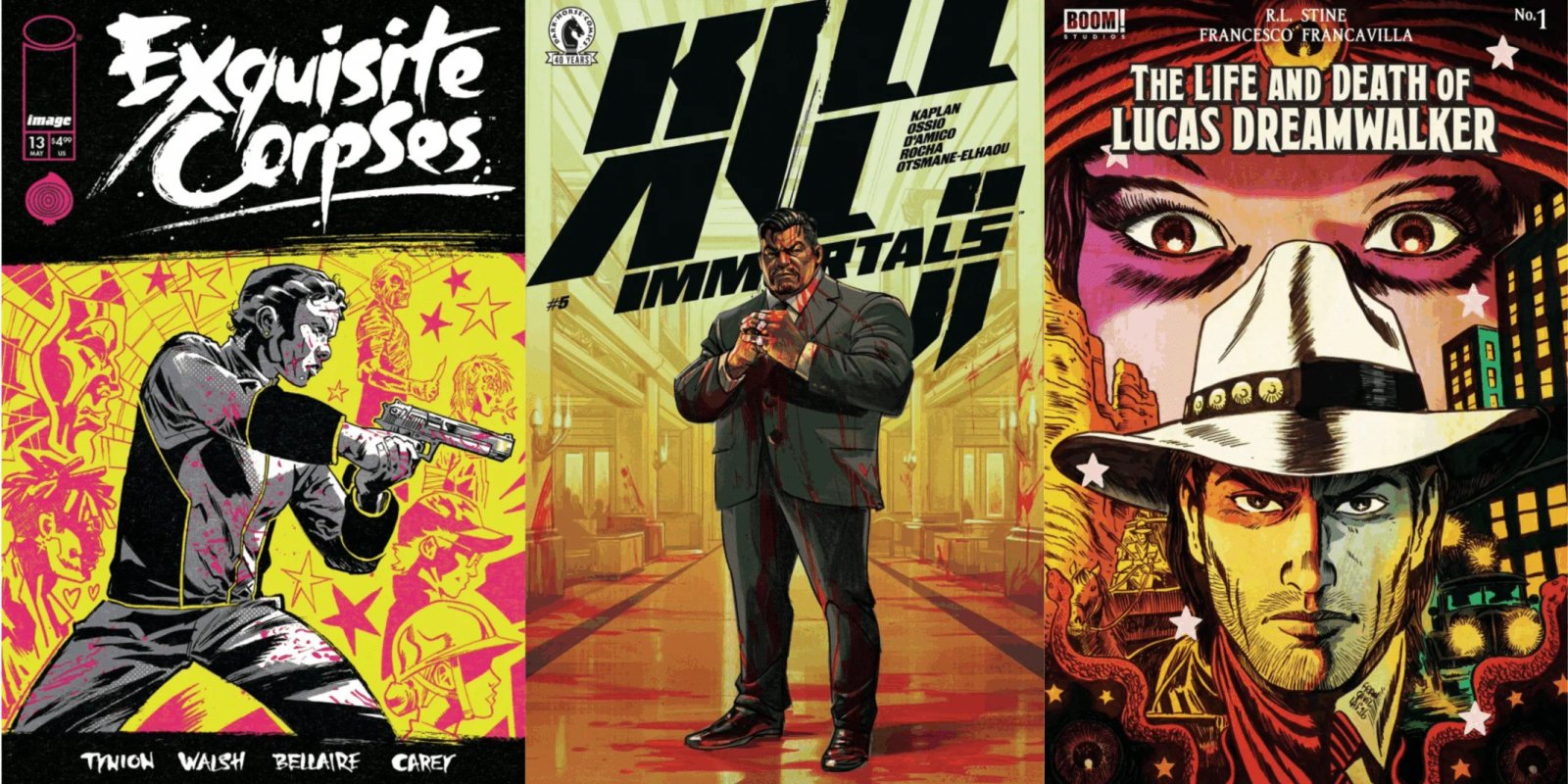
In this week’s Wednesday Comics column, a deadly tournament comes to a crashing end in Exquisite Corpses #13, all things must die at the end of Kill All Immortals II, and more. Plus, The Prog Report!
Exquisite Corpses #13
Writer: James Tynion IV
Artist: Michael Walsh
Colorist: Jordie Bellaire
Letterer: Becca Carey
Publisher: Image Comics – Tiny Onion
Review by Zack Quaintance
If you’re going to do a fight tournament comic, you need to have a thunderous jaw-dropping ending. That’s my personal belief on the genre, and my other belief is that it’s very hard to do. What’s also hard to do is tell stories that satirize the societal ills that have made American life in this particular moment so stressful, defeating, or whatever other adjective you want to put here.
This is all to say that while I enjoyed the early issues of Exquisite Corpses, it was not without skepticism that the book could stick any kind of satisfying landing. Now that the finale is here, however, I am pleased to report that the first season of this series comes to a very satisfying end, one that also stands entirely on its own. I’d say it seeds more seasons to come, but I wasn’t skeptical about that. It’s a story based on a recurring (over generations) fight tournament, so there was always going to be more to do with this one.
But let’s talk about the ending and why it works so well. Exquisite Corpses has pulled off a tricky balancing act throughout its run. The name and the logo and the colorful costumes of the murders participating in its fight tournament all scream PARTY. It’s a book with an ostentatious aesthetic in every way. Combine that with the bloody horror chaos of its plot, and you get a story that feels if not light, than definitely raucous.
At the same time beneath that veneer, the book is also interested in raising questions about a society in which disproportionately powerful people vie for position between each other, with the lives of the masses caught in the balance, essentially unseen. That’s serious stuff, and it runs the risk of feeling dour in 2026.
The book throughout its run, however, used over-the-top balance and good old fashioned what happens next intrigue to keep it from feeling oppressive. And that carries through to this finale. In a vacuum, the plot here is devastating and beyond sad. But it’s delivered in a way that feels intentionally distracting. There’s a sense that it could all be a metaphor for the violence of the country that we all look past as we stay locked into our unprecedented distracting entertainment, which itself thrives by being base and over-the-top. That’s heady, I love it.
But moreover, this finale also just does comics right. Michael Walsh (colored here by Jordie Bellaire, the current best colorist in comics…pay attention to use of blood red in this one, it’s great) is a formidable horror artist, and there’s plenty to go around in Exquisite Corpses #13. He’s also shockingly adept in this issue at using one-on-one combat to create a tense narrative. When the finale goes silent, let-this-sink in montage is when it shines the most though.
Indeed, as our tournament comes to its stunning end here, James Tynion IV’s script wisely backs off and gives it and all that came before it space to breath, punctuating it all with the equally stunned reactions of the surviving characters.
When Exquisite Corpses comes back for a second season, the bar will be high, and that’s a great problem to have.
Kill All Immortals II #5
Writer: Zack Kaplan
Artist: Fico Ossio
Finishes: Elisabetta D’Amico
Colorist: Thiago Rocha
Letterer: Hassan Otsmane-Elhaou
Publisher: Dark Horse Comics
Review by Khalid Johnson
The finale to the sequel arc of Kill All Immortals sees Frey assume bloody leadership in her pursuit of revenge and it’s a fun action packed finale. What worked for me here is the narrative focus of writer Zack Kaplan, creating a really tight issue that throws you right into the action. I wish, however, that there was more time across the board. Frey’s turn into vengeful murderer comes from a big moment but there also feels like lacking internal conflict to get her across that line. Her dad has wanted her to go in that direction the whole time anyway and now she’s embraced what he intended for her. Their contentious relationship still sees Erik vindicated though he’s met her with nothing but insubordination during her attempts at leadership.
Genghis as a domineering patriarch fills a similar role to Erik but through the globe trotting narrative, isn’t given much space to be developed beyond the sheer force of his violence. This makes the final fight here feel a little less emotionally impactful though still really cool visually. The art of Fico Ossio, finished by Elisabetta D’Amico with colors by Thiago Rocha hammers in on the bloody spectacle of violence with impressive spreads that kept me firmly rooted in the action. The lettering of Hassan Otsmane-Elhaou is always a treat and really becomes part off the art in the panel, making the visuals feel that much more complete.
If you’re looking for spectacular violence, the finale to this arc delivers. Kill All Immortals II delivers on its title with higher stakes due to the mortality of our cast and continued narrative payoff. Frey steps into the role expected of her in beautifully constructed pages and panels filled with bloody art. At the end, I wish there was more time getting her there and a more compelling villain to challenge her on it.
The Life and Death of Lucas Dreamwalker #1
Writer: R.L. Stine
Artist: Francesco Francavilla
Letterer: Nate Piekos
Publisher: BOOM! Studios
Review by Jared Bird
How many times can you die in your dreams before it’s truly the end for you? That’s what Lucas Dreamwalker has to reconcile with in this genre-bending one-shot spinning out of the pages of BOOM! Studios’ Hello Darkness anthology. Collecting all three sections of the narrative in one issue, widely popular author R.L Stine teams up with the legendary Francesco Francavilla to explore one man’s dreams and nightmares as he faces his own mortality.
Lucas Dreamwalker works alongside his sidekick, Rusty Meadows. In one dream, they’re cowboys trying to rob the wealthy and morally questionable Hawk Maloney . In another, they’re taking down the mysterious criminal Kegs Driscoll, and in another, Lucas is married to a woman named Lena and attempting to raise his children. All of these are bound together by a warning that Lucas receives from Clara, a fortune teller, who warns him that once he dies in his dreams three times over, his time is up. Can he escape his fate, or is he doomed to repeat his mistakes until the very end? Blending westerns, noir-inspired crime fiction, and supernatural horror elements, this one shot is as much a puzzle as it is a comic, which sometimes negatively impacts the narrative. It can be hard to grasp how it all interlinks, and which of Lucas’ many lives is the most ‘real’ one. This will work for many, but often it comes across a bit confusing, which doesn’t help the pacing of the story at all.
The script, written by the legendary R.L Stine, shares a lot of the quirks you’ll find throughout his work. This includes witty, meta-narrative dialogue, charming characters and fun action sequences, with some surprisingly brutal moments of violence that are striking when they appear in the story. Stine is good at making character beats work even as they don’t necessarily get a ton of on-page presence, which allows the epic scope of the story to thrive in the best way possible. Lucas himself as a protagonist is interesting, as he desperately tries to spend the narrative fighting his fate, to no avail. He’s quite likeable, which allows this story to truly shine, even if its plot structure often betrays it in terms of making the entire narrative comprehensible. The side characters are fun too, with Pynchonesque names that add to the sharp, smart feeling of the script whilst still keeping it firmly in B-movie inspired territory.
The biggest highlight of the comic is Francesco Francavilla’s gorgeous artwork. Like always, it shines on the page, stylish and atmospheric with just the right amount of influence from each of the various genres at play to make the tone shifts work perfectly in his favour. He particularly shines in the third section, which leans into some brilliant character expression moments for his artwork as well as a more grounded, horror-inspired aesthetic that works perfectly in favour with Francavilla’s style. It’s always great seeing such a phenomenal artist doing interiors, and he makes every effort to match whatever Stine’s script asks of him, leading to a fun and well-crafted story that makes use of both men’s skills in their respective artforms.
Overall, The Life and Death of Lucas Dreamwalker #1 is a fun read, albeit limited by its ambition sometimes as it crumbles under the weight of its peculiar structure. However, with a witty and sharp script working alongside the brilliant artwork of Francesco Francavilla, it truly becomes something beyond its limitations, a fun genre-bending comic that will definitely appeal to fans of the genres at play or of Stine’s larger bibliography, and it ultimately stands out as unique and ambitious in a way that deserves praise, even if it doesn’t entirely make the landing.
Spirit of the Shadows #5
Writers: Daniel Ziegler & Nick Cagnetti
Artist: Nick Cagnetti
Letterer: Ferran Delgado
Publisher: Oni Press
Review by Zack Quaintance
Spirit of the Shadows #5 is a finale in every sense. The many plot threads of this excellent series come to an end. They are resolved. Comeuppance are dealt out, and we get to see characters deal with how the events of the preceding chapters have changed them, some moving on, others excepting they still have more work to do.
And while all this is happening, the major strength of this book — the way that artist Nick Cagnetti visualizes the macabre with comic book vision and splashes of neon-yet-fitting color — continues to shine even brighter than it has in the previous chapters. This was really a book that was unafraid to try new things, especially the way it conveys moving between realms.
Throughout its run, we’ve seen the characters in Spirit of the Shadows deal with dark afterlives that essentially punish them for choices they made while living. But we don’t see the familiar visual language that usually defines these types of story. There’s no red hellfire or dark caverns, no shrouded grim reaper with an obscured face and sickle. Instead, Spirit of Shadows makes purgatory and half-death its own.
Finally, this last chapter does what all great serialized comics endings do — it builds on its story so well, that it leaves me wanting to immediately go back and grab the trade, to read it all in one sitting, start to finish.
Did You Hear About Mimi Green? #1
Writer: Connor Goldsmith
Artist: Josh Cornillon
Letterer: Ariana Maher
Publisher: Dark Horse Comics
Review by Zack Quaintance
Did You Hear About Mimi Green #1 is a comic with a lot of ingredients. Ostensibly, it’s set at a sort of rehab facility for Internet pariahs, and that’s what our titular character, Mimi Green, is. She’s a sort of hybrid writer-high-level influencer, who got so big she landed a book deal…at which point blogging from 14 years ago with cruel remarks about body types resurface, costing her everything.
And so she ends up at the chill out facility. This is a lot of plot in itself for a first issue, tackling as it does Mimi’s mistakes, who she is/how she feels now, and the fallout in both her romantic and professional lives. Then on top of that, this comic layers in body and dreamscape horror.
In brief, Mimi is famous for being awful. She’s in a meditative retreat (lightly) against her will. And when she goes to sleep at night, viscera is spilling out of her underwear and/or she has to beat off bloodied eldritch horrors with a tennis racket. And if those horror touch her, there might be actual damage to her body when she wakes up.
Which is all to say that I think artist Josh Cornillon does a fantastic job making it all cohere and read clearly. I particularly liked the sort of blood platelet or bone marrow-inducing panel layouts he deployed in this issue during the most gruesome scenes. Cornillon also does a tremendous job coloring himself in these pages, nailing both the tone of the hippy dippy retreat as well as the nightmare dreamscape. It’s a book that bounces from aesthetically gruesome to visually mellow, and casually weaves the feeling of a horror story through both.
If I have a note for Did You Hear About Mimi Green #1, it is perhaps that I did not particularly mind if bad things happened to the titular protagonist, Mimi Green. Maybe it’s a me thing, but I’ve never quite found the type of figure she’s meant to evoke — the Internet sensation-turned-outcast — inherently sympathetic, and the book didn’t quite give me a reason to root for Mimi. There’s even a two-page montage where people who know her in real life she deserves to lose everything. Who am I to argue?
But I am, however, interested in seeing more of the story. The first issue is packed but fast-paced, and I am game to see just how grody this de-stressing retreat can get…and maybe I will slowly come to root for Mimi in the end.
The Prog Report
- 2000AD #2482: Welcome, new U.S. readers…did you come back after last week’s debut in our comic shops? Good! I think the experience of reading 2000AD stacks (as gamers say), getting better and better the longer you continue into it, learning the characters and creators who make this great weekly anthology. This issue is all continuations of last week’s stories too, with nothing new debuting just yet (although we’re due for that next week, I believe). Last week’s Judge Dredd: Crossed Lines Part One wouldn’t be a very good hook if it didn’t stay accessible in Part Two, and it definitely does here, with a more Dredd character-centric story than any I can remember in a good while. A criminal grills Dredd about his very humanity with a gun to his hostages head, and we see Dredd passing the test by remember stuff he learned mostly while arresting people. It’s clever and kind of fun, for how bleak it is when you think about, and that’s always a good mode for Dredd to operate within. This story is from writer Ken Niemand, artist Andrea Mutti, colorist Pippa Bowland, and letterer Annie Parkhouse. I promise I’ll write about a non-Dredd story next week. This week’s cover (above) is by D’Israeli. As always, you can pick up a digital copy of The Prog here. And it is also now available weekly in US comic shops! —Zack Quaintance
Column edited by Zack Quaintance.
Read past entries in the weekly Wednesday Comics reviews series or check-out our other reviews here!
