

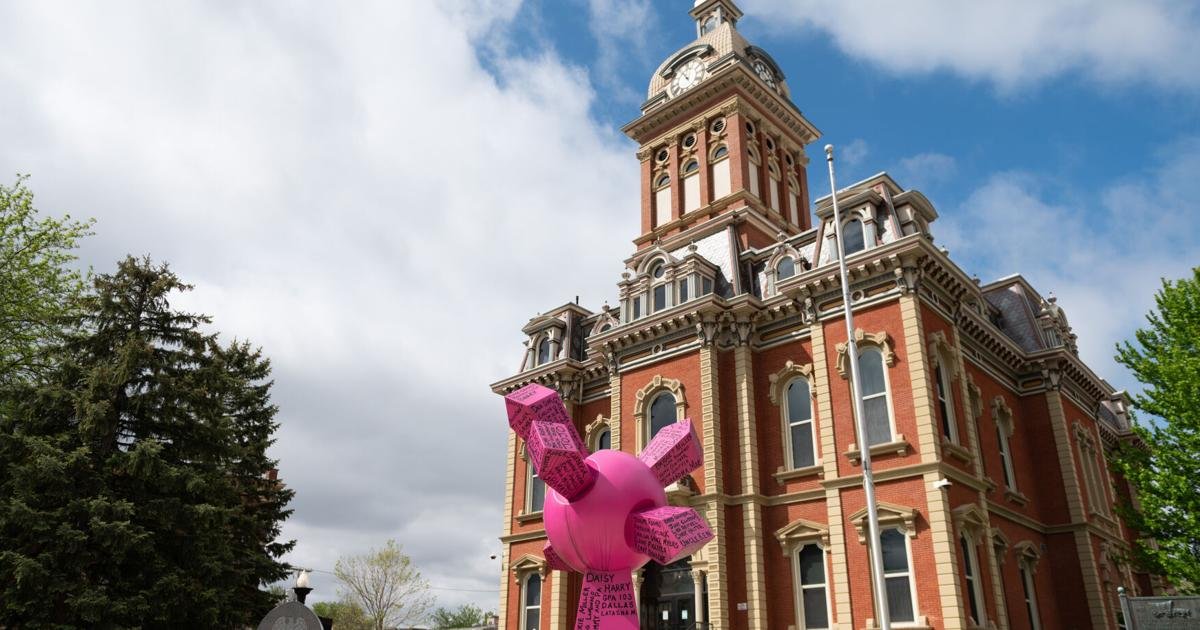
The benefits of public art are easy for Decatur Mayor Dan Rickord to spot.
Walking around downtown, he often sees people looking for a map of the annual Decatur Sculpture Tour, which will unveil its 15th collection of installations June 13.
“You know that person is going to stick around,” he said. “They’re probably going to have lunch before they leave. Maybe they’ll hit a couple of shops. So it definitely boosts the local economy.”
Dozens of pieces are featured every year on the tour, and Decatur has purchased sculptures that are on permanent display in its Riverside Sculpture Park on the banks of the St. Marys. Art has become so much a part of the Adams County city’s identity that its slogan is “Artistically Inspired Innovation.”
Public art encourages residents to have a stronger connection to their city, Rickord said. “I think just having the arts builds community pride.”
Communities across northeast Indiana are leveraging public art to create inviting spaces – not only for their residents, but also to draw visitors, investment and talent.
Targeting visitors
Visit Fort Wayne places ads in cities and towns between 50 and 250 miles from the city. Public art is often used in the ads because it is vibrant, but also because it has become a part of the community’s brand.
“Part of our job is identifying different reasons that people visit our community … and promoting those to visitors to entice them to come and visit,” Vice President of Marketing and Communications Kristen Guthrie said.
Public art is high on the list of things Fort Wayne and Allen County do well and that other communities might not have to offer. It’s an accessible and free way for visitors to enjoy the city, and it draws them out of convention centers and hotels to explore. After they are on the street in core areas such as downtown, travelers might find restaurants, businesses and other attractions to patronize.
Officials, arts leaders and creatives in northeast Indiana talk about the impact of public art on communities, how organizations and artists e…
The tourism bureau offers paper maps and a Public Art Trail digital passport for mobile devices. Users “check in” on the latter as they visit some of the more than 200 murals, sculptures and other installations across the county. Since the passport was launched in 2021, Guthrie said there have been about 8,000 check-ins.
Allen County draws about 9.2 million visitors annually, generating $1.1 billion in expenditures and $121 million in state and local tax revenue, according to data from a 2024 Indiana study included in Visit Fort Wayne’s 2025 annual report.
Kosciusko County also harnesses public art to enhance the visitor experience. Installations help create walkable, engaging spaces and give the county’s convention and visitors bureau strong visual content for marketing, Executive Director Cori Humes said.
“We integrate public art into visitor guide, travel itineraries, maps and storytelling, connecting it to our lakes, trails, downtowns and events, so visitors have more reasons to discover different parts of the county,” she said. “It’s a simple but impactful way to support local artists, elevate our communities and strengthen tourism overall.”
Public art adds to the county’s appeal, turning everyday places into something memorable to explore, Humes said. It also helps tell the county’s story by reflecting natural assets and sharing heritage while displaying the community’s creativity.
“It’s part of our county’s identity and shaping how people experience and remember our destination,” she said.
The county drew 2 million visitors in 2023 and 2024, according to the Clearly Kosciusko 2025 annual report. Visitors spent $187 million in the county and generated $20 million in state and local tax revenue.
Kosciusko offers a Public Art Trail Challenge digital passport with more than 40 murals and sculptures across cities including Warsaw, Winona Lake, Syracuse and North Webster. There have been 2,170 check-ins since its launch several years ago, Humes said.
The bureau consistently hears positive feedback from visitors about public art in Kosciusko County. Travelers appreciate the color, creativity and sense of discovery it lends to communities.
“Visitors also enjoy how shareable it is; public art naturally creates photo moments that help them capture and remember their experience,” Humes said. “Overall, it leaves people with a stronger sense of place and often becomes one of the highlights of their visit.”
Seeing an impact
When someone is looking for a place to visit or move, they are looking for vibrant communities that have a lot going on, said John Urbahns, president and CEO of Greater Fort Wayne Inc. Arts and culture help make a community inviting.
“I think we’ve done well in Fort Wayne and Allen County to make sure that art is part of what we’re doing,” he said.
Arts and culture assets are among elements the economic development organization might mention in pitches to businesses looking at the county. Downtown, the riverfront and neighborhoods are among other assets that might be highlighted as pitches are tailored for each opportunity.
One of the top responses when local companies are surveyed about talent attraction and retention efforts is riverfront development and the cleanliness of downtown, Urbahns said. Each of those has public art as a component.
Placing value on the arts helps build a stronger, more vibrant city, Mayor Sharon Tucker said.
“The arts keep us thriving,” she said. “A successful community has arts as a focus. The arts help us grow as a fun, family-friendly and safe community.”
The mayor hopes the city will continue to look for more ways to highlight public art throughout the community with efforts such as the Public Art Commission’s Shout-Out program, which creates temporary and permanent art pieces in neighborhoods with significant input from residents. The Harvester and East Central neighborhoods are slated to receive permanent installations this summer.
Tucker considers city residents fortunate to have so many diverse art experiences from which to choose. She pointed to the recently renovated Arts United Center as another quality-of-life component that sets the city up for success.
“The arts give us a sense of community where people from all walks of life can enjoy and appreciate different expressions of art,” she said. “I think it brings us closer together with a unified vision to highlight the many talents of so many individuals and groups.
“It’s also assisting us in our efforts to attract new businesses, expand current businesses and increase our population to bring more people to the city.”
That rings true for other northeast Indiana communities as well.
Rickord said it is not uncommon to hear visitors say that arts and concerts are one of the reasons they visited Decatur. Some of those people enjoy it so much that they end up moving to the city. He shared the example of a CEO hired by an area business. The CEO looked at cities in the area and chose to live in Decatur because of its arts scene.
“That was really cool to hear that,” he said.
Public art is a component of placemaking efforts underway in Bluffton. The Wells County city was among 15 communities chosen in March to be part of Indiana University’s 2026 Rural Placemaking Studio.
Sculptures put Decatur on the map in a new way, Rickord said. The success of the sculpture tour, an independent program which began in 2012, has drawn representatives from other northeast Indiana communities looking to learn from Decatur’s example, Rickord said. They include Bluffton, Angola and Warsaw.
Angola has a smaller annual sculpture program on its downtown circle and Maumee Street. Fully funded by local sponsors each year, Sculptures Angola began in 2019 with four sculptures on the circle around the city’s Soldier’s Monument. Those would be unveiled in the spring with additional sculptures being installed on Maumee Street in the fall.
This year, Angola is combining the sculpture reveals into one event from 4 to 6 p.m. June 5 on the circle. Community Coordinator Allison Daglow said the Steuben County city wanted to make it a larger event for residents and visitors. The fall reveal party was often less attended because of colder weather.
Other public art projects in Angola include the activation of an outdoor gallery space known as Imagine Alley with installations and arts events. A mural has been installed at Sheets Family Park, 700 E. Harcourt Road, which had a soft opening in the fall and will have a grand opening celebration from 10 a.m. to 2 p.m. May 30.
Daglow said public art is an economic development tool that shows potential business owners and people looking to move to Angola that the city cares about the community and is investing in the area. But that’s not the only benefit. For a small community, it also brings quality art to residents who might otherwise have to travel to larger cities such as Fort Wayne or Indianapolis to experience those types of pieces.
Visible art can also provide safety. A sponsorship from Nate Lauer’s State Farm office allowed Angola to install two crosswalk murals in school zones in 2025. The city’s engineering department placed speed readers in the zones before the murals were painted. Data showed that traffic moved more slowly after the crosswalk murals were installed – information supported by national reports, Daglow said.
“We’ve done some studies on driver safety, and drivers slow down up to (5 mph) slower when public art is viewed,” she said. “It’s just something that they see a little bit more than being complacent and driving by that area. And so it was a safety initiative that we did, but also brings some public art to the town.”
Five more crosswalk murals will be installed in Angola this summer with funding from a Safe Routes to School grant from Indianapolis-based Health By Design. Like Angola’s sculpture program, artists for the crosswalk murals are chosen through open calls organized by the Mayor’s Arts Council.
Maintenance is an important element of public art management, local leaders say. Various agencies approach that work differently, but with the same goal in mind: to ensure longevity of work that boosts the community.
Maintaining art
Part of being a public art steward is keeping installations maintained. For one thing, the art has to be able to survive outside, Rickord said. Some pieces submitted for the Decatur Sculpture Tour, of which he is a board member, are rejected if they are not likely to last in outdoor conditions.
Decatur artists Greg and Alex Mendez oversee maintenance for sculptures in that city, and the brothers have been tapped to survey installations that are part of the Public Art Commission’s collection in Fort Wayne.
Maintaining public art along with Fort Wayne’s parks and other assets, is vitally important, Urbahns said.
“The last thing you want to see is a community that invested in something and then they’re not maintaining it, right?” he asks. “We’ve all seen places where it’s not maintained, and it’s just not the same experience.”
Guthrie said Visit Fort Wayne appreciates that public art in the city has been well maintained. New pieces are regularly added to the Public Art Trail map and passport; others are removed as they are decommissioned by owners, which might happen because they are no longer in top condition.
Word of mouth is possibly the most difficult type of promotion for Visit Fort Wayne to control, Guthrie said, but having friends or family who enjoyed a destination is also one of the most powerful reasons travelers decide to go there themselves.
It’s important that visitors have a good experience in the community because they will want to visit again, and they will tell their friends and family about it, Guthrie said.
Sporting events, conventions and family attractions might be the core of what draws people to the city, but arts and culture activities help fill out the package to make people want to stay and explore, Guthrie said.
“We love having things like public art that make a beautiful addition to that itinerary and make it a more enjoyable community to be in,” she said.
