


Two new exhibitions at The Warehouse, “Yoshitaka Amano” and “Chase a Crooked Shadow: Film Noir as Contemporary Mirror,” show a fruitful cross-pollination between motion pictures and two-dimensional works of art.
In the two rooms at the entrance to the warehouse, Amano, who has had a long and successful career in Japanese animation and video games, including Speed Racer and Final Fantasy, displays his equally long-standing interest in the traditional arts of drawing and painting. Across the remaining 14 galleries, the expansive show curated by Alexandra Terry uses the film genre that originated in the 1940s and 1950s to build a framework for understanding “the darker contours of modern life,” as Terry writes in the show’s introduction.
Some of Amano’s works come directly out of his film career, as in works on paper that reference his 1985 cult film Angel’s Egg and his 2007 short film Bird Song. But most of the show is more engaged with art history than with the artist’s parallel career in moving images.
From Yoshitaka Amano’s Bird Song, 2006. (Matthieu Samadet/Courtesy of the artist and LOMEX New York)
Amano’s work shows a great fluency in both Eastern and Western artistic traditions. For example, a series entitled Serenade employs the tradition of ink wash painting known in Japan as sumi-e. Rather than the serene landscapes common in traditional sumi-e, Amano depicts sensuous scenes of nude or suggestively draped female figures hovering weightlessly in the mist, recalling decadent and symbolist works from the turn of the 20th century by Aubrey Beardsley and Gustave Moreau. Further engagement with fin de siècle Western art comes in the paintings Remembrance of Time and Pandora 2, whose swirling shapes and ominous suggestions evoke the psychologically charged work of Edvard Munch.
From Yoshitaka Amano’s Serenade series, 2023. (Courtesy of the artist and LOMEX New York)
Among Amano’s most explicit references to traditional Asian culture are the large-scale drawings of the Four Heavenly Kings, done in ink and silver leaf on wood panels. These Buddhist deities, known across Asia as the guardians of north, south, east and west, are fierce and benevolent; Amano’s renderings have the musculature of action-movie heroes, and the dark charisma of the fallen angels in Milton’s Paradise Lost.
From Yoshitaka Amano’s Serenade series, 2023. (Courtesy of the artist and LOMEX New York)
In “Chase a Crooked Shadow,” Terry’s curatorial idea is to take the widespread contemporary sense of powerlessness in the face of threatening forces, and place it in historical perspective with reference to the classic film genre. In the show’s introduction, she asks: “How do we navigate systems we cannot control? Where do ethics fracture under pressure? And what does it mean to live with clarity when the world itself is fundamentally unstable?”
This approach is clever, and generates many connections across historical periods. The first section of the show, on the “Crisis of the American Dream,” refers to the interlinked fears of Communism and nuclear war that developed after World War II. Among the works in this section, Danh Vo’s In God We Trust, from 2025, elicits a similar sense of fear and threat. Vo’s work consists of a massive wood pile, partly fallen down, that presents a crumbling remnant of an American flag, in subdued brown and gray.
In noir films, the ambient sense of instability and ambiguity often extends to within the characters themselves, as neither they nor the audience know who can be trusted. In a gallery devoted to “Duplicity and Ambiguity,” several works present human figures with faces partially or fully obscured, leaving a viewer uncertain how to respond. Out of Body, Out of Mind, by the ceramicist and painter Woody de Othello, has a figure with his face in his hands sitting on the bed, with an embodied shadow clinging onto his back as the walls appear to close in around him.
Woody De Othello’s Out of Body, Out of Mind, 2020. (The Rachofsky Collection)
Another gallery brings together works that play with some of the cinematic techniques common in noir films. Ann Hamilton’s digital print flectere (Latin for “to bend”) shows a figure with close-cropped hair behind textured glass, possibly suggesting the grim fate of Janet Leigh’s character in Alfred Hitchcock’s Psycho shower scene. In Kate Mosher Hall’s painting Moon Mesh, a nighttime scene is dimly visible through a gridded screen; the darkness is both figurative and literal.
Each of the three main character types in a noir film — the detective, the criminal and the femme fatale — shares in this ambiguity. In the gallery devoted to the the detective, “a figure who never quite earned the title of hero,” as the wall text says, Jiro Takamatsu’s Shadow shows the gray silhouette of a male figure with arms extended; he could be apprehending a criminal, or he could be a killer himself (as when we see the killer approach in shadow in the Psycho shower scene).
Tomoo Gokita’s Don’t Talk About Me, 2018. (The Rachofsky Collection)
Nearby, the gallery on “The Criminal & The Scene of the Crime” is equally unsettled. Tomoo Gokita’s painting Don’t Talk About Me shows a figure entangled in black and white shapes that wrap around him. Like Takamatsu’s shadow, he could be a good guy or a bad guy — or, more likely, could exist outside those moral categories entirely.
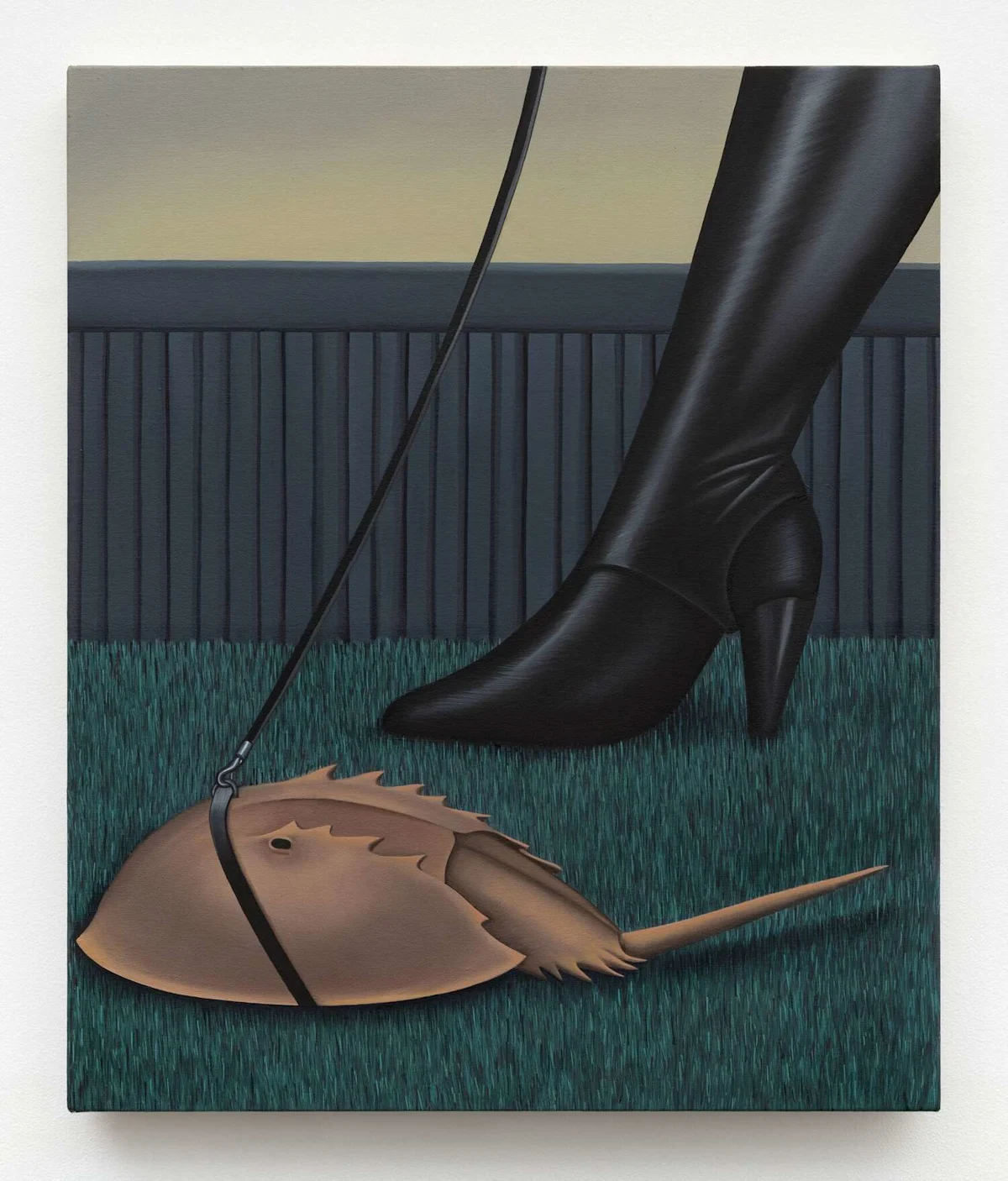
Many of the most memorable characters in noir films are the femmes fatales, the women through whom the main male characters meet their deadly fates. The exhibition attempts to explore these “seductive, intelligent, and opaque” women with “nuance rather than judgment,” a wall text says, holding back from the instinctive emotional responses that femmes fatales often elicit. Some of the works, like Julie Curtiss’ painting Limule (Horseshoe Crab), have a sense of humor that appears occasionally in both noir films and avant-garde art. Curtiss’ arthropod, being walked through the garden by a figure in high leather boots, recollects the lobsters of Gérard de Nerval and Salvador Dalí.
Seen together, the combination of the two Warehouse shows suggests how easily new interpretations can arise in the crossing back and forth over the boundaries that separate art forms. Although film noir and anime may be familiar, using them as the context for gallery exhibitions sheds new light on a wide variety of contemporary work.
Details
Chase a Crooked Shadow: Film Noir as Contemporary Mirror continues through July 18. The first installment of Yoshitaka Amano continues through May 30, while the second installment will run from June 6 to July 18, at The Warehouse, 14105 Inwood Road. Open Saturdays from noon to 5 p.m., advance registration encouraged. Admission free. 214-442-2872. thewarehousedallas.org.
Subscribe
Sign up for the Morning Roundup, a free newsletter delivering the latest North Texas news each morning.
