


4 min read
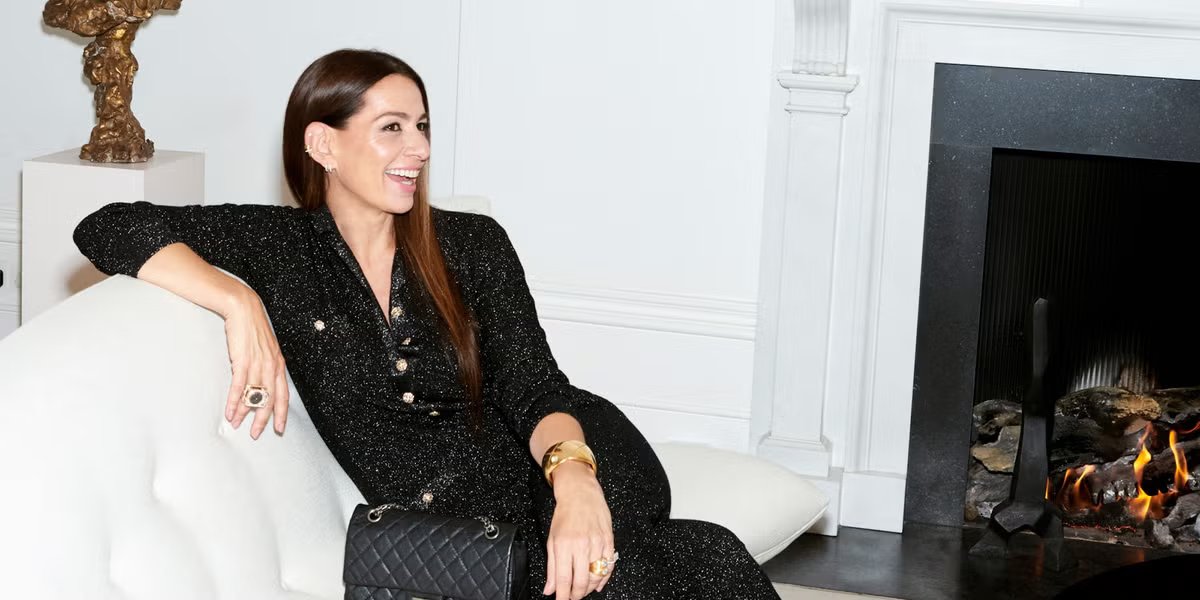
Yana Peel gets a lot of work done on trains. Sitting in her London office, double-C buttons glinting from her black-and-white sweater and star-shaped earrings sparkling in her ears, she tells me that the Eurostar trip to Paris is “a very happy zone for me.…When I was with Hans Ulrich [Obrist] at the Serpentine Galleries, we would say, ‘Never complain if you’re on a train.’ ”
It makes sense that Peel would be most comfortable in motion. Her work as the president of arts, culture, and heritage for Chanel requires her to not only cross a dizzying number of latitudes and longitudes, but also traverse genres, overseeing the house’s involvement in visual art and culture. One day you’ll find the peripatetic Peel in conversation with Misty Copeland at Davos; the next, speaking at the Aspen Ideas Festival with playwright Anna Deavere Smith. In the mode of Gabrielle Chanel, who was friends with (and, in some cases, a patron to) artistic figures like Picasso, Stravinsky, and Diaghilev, she feels comfortable moving between worlds.
Peel often finds herself citing the Andy Warhol quote “Good business is the best art.” Russia-born, Canada-bred, she has a finance background and worked at Goldman Sachs. Post-Goldman, she quickly made inroads into the art and nonprofit spheres, cofounding the Outset Contemporary Art Fund, a nonprofit that connects artists with patrons, and the live debate platform Intelligence Squared, which hosts discussions on various subjects. She also served as the CEO of the Serpentine Galleries from 2016 to 2019. When she joined Chanel in March 2020, she found a way to make the arts feel close to home in a socially distanced time by starting the Chanel Connects podcast. “It emerged from a time where everyone would take your call” since so many people were at home, she says of the project, which marked its fifth season last year. “Chanel [could be] connecting you from your kitchen to the director of the British Museum or Tilda Swinton in her home.” The podcast has since taken on new dimensions, expanding to a live event at the Guggenheim with Peel in conversation with artists Sarah Sze and Julie Mehretu.
Courtesy Of Zdeněk Porcal/Studio Flusser, the artist, Kraupa-Tuskany Zeidler, White Cube, and Nationalgalerie and Staatliche Museen Zu Berlin.
Klára Hosnedlová’s embrace installation (2025) for the Chanel Commission in the hall of Hamburger Bahnhof, Berlin.
Peel’s passion for getting art out into the world is evident in projects like The Window, a digital installation in the, yes, window of Chanel’s global headquarters in London’s Mayfair district; and public screenings of a video-based artwork at New York’s High Line. “That idea of art for all is really important to me,” she says. Local impact is also crucial. For example, Peel helped develop the Chanel Arts & Culture magazine, which launched this past summer in 23 independent book and magazine stores, including Casa Magazines in New York City, with features on artists such as Tracey Emin and an interview with photographer Stephen Shore.
Roe Ethridge
CHANEL, N°5 perfume, 1924.
Unlike some other major luxury houses, Chanel does not have its own dedicated museum. Instead, the house’s Culture Fund makes it a point to work together with established institutions, including the National Portrait Gallery in London and the Centre Pompidou in Paris. At the former, a project titled Reframing Narratives: Women in Portraiture focused on increasing the number of women represented among the institution’s portraits. (It is now up from about a third in 2020 to nearly one-half today.) And at the latter, they have worked to expand acquisitions of contemporary Chinese art, with a special concentration on work by female artists.
“That idea of art for all is really important to me.”
There is no commercial mandate to her work, Peel says. Rather than enlisting artists to create fashion pieces or design runway show sets, she wants to help them to…make art. She thinks of Chanel as “a house that can create time and space and extend the luxury of resources and long time horizons to artists, to institutions, and to the audiences they serve.” The biannual Chanel Next Prize honors 10 contemporary artists across countries and disciplines, while CalArts is playing host to the Chanel Center for Artists and Technology, which promises to give students access to digital resources. But, refreshingly, Peel is just as interested in figures like punk-era artist Linder Sterling as she is in emerging talent. When I ask what qualities put an artist on Chanel’s radar, she says, “It’s not an age thing. It’s a psychographic.”
Clément Vayssieres
The cloister at La Pausa, Gabrielle Chanel’s former home.
Peel also oversees the house’s heritage sites and patrimoine, or cultural heritage. One of those sites, La Pausa, Gabrielle Chanel’s former home in the South of France, recently underwent a restoration by starchitect Peter Marino. “It was five years of intense work to make it feel like Gabrielle Chanel had just left,” Peel tells me. The Riviera-side residence was a gathering place for artists in the 1930s, with Dalí using it as a painting studio at one point. The questions Peel’s team asked themselves, she says, were “How do we imbue this heritage site with the spirit of its founder? And how do we bring the spirit of the people who used to inhabit it really freely, without any rules about what to wear to dinner or who would be seated where?” She adds, “It was an amazing year of role-playing in terms of ‘What would Gabrielle have wanted?’” A literary retreat hosted by Merve Emre and a performance by members of the Pina Bausch dance company were among the delights on offer. But as usual, Peel is one step ahead, the proverbial lightbulb appearing over her head: “Maybe we should put in a music residency!”
This story appears in the May 2026 issue of ELLE.
GET THE LATEST ISSUE OF ELLE
