


Listen to this article
Estimated 5 minutes
The audio version of this article is generated by AI-based technology. Mispronunciations can occur. We are working with our partners to continually review and improve the results.
North America’s only winter art biennial, Manif d’art has been taking over Quebec City for 26 years now. This year’s edition — now in its final week — includes 60 artists from around the world, displaying their work in more than 40 spaces across the city.
Curated by Didier Morelli (who’s also a CBC Arts contributor), the theme for the 2026 festival is Briser la glaçe or “Splitting Ice.” The exhibition is as much about physical ice and nature as it is about social, geopolitical and ecological tensions. The theme is not a direct translation from English to French, Morelli explains. Instead, he wanted to explore how language can allow for multiple understandings of what it means to “enter” the ice.
To plan the winter biennial, Morelli began by considering how people interact with the landscape, which drew his mind toward performance and art history. On display at Espace 400e, the main exhibition hub, two photos by the pioneering Quebec artist François Sullivan document Promenade parmi les raffineries de pétrole — an improvisational performance in and around Montreal’s oil refineries from 1973. Sullivan is thought to have shaped the history of performance and contemporary art in Canada through a unique dialogue between the body and the landscape.
Installation view of nibia pastrana santiago’s Your Island Here at Espace 400e in Quebec City during Manif d’art. (Ivan Binet)
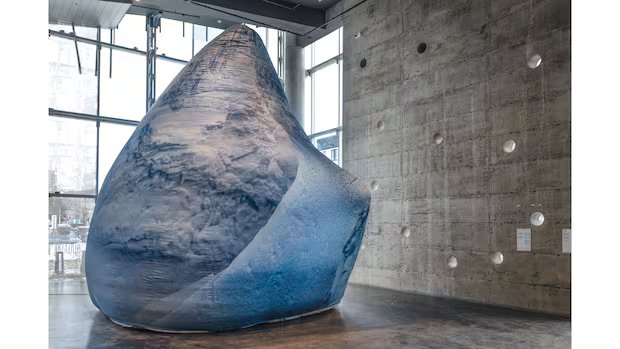
Visitors will also find a giant inflatable iceberg by Greenlandic artist Jessie Kleemann, as well as a huge sign by Puerto Rican artist nibia pastrana santiago that says “your island here” with an X striking out the Y. Morelli strategically installed these works side-by-side, he says. “Juxtaposing certain practices and pieces like Jessie Kleemann’s breathing iceberg with nibia pastrana santiago’s banner in the main exhibition is a way to show how performing bodies are interrelated in their actions on frozen landscapes and warm, watery ones. Creating juxtapositions, connective tissue, and highlighting hydro-solidarities across climates, geographies and communities … felt like an apt way to bring us closer to each other across time and space.”
Nearby, the artist-run centre La Chambre Blanche is home to Elias Nafaa’s À manipuler avec soin (Handle With Care), an installation of 300 resin missile replicas. The Lebanese Montrealer conceived of the work in 2024, when Israel invaded Lebanon, as a way of creating something while feeling powerless. Nafaa researched the different types of missiles used, focusing on six specific styles. “Each one is designed to inflict a certain form of harm on the landscape,” he explains. By making the missiles translucent and hollow, the sculptures evoke a ghostly presence.
Installation view of À manipuler avec soin (Handle With Care) by Elias Nafaa at La Chambre Blanche in Quebec City during Manif d’art. (Pedro Barbáchano)
Nafaa wants to remind the audience that these conflicts, though physically distant, impact the Quebec immigrant community. “Immigration in of itself is something very violent,” he says, “to be uprooted from your land. The shape of the installation is a topography in a way. I came up with this idea of looking at a snowy, very peaceful, beautiful landscape with glass, and reminding myself that I’m not from here.”
Similarly, artist Amélie Laurence Fortin splits her time between Quebec and Poland, not far from the war in Ukraine. Fortin is known for her work in performance, installation, sound and kinetic sculpture. Found at Chiguer art contemporain, her work Friction is a human-size monument made of metal (you can watch it here). Several moving chains encircle the figure, creating a sound, which Fortin describes as “icy,” like hail. Throughout the day, the chains loosen, altering their noise.
Installation view of Friction by Amélie Laurence Fortin at Chigeur art contemporain in Quebec City during Manif d’art. (Ivan Binet)
Living near the conflict in Ukraine and watching as Canada started to experience tension with the U.S., Fortin used her work to explore the tension within herself as she began to feel less secure in either place she calls home. “The feeling I was exploring was a feeling of insecurity, but at the same time a feeling that we have no choice,” Fortin says. “It’s changing. Things are changing. It’s like this feeling of tectonic plates.”
Like the shifting tectonic plates, Fortin feels like her unsettled sculpture could also be likened to ice sheets on the St. Lawrence River (fitting for the biennial’s theme), adding to this idea that we are in the middle of the narrative — not at the start and not able to stop it.
Other major art sites include the Huron-Wendat Museum in Wendake, the Lévis ferry terminal, a live performance at Montmorency Falls, an outdoor exhibit at Domaine de Maizerets as well as other venues around Lévis, Laval and Joliette, Quebec.
Though a person could see many of the art sites in one day, Morelli says it is better to explore the biennial slowly over a few days.
Manif d’art – the Quebec Biennale 2026 runs through April 19 in Quebec City.
