


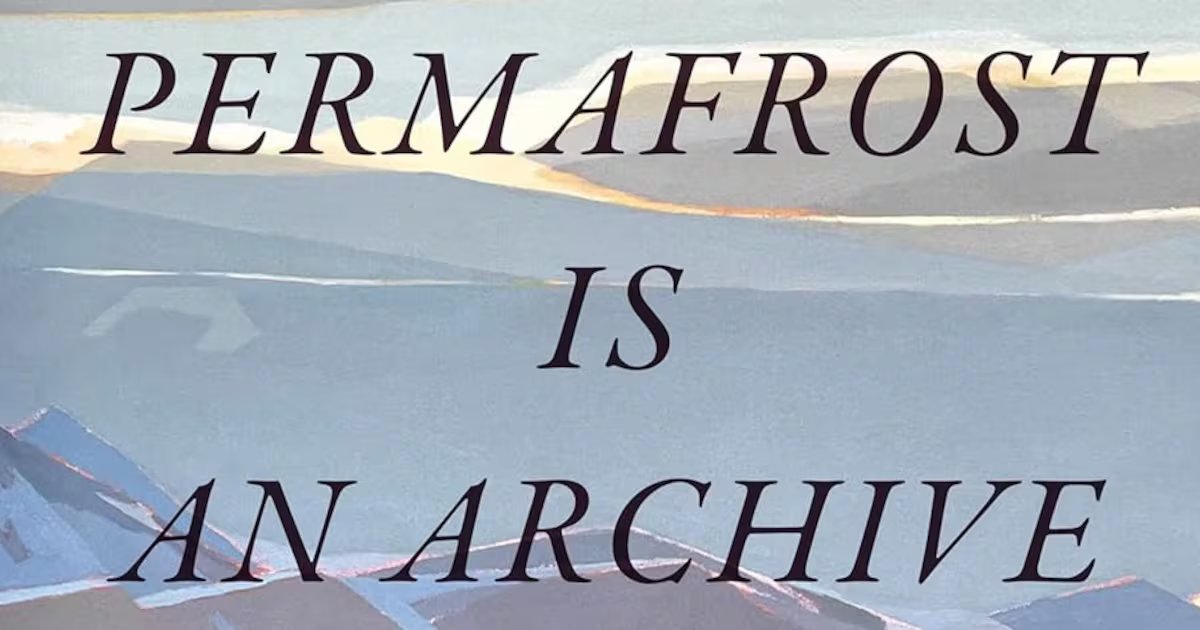
“Permafrost is an Archive and Other Inheritances from the Alaska-Yukon Borderlands” by Corinna Cook
“Permafrost is an Archive and Other Inheritances from the Alaska-Yukon Borderlands”
By Corinna Cook; West Virginia University Press, 2026; 298 pages; $22.99.
Douglas resident Corinna Cook, author of the previous essay collection “Leavetakings,” was the recipient of a Fulbright fellowship for a research year in Canada’s Yukon Territory. Her new book is the result of that fellowship, which included spending time with faculty members and archives at Yukon University in Whitehorse as well as exploring a physical environment she compares and contrasts to her more familiar coastal one.
Cook’s approach to her research brings to mind Joan Didion’s famous quote, “I write to find out what I’m thinking.” Her 15 essays are very much in that tradition, almost as though she’s thinking aloud to try to understand what she’s experienced, read, heard and discovered. She invites readers to join her in her process of asking questions about culture, art, Indigenous learning and northern science. The reader is challenged to make meaning right along with her.
The title essay, “Permafrost is an Archive,” is literally about that — the way that permafrost holds a record of the land and its history. The first part, titled “The Field Trip,” involves an excursion with the university’s Permafrost Lab to visit a slow-moving landslide. “As the ice in the earth melts and runs out, land that was once held up by ice is no longer held up. It falls down. It sinks. It slumps.” The scientists are excited. Cook quotes them: “It’s a textbook perfect drop shape, a typical permafrost retrogressive toe slump.” And adds, “Typical, as I understand it, means gorgeous.”
In the second part of that same essay, “The Core Samples,” Cook visits the lab with a scientist who shows her his rows of ice core cylinders, something she likens to an art installation. She meditates on and critiques the word “cryostructure.” The scientist envisions finding an artist to carve images of animals into the ice cores.
The third part of the permafrost essay, “The Maps,” addresses the way maps created by the lab are used for social purposes — to show communities hazards related to permafrost and its thaw, so that they can plan with those in mind. The scientist tells the writer that he “wants to change the story of the day.” Cook thinks about this. “Maybe I even think about what I might mean, if I were to say such a thing myself.”
In another essay, “YFN 101: What We Give to One Another,” Cook tells of what she learned from a one-day class about the history of Yukon’s 14 First Nations, a class required for all students, faculty, and staff at the university. “I am, of course, enthralled. The entire premise of the course is that the past is with us there in the present, and that we should all, every single one of us, get to know it.” The essay goes on to discuss Canada’s colonial history, its recognition of Aboriginal treaty rights, and the recommendations of its 2015 Truth and Reconciliation Commission. Cook lists the histories and abuses of Yukon’s residential schools.
In the following essay, “Chooutla: Truth and Reconciliation,” Cook visits the university archives to research its residential school records. Chooutla, a notorious residential school in Yukon, operated from 1903 to 1969. She quotes generously from letters, articles and reports she finds there. “I will see if old papers and pamphlets speak of the histories among us just as rocks and ice do.” She questions what she’s looking for or what she should do with what she gathers. She thinks about Alaska’s land claims and other Alaska parallels. She recalls her childhood and the divisions between Native and non-Native classmates. “I am interested in understanding my own life.” She meets and becomes friends with a First Nations artist.
Cook writes: “I have to accept that my time in the archives has little to do with research … Instead, my time in the archives is existential, born from my sense that a shared future here, on the North’s uneasy, melting ground, requires us to enter into right relations with divisive histories.”
Toward the end, in “The Kohklux Map,” Cook tells the story of an 1869 map drawn by a Tlingit chief and his two wives for a visiting geographer. The large map tracks in exquisite detail, from memory, the more-than-400-miles route from Klukwan to Fort Selkirk on the Yukon River, a trade route that typically took a month to travel. During her fellowship, Cook helped plan and participated in a conference that marked the 150th anniversary of the map’s making. She observes that the map “maps the land, but it also maps out a long lineage of cooperation, hard work, and rest.”
“Permafrost is an Archive” is, ultimately, a book of questioning and imagining, rich in metaphor and lyricism. Its many references to other texts and to cultural theory contribute significantly to understanding the North — its past, present and future. Notes at the end add more context and sources for consideration.
[Book review: Culture changes and character clashes in ‘Arctic Dreams and Nightmares’]
[Book review: A search for the elusive night sky detailed in ‘The Wild Dark’]
[Alaska author underscores the value of science and history by highlighting individual experiences]
