


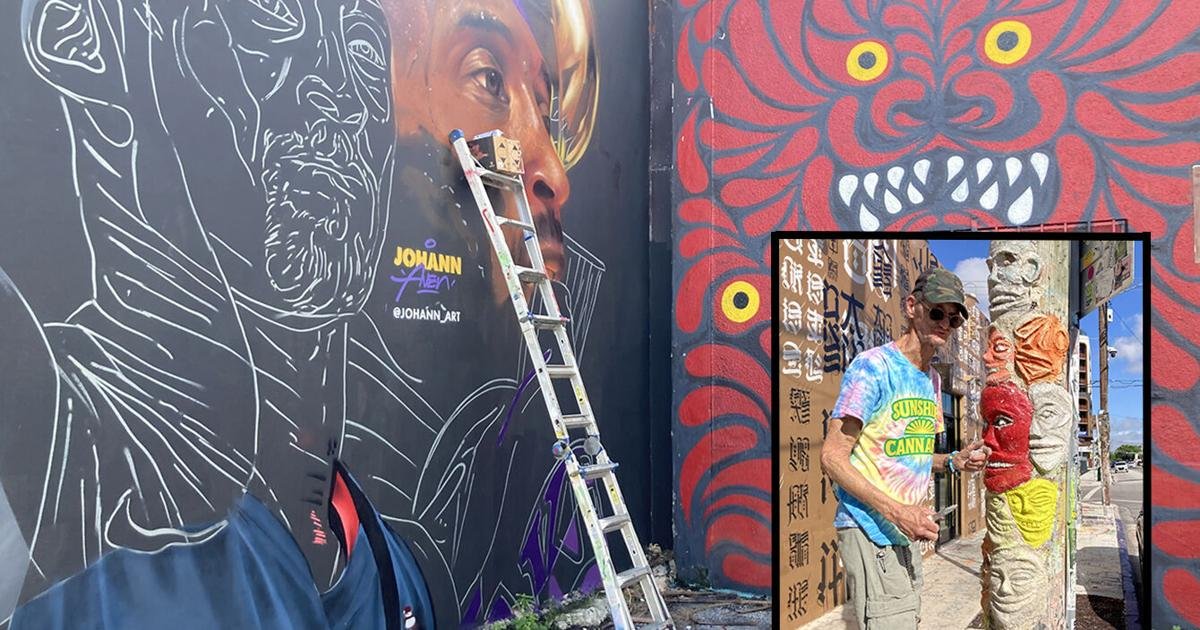
I have been traveling to the South Florida area for many years, starting as a little kid visiting my grandparents on Miami Beach. I remember the goal was to get a great tan, but it would always end in a blistering sunburn. I am reminded of those days every time I go to a dermatologist.
As a teenager, my parents lived outside of Fort Lauderdale. Since then, I have returned often to cover many major horse races at Gulfstream Park.
That was again the case this year, as I photographed the $3 million Pegasus Stakes at the end of January. After the event I ventured to Miami to visit my cousin, who lives in a section of the city called Wynwood.
I was surprised I knew nothing about the place. It is one of the largest, open-air street art installations in the world, attracting some of the best graffiti artists from around the globe. For dozens of city blocks almost every building, sign, and window is covered with art — some of which is visually stunning.
Essentially, the powers that be there happily sanction graffiti. However, don’t think you can just grab a can of spray paint and start tagging. There is a process to how and where the large murals go.
The Wynwood Walls district was created in 2009 in an effort to develop the area’s pedestrian potential. And, it has succeeded with a nightlife that is quite lively, filled with crowded streets, restaurants, bars, nightclubs, and retail shops.
Community-wide art walks are held often. Galleries, art studios, alternative spaces, and showrooms open their doors to the public for art, music, and refreshments. The Wynwood Walls district has grown to include more than 300 businesses. One can even pay to have a private tour of the murals.
The art experiment to increase pedestrian traffic worked perfectly. The downside of it is the area has become so popular that rental rates have skyrocketed. It has resulted in gentrification, a process where increased investment in a neighborhood drives up property values and rents, displacing lower-income residents and increasing prices so that lower-income residents are unable to afford a lifestyle there.
My cousin’s rent is $4,000 per month for a two-bedroom apartment.
As someone who is an art school graduate and appreciative of the arts, I was hoping to see the creation of art in action — in other words, a muralist working on a wall.
That happened.
The next morning, while walking to get breakfast, a few guys were set up and “creating” their mural (accompanying photo). Interesting, to say the least, but one character in particular drew my curiosity. He was doing his thing on some of the light poles in the area and I stopped to chat with him.
Michael Addis (inset) was more of a rogue artist. Technically, he didn’t get permission, but at the same time his canvas is not a wall. Addis is 74 and has lived in Miami most of his life. He grew up with eight siblings. His stepbrother is actor Mickey Rourke. He has spent many years in and out of rehab and being homeless.
A self-taught artist, he credits his art for helping end the cycle of drugs and repeated rehab stints. He says art literally saved his life.
Addis has his own “special” clay-like substance he created that he molds into face-like masks; then, they are painted and stacked one upon another up a pole.
His colorful “faces” have become a signature sight in the neighborhood. It is something he has been doing for close to a decade — a decade of sobriety.
A few weeks before I met him, someone ripped many of the masks off the poles. The act of vandalism caused a public outcry by many who know Addis, and the story was featured on a local television station. When I bumped into him, he was resurrecting new masks to replace the damaged ones, determined to continue his enlightened journey within the street art world.
