


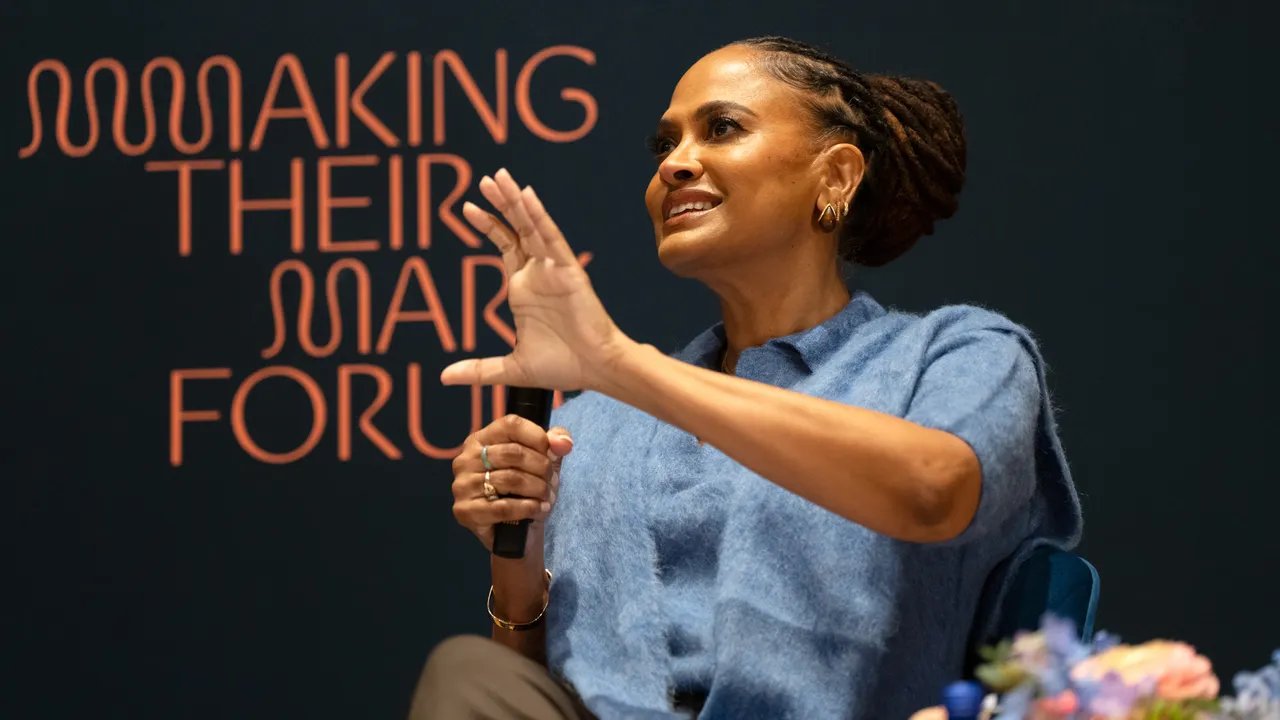
The art market has its share of globe-trotting fairs but few glamorous female-centric industry events—until now. This month, Komal Shah, the California-based collector, decided to simply invent the event that didn’t exist. Her Making Their Mark Forum gathered more than 350 curators, artists, and industry leaders (the vast majority of them women) in Washington, DC, from March 5 to 7, primarily at the Martin Luther King Jr. Memorial Library.
The main theater where talks were held was extraordinary, befitting of the art appreciators in the room. Steeply raked in the classical sense, it was a theatron, literally, with guests arrayed above and speakers emerging below from what the Greeks called the skene, a closed structure behind the stage. “I spent a lot of time in these libraries as a kid,” said Chelsea Clinton, one of the morning’s speakers, of the D.C. library system. The setting gave the panel discussions a faint charge of drama, and indeed dangerous ideas were being shared.
Dr. Sarah Lewis, Founder, Vision & Justice and Dr. Chelsea Clinton, Vice Chair, Clinton Foundation, speak on a panel at Making Their Mark Forum.Stephen Voss / CKA
According to a paper coauthored by Renée Adams—a professor of finance at Saïd Business School, University of Oxford, who studies gender disparity—paintings by female artists still sell at a discount of 42.1%, tracked across a sample of 1.9 million auction transactions. And this matters. As Shah put it, introducing a panel that included Bonnie Brennan, CEO of Christie’s, and Amy Cappellazzo of Art Intelligence Global, “If artists shape the story that society tells about itself, then markets shape which storytellers endure.”
That particular panel was off the record, but it grew quite heated in the audience as speakers discussed what markets mean for legacy, especially at a moment when female collectors are starting to outpace men (the Art Basel UBS annual report indicates that high-net-worth women spent 46% more on average for fine art and antiques than men did in 2024). Galleries trying to build artists for posterity, though, must reckon with far more than auction results, which can appear as a deus ex machina dictating who gets remembered and who gets tossed in the dustbin of history. Christa Blatchford, executive director of the Joan Mitchell Foundation—Mitchell being the Abstract Expressionist with some of the highest auction results among women—spoke movingly about Joan’s wish to support thousands of working and struggling artists in order to preserve their legacies.
I came to the forum as a representative for my mother, Mary Grigoriadis, a pattern painter whose work was shown in a New York exhibition of Shah’s collection at the former Dia Chelsea space, curated by Cecilia Alemani. At the time, press coverage described my mother as “long-overlooked.” Like many artists who receive that designation, though, she was once quite well known as a founder of A.I.R., the first women’s cooperative gallery in the US, established in 1972 on Wooster Street, and now works with Ortuzar in Tribeca. Also present this weekend was Joan Semmel—a painter focused on sexuality, a surprising take on nudes, and her own aging body—a friend of my mother’s from decades of summers spent in East Hampton’s Springs neighborhood. Semmel, now 93, is currently the subject of a major exhibition at the Jewish Museum.
