


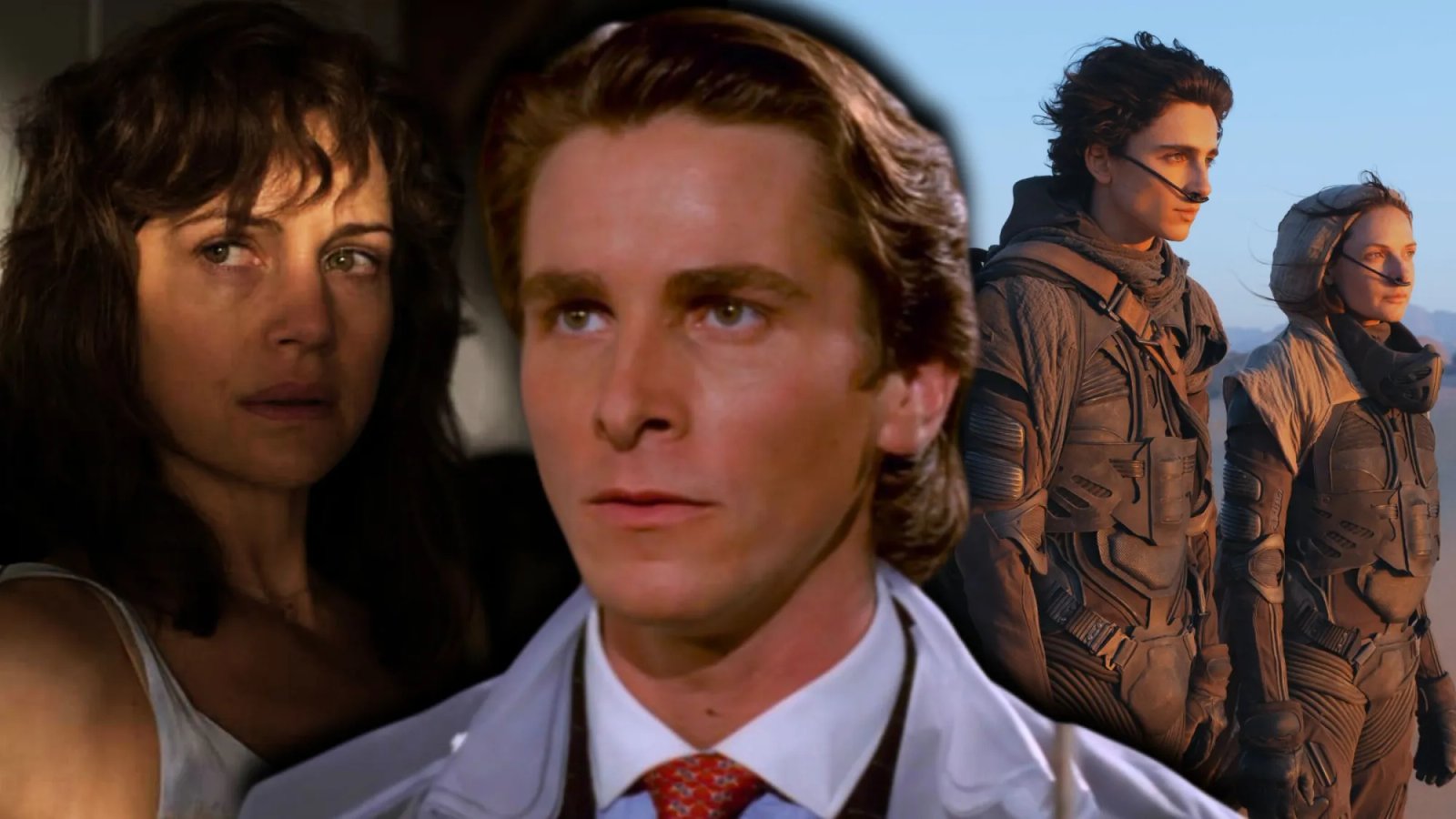
Nowadays, book adaptations are everywhere, whether as TV series or movies, which can make the whole process seem pretty easy on the surface. But the truth is that it’s a minefield, especially when you factor in audience expectations and the pressure to do justice to the original material. Some books almost feel like they were never meant for the big screen, and taking a chance on adapting them can be a serious risk: sometimes the story depends heavily on style and language, and sometimes it’s simply too controversial to ever be mainstream. Still, some filmmakers believe in the potential of these stories like no one else, and they’re willing to take the leap. The result? Incredible productions.
Here are 10 adaptations that were, for a long time, considered impossible to turn into movies, but ended up succeeding spectacularly. These are the rare cases where cinema proved it really can transform almost any book, as long as there’s strong direction, courage, and smart creative choices.
10) Enemy
image courtesy of a24
Any Denis Villeneuve film tends to be a little complicated to fully wrap your head around, so imagine what happens when he decides to adapt a book that isn’t even driven by major plot events. José Saramago’s The Double is all about paranoia, obsession, and a feeling that reality is slipping through your fingers. In Enemy, we follow a professor who discovers an actor who looks exactly like him, and that discovery sends him spiraling into something strange and unsettling as he tries to figure out who this man is and what it actually means.
The movie isn’t talked about nearly enough, and it’s honestly pretty underrated, because what Villeneuve pulls off here is seriously impressive. The thriller doesn’t try to over-explain itself at all — it does the opposite. It takes the confusion and turns it into the film’s entire language, using atmosphere, repetition, and symbolism to make the audience feel just as unsteady as the protagonist. In the end, Enemy works so well because it understands the story was never really about “what happens,” but about “what it does to you.”
9) Blade Runner
image courtesy of warner bros.
A classic, Philip K. Dick‘s Do Androids Dream of Electric Sheep? is packed with brilliant ideas, but it’s also a nightmare to adapt, since it’s far more philosophical than plot-driven. It’s full of internal reflection and long discussions about empathy and humanity — the kind of material that could’ve turned into a stiff, overly pretentious movie. But Blade Runner was smart enough to take the core of the book and rebuild everything around that. The story follows a replicant hunter in a decaying future, tasked with “retiring” androids who feel a little too human.
The key is that the film isn’t faithful to the details, but faithful to the discomfort. Ridley Scott basically translated the book’s existential questions into atmosphere, visuals, and a strong noir rhythm, and that made all the difference. The result is that, even today, Blade Runner proves that sometimes the best adaptation isn’t the one that copies pages word for word, but the one that understands exactly what kind of feeling the original story was meant to leave behind.
8) Lolita
image courtesy of mgm
Lolita has always been one of those books that feels almost scary to even touch, as adapting it comes with the risk of looking like you’re normalizing what the story is actually condemning. And that’s not even the biggest issue: the entire novel works because the narrator is a brilliant manipulator, and Vladimir Nabokov holds you in through language, irony, and perspective. So how do you translate that to film without it turning into a disaster? That’s where the eccentric Stanley Kubrick comes in, managing to not soften the story in 1962, but also avoiding the mistake of turning the subject into some kind of spectacle.
The movie follows a man who gets close to a woman purely to stay near her daughter, and the discomfort is always there, even in moments that almost seem like they’re trying to play with the situation. But Lolita is great since it shifts the weight onto subtext and absurdity, making it clear that the entire story is about distortion, control, and self-delusion, and not some forbidden romance.
7) American Psycho
Image Courtesy of Lionsgate
If you’ve never seen American Psycho, you’re missing out on one of the most memorable movies of the 2000s. But did you know it’s based on a novel by Bret Easton Ellis? And not just any novel, but one that seemed almost impossible to bring to the screen. The book is aggressively repetitive, with endless descriptions, and features violence so extreme that a lot of people thought filming it would automatically be irresponsible. Besides, so much of its impact depends on tone: it’s satire, but it’s also horror, and it’s also social commentary — and messing up that balance would’ve been a disaster.
So why is the adaptation so good? Because it understood the story was never about a “cool serial killer,” but about a man who’s basically a product of corporate emptiness. The movie follows a wealthy executive obsessed with status and appearances as he starts killing people (or possibly just fantasizing about it) in a spiral of ego and alienation. So instead of just recreating the book’s brutality for shock value, the film reshapes it into something sharper and more ironic, making American Psycho a character study that never ends up glamorizing the sickness.
6) Adaptation
image courtesy of sony pictures
The fun thing about Adaptation is that it’s completely meta, and it fits into a very unique kind of book adaptation. The Orchid Thief isn’t really a story with a clear beginning, middle, and end; it’s more of a journalistic work about a guy obsessively chasing orchids, filled with digressions, research, and reflection. In other words, it’s the kind of material that doesn’t naturally lend itself to a traditional screenplay with structure and tension. But the rights were actually bought for a movie in real life, and because of how difficult it was, screenwriter Charlie Kaufman decided to turn that struggle into the adaptation itself.
In the film, the main character is a screenwriter desperately trying to adapt the book, hitting a wall, and spiraling into a full creative breakdown, while author Susan Orlean and the “orchid thief” start coming alive inside the story. Adaptation is genuinely brilliant. Instead of forcing the book into a formula it was never meant to fit, the movie embraces the chaos and still delivers a commentary on the industry, creativity, and the way Hollywood demands neat storytelling rules even from stories that were never built for them.
5) A Clockwork Orange
image courtesy of warner bros.
This one seemed impossible for one simple reason: Anthony Burgess’ A Clockwork Orange relies heavily on its invented slang (Nadsat) and on the psychological effect of reading horrific acts through this almost childlike vocabulary. On film, that could’ve turned into nothing more than stylish violence with no real point. But here’s another case where Kubrick turned an unfilmable book into a masterpiece — not by making the material more palatable, but by making it even stranger, which is a huge compliment.
The story follows an ultraviolent delinquent who’s subjected to a government treatment meant to “cure” him by force, stripping away his free will in the process. And the movie has an exaggerated aesthetic, but not just for the sake of being different, because it’s part of the entire message. A Clockwork Orange is brutally violent, yes, but it’s also theatrical and almost grotesque, which perfectly matches the book’s central argument: the idea that a human being programmed to be good can end up just as monstrous as someone who chooses cruelty naturally.
4) Gerald’s Game
image courtesy of netflix
Stephen King has had several books adapted for the screen, ranging from great to absolutely terrible. But with Gerald’s Game, it feels like Mike Flanagan somehow pulled off the impossible, since almost everything in the story happens inside the protagonist’s head. It’s basically a woman stuck to a bed, alone, talking to herself, and slowly spiraling into psychological collapse. If that isn’t written and directed extremely well, it turns into filmed theater and something that would get boring fast. However, the movie takes that introspection and turns it into pure suspense.
The adaptation centers on a woman left handcuffed to the bed after her husband dies during an attempt to spice up their relationship, and she’s forced to survive while battling thirst, hunger, hallucinations, and traumatic memories. Here, claustrophobia is the fuel for everything, and the film doesn’t even need action scenes to keep the story moving. And when it opens the door for flashbacks and delusions, it shows that her mind is her real monster. Gerald’s Game is on another level.
3) Life of Pi
image courtesy of 20th century studios
When it was released, Life of Pi got strong reviews, but a lot of people don’t even realize it’s actually a book adaptation. The story is basically about a person trapped on a boat with a tiger, with their relationship built on symbolism and ambiguity, which almost feels more suited for a documentary than a narrative film, honestly. Plus, Yann Martel’s writing is all about narration and reflection, letting the meaning of everything shift as you keep reading. But the film found a surprisingly effective way to translate that: turning it into a visual experience, without ever treating it like an effects showcase.
Here, we follow a teenage boy who survives a shipwreck and spends days stranded in the ocean, sharing a lifeboat with a Bengal tiger. But what makes Life of Pi work is that all of its spectacle is there to serve the emotion — the loneliness, the fear, and the need to believe in something bigger. And when the story reaches that moment where you start questioning what might actually be real, the production holds onto the same impact the book had, without spelling everything out. It’s an adaptation technically ambitious and still personal and intimate.
2) Dune & Dune: Part Two
image courtesy of warner bros.
Sometimes it feels like certain books are only meant to be adapted by one specific director, and that was definitely the case with Dune and Villeneuve. The story had already been attempted by David Lynch, but it ended up being a mess, as it’s just too complex to translate to the screen. The plot follows the heir of a noble house who’s sent to Arrakis, a desert planet that holds the most valuable resource in the universe, only to get pulled into a conflict involving empires and fanaticism. But it isn’t just a plot — it’s an entire ecosystem of politics, religion, prophecy, ecology, war, and philosophy. So you can’t adapt that with a few explanatory lines of dialogue.
That’s why Dune had to be split into two parts (at least for the first book), and it ended up being praised for a reason. The most impressive thing is that it isn’t trying to be nonstop entertainment; even with action scenes, it depends on a perfect balance between patience and payoff. Villeneuve understood that this story only works if you let the world breathe, instead of rushing to the cool moments. In the end, it’s an adaptation that finally gets what the book has always been about: not just sci-fi, but a warning about power (and one that hits close to real life).
1) The Lord of the Rings
image courtesy of new line cinema
When you look at all three The Lord of the Rings films today, it feels almost impossible to believe that this saga was ever considered too complicated for cinema. But it absolutely was, since J.R.R. Tolkien’s book is massive, with multiple characters, mythology, side stories, and a pacing style that isn’t exactly friendly to adaptation. The story follows a hobbit tasked with destroying the One Ring while a powerful villain attempts to take over Middle-earth. And with that, there was always the risk of it turning into either a rushed mess or something overly long and exhausting.
And yet, Peter Jackson pulled off what basically feels like magic, balancing epic scale with real character drama in a way that still holds up. How? By understanding that he didn’t need to adapt everything, he just needed to make the audience believe in that world enough to get completely pulled into it. That meant making tough choices such as cutting, condensing, and rearranging storylines, but still preserving the heart of it all: friendship and sacrifice. The Lord of the Rings started as a world that felt almost too literary for the big screen, but its movies are still the gold standard for how to translate that kind of material with emotion and scale in exactly the right dose.
What do you think? Leave a comment below and join the conversation now in the ComicBook Forum!
