


This book aims to give voice to the women who were silenced and controlled,” writes Louise Brangan in her compelling The Magdalene Laundries & Ireland’s Legacy of Silence (Bodley Head). Dr Brangan details the way women and young girls were abused, dehumanised and vilified in what were effectively detention and forced labour camps for so-called “fallen women”. The last Magdalene laundry did not close until 1996. They were run by Catholic orders and the author tellingly compares the refusal of nuns to break their silence over such a dark part of Ireland’s history to “a villainous act”.
In 1972, Shere Hite, a Playboy model turned feminist researcher, published a groundbreaking study of sex. The book sold millions of copies and changed the way many women thought about their right to sexual pleasure. Her conclusions – that heterosexual women stayed silent about wretched sex lives in a culture shot through with gender inequality – shocked America. In The Book That Taught the World to Orgasm and then Disappeared: Shere Hite and the Hite Report (Melville House), academic Rosa Campbell tells the intriguing story of Hite’s fraught childhood, her rise to fame and her eventual cancellation by the far right and the media.
Son of Nobody (Canongate) is the first novel in a decade from Life of Pi author Yann Martel. The structure combines a fictional epic poem by a foot soldier in the Trojan war with footnotes and personal revelations from an academic who has discovered the lost classical fragments at the Bodleian Library. There are clever moments, although its overall effect on me was to prompt reflections on the earlier pleasure of reading Vladimir Nabokov’s Pale Fire, a novel in similar territory (although published in 1962), about a fictional poem and the lengthy commentary by an academic colleague.
Finally, avid readers and book-collecting enthusiasts will find much to enjoy in Nicholas Royle’s Finders, Keepers: The Secret Life of Second-Hand Books (Salt).
The choices for novel, biography and non-fiction book of the month are reviewed in full below:
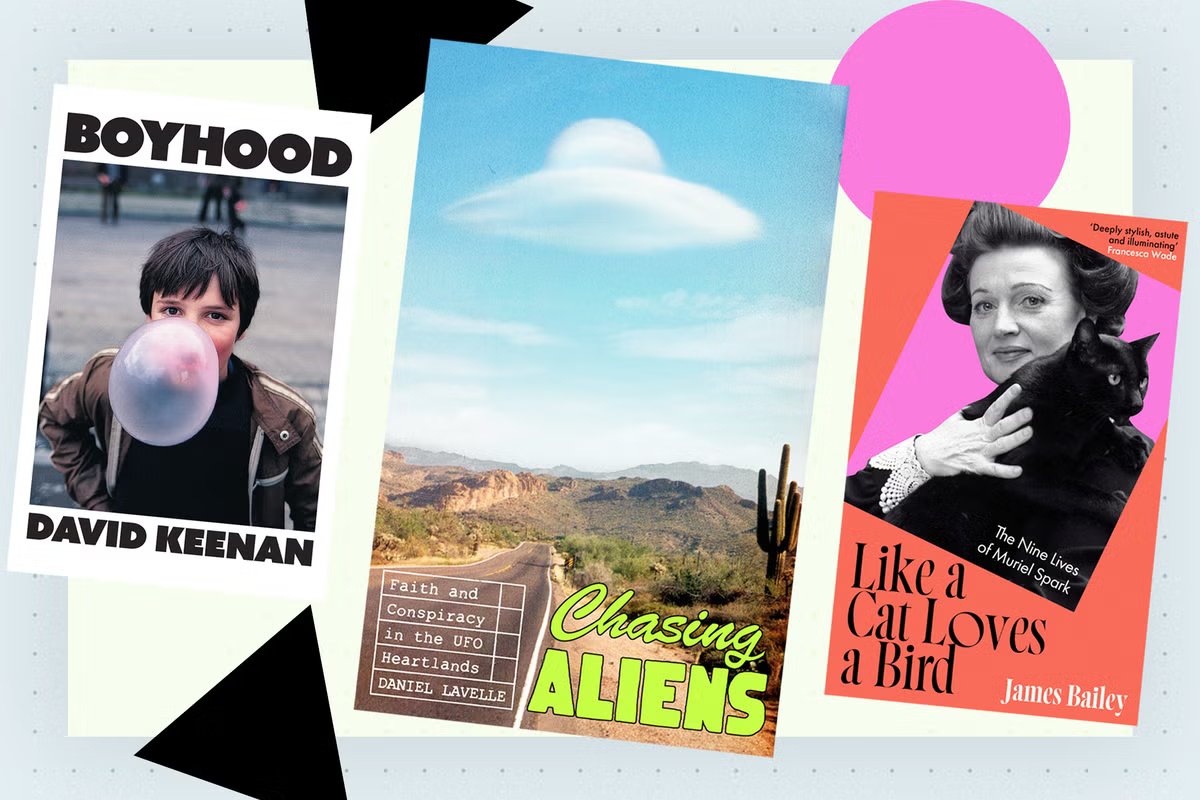
Novel of the Month: Boyhood by David Keenan
★★★★☆
David Keenan’s Boyhood opens in startling fashion, with the abduction of a young boy outside a Glasgow football ground in 1979. Nine years later, the focus moves to the boy’s brother, Aaron Murray, who has “The Precious Gift” of being able to use “remote viewing” to see events, past and present, from afar. His visions span wartime Paris to the Irish Troubles in the 1970s, from Mexico City to Glasgow, the main setting of the action, in the 1980s. Aaron’s visions bring to life soldiers, poets, burlesque dancers, East End gangsters and a child killer in Derry, all mysteriously tied up in each other’s fate.
Out of all this, and with a true, stylish flourish, Keenan creates a sprawling, multilayered, almost modern picaresque novel that celebrates the wildness of Glasgow and the creative, anarchic language of Glaswegians. He reveals how minor events in life can actually be major events and leaves the reader with moments that linger in the mind, including the poignant account of a “failed dirty weekend in Paris” that leaves a violent old “king of the gypsies” standing on the Eiffel Tower, reflecting that he no longer knows where a country ends and another begins, “and the same thing with another person”.
‘Boyhood’ captures, with lyrical grace, the resilience of youth, the zest of life and its concurrent ability to jade and squash joy (Marzena Pogorzaly/Orion)
Boyhood is very intentionally not politically correct (even the horses are given LSD) and replete with violence and brutal dialogue. I enjoyed the humour, including the moment when a thug declares a “hostage situation” and one of the policemen replies: “What do you think this is, f***ing Taggart?”. There are many neat song references, including when former music journalist Keenan has Aaron’s friend Joyce wittily sum up jazz musician Albert Ayler’s “Truth is Marching In” as sounding like “a marching band from hell”.
There is terrific energy to the writing throughout, although occasional similes felt a bit strained, as when the amusing description of someone looking “like a beefy John Travolta who has been dragged through the divorce court” is followed 18 pages later by the more mundane one of a waiter looking “like Harvey Keitel gone to seed”. There are plenty of sex scenes, including one in which a female character says, “F*** me with your big daddy c**k” to a man who then “absolutely ploughs her to another screaming climax”. Perhaps the scene is meant to highlight the attitudes of the time; perhaps that sort of thing just floats the boats of certain male readers?
Caveats aside, Boyhood captures, with lyrical grace, the resilience of youth, the zest of life and its concurrent ability to jade and squash joy. As one character says, “I no longer think it is possible to be happy. But I do think it is always possible to be unhappier.” Boyhood is a challenging, unconventional and daring piece of fiction.
‘Boyhood’ by David Keenan is published by White Rabbit on 9 April, £25
Biography of the Month: Like a Cat Loves a Bird: The Nine Lives of Muriel Spark by James Bailey
★★★★☆
James Bailey follows up his 2021 work Muriel Spark’s Early Fiction – which analysed the literary experimentation of her work in the 1950s and 1960s – with a broader biographical study of the Edinburgh-born author, whom he calls “perhaps modern literature’s finest shapeshifter”.
Timed for publication around the 20th anniversary of Spark’s death at 88, Bailey claims “there is still something of the monster to Spark’s public image”.
Cats certainly wandered in and out of her life. She adopted Patricia Highsmith’s furry pet, and among the more unusual names she coined for her own feline companions were “One-Eyed Riley” and “Pinot Grigio”. She also claimed that the cruelty she inflicted on some of her characters was like the way a cat loves a bird; “you know cats do love birds; they love to fondle them,” she said.
Bailey’s biography is a welcome addition for anyone caught in the mental claws of one of the most elusive and brilliant writers of modern times (Hodder & Stoughton)
Bailey does not skirt over Spark’s faults – especially the mean and score-settling side of her personality – as he offers some damning biographical nuggets. He also gives astute insights into her work and her “morbid curiosity”. I particularly enjoyed his account of one of Spark’s finest works, the maudlin Memento Mori, in which each old character is rung by a mysterious caller who tells them, “Remember you must die.” I rather wish Bailey had elaborated on the “cruder, more outrageous touches” she originally mooted in her book proposal for Memento Mori to Macmillan.
Spark was made famous by her 1961 novel The Prime of Miss Jean Brodie and the subsequent film adaptation. However, she admitted she was “bored with Miss Brodie”, adding that it reminded her of Thomas Hardy’s view of Tess of the D’Urbervilles, when the Victorian author joked that he called the novel “Tess my old milch cow” because it was a money-maker for him.
Bailey’s book will possibly suffer as it follows in the wake of the excellent Electric Spark: The Enigma of Muriel Spark by Frances Wilson – which I included in my best books of 2025 pick – although he explores different enough paths to make it a welcome addition for anyone caught in the mental claws of one of the most elusive and brilliant writers of modern times.
‘Like a Cat Loves a Bird: The Nine Lives of Muriel Spark’ by James Bailey is published by Sceptre on 16 April, £20
Non-fiction of the Month: Chasing Aliens: Faith and Conspiracy in the UFO Heartlands by Daniel Lavelle
★★★★☆
Does it make you more or less likely to believe in aliens to learn that Kurt Russell supposedly witnessed paranormal activity in the skies over Phoenix, or that fellow actor Dan Aykroyd has encountered flying saucers? In any case, given that Akroyd claims to have seen four UFOs on three different occasions, it would seem sensible to fit the Blues Brothers star with his own 24/7 extraterrestrial bodycam.
There were sightings of UFOs in Ancient Rome, reports Daniel Lavelle in his highly enticing Chasing Aliens: Faith and Conspiracy in the UFO Heartlands, a book that takes him on what he calls a sleeper tour through “America’s superstition and conspiracy belt”.
Orwell Prize-winning journalist Lavelle mixes sardonic wit with genuine curiosity as he investigates “ufology”. He hears about secrets that should never be made public, about an encounter near RAF Woodbridge in Rendlesham Forest in Suffolk that believers claim is “more significant than the infamous Roswell incident”, and former intelligence officer David Grusch’s revelation that the US government possesses UFOs “the size of football fields”.
Lavelle embarks on a sleeper tour through ‘America’s superstition and conspiracy belt’ (Penguin Random House)
A 2021 Gallup poll found that 41 per cent of Americans (that’s roughly 136 million people) “believe aliens have landed on Earth” with descriptions varying from “short and black-eyed” to “blond, elfin-like beings”. One man boasted that he awoke to find “a woman with blue skin straddling him”. It seems an appropriate moment to mention that Lavelle remarks that UFO spotters are “mostly middle-aged and male”.
There are an estimated 50,000,000,000,000,000,000,000 habitable planets in the known universe, so it’s plausible there are extra-terrestrial civilisations out there (who are believed by some to time-travel to our planet using “space wormholes”), and Lavelle does his best to contextualise this desperate need to believe there is more to our world than the rather inadequate human race.
He also deals with some of the more worrying aspects of the hocus pocus of ufology, including alleged alien abductions involving rectal probes. Interestingly, he explores why it is no coincidence that QAnon influencers “are entering UFO communities to expand their audiences”. Jason Colavito, an expert on fringe theories, argues that “right-wing extremists use UFO conspiracies as a kind of gateway drug to lure people into a wider world of conspiracy”. There are convincing theories and reports that the US government uses “fake alien stories” as a smoke screen to protect advanced military technology. Ultimately, Chasing Aliens leaves the reader to make up their own mind.
Lavelle is an entertaining guide to the UFO landscape, even if he does memorably complain that “the world of ufology is like a river contaminated with raw sewage: when wading into it, one will inevitably come out covered in s***. I guess we’ll all just have to wait and see whether little green men emerge from Uranus.
‘Chasing Aliens: Faith and Conspiracy in the UFO Heartlands’ by Daniel Lavelle is published by Viking on 30 April, £20
