


Having existed for three whole decades, the Resident Evil series naturally has a number of casualties – games that were halted and culled mid-way through development. Some of those lost games have been recovered by an army of faithful fans, such as the infamous “Resident Evil 1.5” and a Game Boy Color port of the classic 1996 original. But some lost Resident Evil games are purely ethereal – no build to recover, no demo to play, no grainy trailers captured on a MiniDV camcorder in Kentia Hall. Just rumors of what could have been. A ghost, like RE2 director Hideki Kamiya’s original vision for Resident Evil 3.
Codenamed “Ship Bio,” the sequel starred HUNK, the gas-masked Umbrella mercenary from Resident Evil 2’s brutal bonus scenario The 4th Survivor, sent to recover the G-Virus from a cruise ship overrun with human-plant hybrids. When Sony announced the PlayStation 2 in 1998, though, Capcom grew nervous about releasing a major title on dying hardware and pulled the plug.
Instead, an internal side project called Resident Evil: Gaiden was hastily promoted to mainline status and became Resident Evil 3: Nemesis – not to be confused with the 2001’s Resident Evil: Gaiden for the Game Boy Color, which was set on a ship, or the original concept for Resident Evil 3, which was also set on a ship. Capcom was clearly scared shipless by the advent of new hardware, and Kamiya’s project was redirected toward a next-gen PS2 game.
Resident Evil 4 was famously, controversially a GameCube exclusive, at least before it was ported to practically everything with integrated circuits, but the game Kamiya began developing was unrecognizable from the RE4 we’ve come to know. No sass-talking Leon, no Plagas, no pro wrestling moves. An unthinkable alternate universe in which Ingrid Hunnigan never existed.
Resi-storians have cataloged at least four distinct versions of the game, each unique enough to earn its own name and all of which left their mark on the eventual classic. Hideki Kamyia’s version came first. Today, it’s called “Stylish”.
Stylish
Mikami’s concept for Resident Evil 4 eventually became Devil May Cry. | Image credit: Capcom
Starring Tony Redgrave, the red-and-black clad superpowered son of Umbrella founder and Mansion namesake Oswell E. Spencer, the so-called “Stylish” version of Resident Evil 4 ditched pre-rendered backgrounds for the heroism and agency of an active camera as we stormed the castle stronghold of Mallet Island with aura and rizz to spare.
If any of this sounds familiar, that’s because it’s literally Devil May Cry, and fans of the series have veteran Resident Evil director and producer Shinji Mikami to thank for its existence. He felt the concept was too flashy for survival horror and firmly encouraged Kamiya to transition the game into a fresh IP more suited to his sensibilities, so RE4 became 2001’s Devil May Cry.
The goopy sci-fi body horror of Resident Evil got a mythological makeover. Tony and his Les Enfants Terribles twin Paul became the dashing, demonmaxxing Dante and Vergil. DMC willed itself into existence from the cutting room floor by being cool, outrageous, and addictive, birthing a hit franchise and arguably the entire character action genre from the recycle bin.
The DNA of Resident Evil 4 is all over the final game, with much of the enemy and character design legwork coming from Resi-era concept art. The Stylish RE4 was never previewed, and little of it survives today. It’s lost by any definition of the word, except for the fact you can buy and play Devil May Cry on modern hardware right now. Kamiya transmogrified his last attempt at Resident Evil into an SSS-ranked swansong from Capcom, the only DMC he directed before leaving to co-found PlatinumGames and create Bayonetta.
With Kamiya occupied, Capcom tapped director Hiroshi Shibata to build a new RE4 from the bones of his original pitch, resulting in another abandoned attempt dubbed “Castle”.
Castle
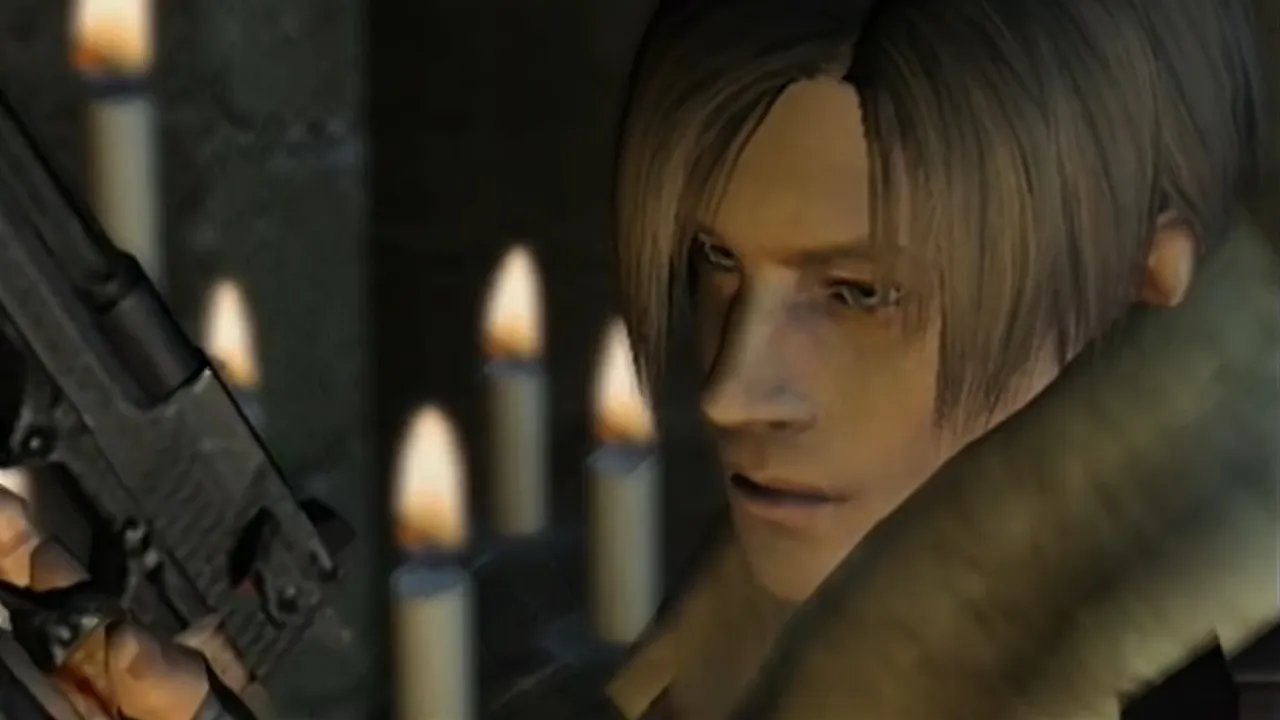
Leon’s bomber jacket first made its public appearance in an early trailer for RE4. | Image credit: Capcom
Resident Evil 4 had a new target platform. In 2002, Capcom stunned the industry by entering into a blockbuster exclusivity deal with Nintendo, promising five flagship games for the new GameCube overseen by Shinji Mikami. The announcement of the so-called “Capcom Five” was accompanied by the only extant footage of the “Castle” or “Fog” version that exists.
We see Leon arrive at the aforementioned fortress on an airship, already rocking the immortal bomber jacket that would outlast every cancelled version of this game. Like the final RE4, the plot involves Leon battling a mutagenic infection, though unlike the Plaga this virus would slowly consume his left arm. Along the way he encounters an imprisoned young woman protected by a trained B.O.W. dog. The castle still belongs to Spencer, but the camera hasn’t found its paradigm-shifting place over the shoulder yet as Leon battles a swirling black mass of tentacles.
The signature fog monster proved too ambitious for GameCube hardware to render convincingly, and the Castle version was razed at roughly 40% completion. The script was sent to a separate Capcom team, who built a new game called Haunting Ground around the girl and her mutant canine as RE4 started over once more.
Noboru Sugimura, the Sentai-scribe-turned-savior who rescued the Resident Evil 2 narrative had become somewhat of a loremaster for the series. Through his scenario-writing studio Flagship he was tasked with cracking the RE4 conundrum. With the emancipation of Devil May Cry and the failure of “Castle,” co-writer Yasuhisa Kawamura had an idea.
The man who scripted RE: Nemesis had grown weary of the physical limits imposed by vintage Resi biopunk and was acutely aware that Konami’s Silent Hill was eating Capcom’s lunch in the psychological terror department. Inspired by cerebral mind-benders like Lost Souls and Jacob’s Ladder, Kawamura pitched a pivot: more than a mere mutation, Leon’s infection would plunge him into madness. The build became known as “Hallucination”.
Hallucination
The first gameplay video for RE4 introduced the over-the-shoulder aiming camera. | Image credit: Capcom
It was a huge departure, though somewhat less blasphemous to purists than the stylized dash-cancels and Devil Triggers of Kamiya’s early prototype. Still, it was growing clear that the franchise needed a shot of adrenaline. Shinji Mikami gave the “Hallucination” build his public blessing at E3 2003. Wearing the heck out of some Wachowskian wraparounds, he assured the crowd that this twice-rebooted game was doing just fine and introduced the first real footage.
Unlike the cinematic “Castle” teaser, Capcom premiered what appeared to be genuine gameplay. Leon’s character model looks familiar, but development is clearly further along. There are hints of a UI, while parries and quick-time events are on full display. The camera still utilized cinematic, semi-fixed tracking, but when Leon raises his weapon the view aggressively snaps to his shoulder and a familiar red laser sight pierces the darkness.
Then things get strange. The mundane castle geometry bleeds into a bleached, sickly blue nightmare world. Creepy dolls and mannequins litter the corridors. Taxidermied deer heads fall from the wall and writhe at your feet. Suits of armor spring to life and attack you while a ghostly figure wielding a hook and chain drifts out of an infernal painting as Leon desperately backs away. It’s “Resident Evil” taken to its paranormal conclusion, a castle that wants to kill you.
But like Leon’s on-screen visions, the “Hook Man” demo was an illusion. To pull off the seamless, real-time hallucination shifts, the dev team had to keep two complete environmental models loaded into memory simultaneously. Nintendo’s adorable purple hexahedron simply didn’t have the RAM. The GameCube, which had effortlessly dazzled with the gorgeous pre-rendered backgrounds of 2002’s Resident Evil remake, buckled under the weight of Resi 4’s 3D dreams. The game had hit a wall. The Hallucination version was scrapped, and Sugimura and Kawamura quietly exited the project.
It wasn’t even the last time the game would be rebooted.
Zombie
RE4 saw the series’ traditional zombies replaced with new Las Plagas-infected people. | Image credit: Capcom
Desperate for traction, director Shibata went back to basics for his final attempt. This penultimate prototype pitted Leon against traditional slow-moving ghouls in the real-ish Resi world. Fans appropriately dub it “Zombie”. The name fits for more than one reason. Returning to the well of shuffling corpses was like witnessing a series go stagnant and decompose in real time. Mikami, overseeing from his producer role, concluded that his predecessors had been right about one thing: the series needed to change or die. Mikami decided to do it himself.
Stepping in as director, Mikami swept the table clean and rewrote the scenario in just three weeks. No more Umbrella, no more T-virus, no more fixed cameras. Instead the player found themselves fighting parasites in remote rural villages and cutting pro wrestling promos on a strange little man in a tricorn hat. The new game would have a heavy mechanical focus on aiming and combat supplied by intelligently generated item barrels as the camera detached from the wall and locked firmly to Leon Kennedy’s broad shoulders.
After a truly tortured development cycle, Resident Evil 4 finally shipped in 2005, invigorating the franchise and influencing the next decade of action and adventure games. It was an awkward, agonizing rebirth, but Resi is nothing if not resilient.
Time and time again, the teams behind RE were willing to take a hard look at their work and make the painful decision to go back to the drawing board. It’s easy to view a scrapped prototype or cancelled port as a colossal waste of time, countless hours and resources left to rot in Capcom’s basement. But without the awkward growing pains of these abandoned projects, the landscape of survival horror, if not the entire video game industry, would be unrecognizable today.
These phantom games could have easily faded into obscurity, but they live on thanks to a tireless, dedicated community that refuses to let sleeping Cerberuses lie. Fans have become digital preservationists, sniffing out ROMs and collaborating on ancient unfinished code to unravel the mysteries behind one of the most bankable and beloved franchises in modern media. Three decades after the original outbreak, it’s clear that in the world of Resident Evil, nothing ever really stays dead.
The Lost Games of Resident Evil
In celebration of Resident Evil’s 30th anniversary, we’re looking back on the survival horror games that never escaped Capcom’s walls. The stories of a culled sequel, a struggling Game Boy port, the prequel designed for a failed Nintendo 64 peripheral, and the many, many versions of Resident Evil 4 are all explored across a trilogy of articles (or, if you prefer, one packed video).
