


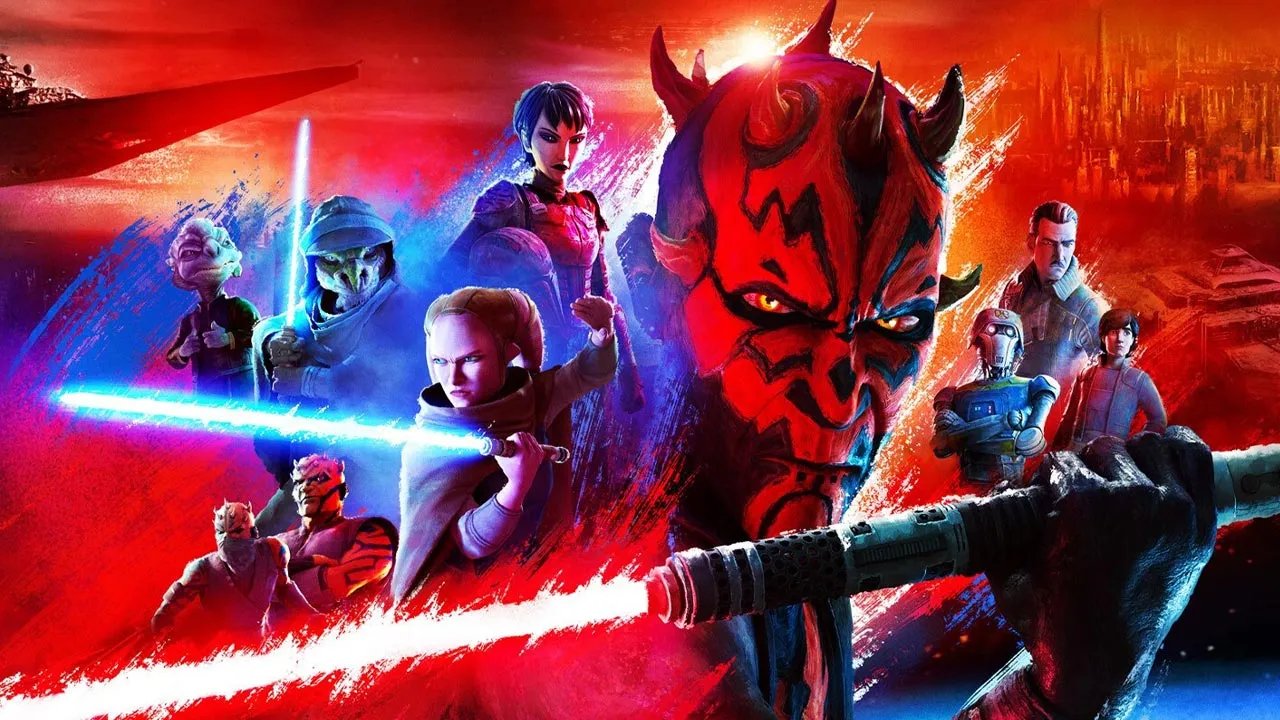
This is a spoiler-free review of the first eight episodes of Maul: Shadow Lord Season 1. The first two episodes of the 10-episode season premiere on Disney+ on April 6, 2026.
As a longtime Darth Maul superfan, my feelings on the announcement of Maul: Shadow Lord were conflicted, to say the least. On the one hand, Maul’s extended story arc was arguably the highlight of Star Wars: The Clone Wars in its later seasons. Who wouldn’t want a continuation of that story? On the other, did we really need yet another Star Wars series set in the era between Revenge of the Sith and A New Hope? Between Star Wars Rebels, Andor, and The Bad Batch, haven’t we said all that needs to be said about this particular era? Are we ever going to get that New Jedi Order-focused answer to The Clone Wars we’ve all been clamoring for since The Force Awakens came out?
It’s probably best to come into the new series with tempered expectations. No, Shadow Lord doesn’t exactly break new ground for the franchise in terms of setting or plot. But it gives us an even deeper dive with what has become one of Star Wars’ most fascinating villains, and establishes a solid new supporting cast besides. There’s a lot for Star Wars fans to like in Season 1.
Star Wars: Maul – Shadow Lord Images
Maul: Shadow Lord opens about a year after the events of The Clone Wars: Season 7, which culminated with Sam Witwer’s Maul battling Ahsoka Tano on Mandalore and escaping capture during the chaos of Order 66. The former Sith Lord has gone into hiding, seeing the rise of the Galactic Empire as an opportunity to both rebuild his shattered criminal empire and seek vengeance against those who wronged him. But is that all that motivates him?
He may be the title character, but it should come as no surprise that Maul: Shadow Lord isn’t solely about Maul himself. To do otherwise would be misguided on the part of creator Dave Filoni and his team, given that we already know the broad strokes of where Maul’s story is heading from here. Thanks to 2018’s Solo: A Star Wars Story, it’s been established that Maul is ultimately successful in rebuilding his criminal empire, becoming the secret hand pulling the strings of Paul Bettany’s Dryden Vos and the Crimson Dawn organization. Then, years later down the timeline, you have Star Wars Rebels chronicling the last, tragic months of this villain’s life. If Shadow Lord were only filling in the blanks of Maul’s criminal career, it might not have enough to offer fans.
That’s where characters like Gideon Adlon’s Jedi Padawan Devon Izara and Wagner Moura’s Captain Brander Lawson helpfully step in. Shadow Lord is set almost entirely on the world of Janix, a neon-drenched, cyberpunk-y planet that has so far managed to stay outside of the Empire’s looming gaze. For Maul, Janix is a useful place to start rebuilding. For Devon, it’s a world where she and her master, Dennis Haysbert’s Master Eeko-Dio-Daki, can lie low and plan their next move. For Lawson, it’s a place to call home, and the worst thing that can happen to that home is for the Empire to suddenly pay a visit.
The series gets a lot of mileage out of exploring the constant push-and-pull between these characters and their conflicting desires. The show isn’t just about Maul punishing his rivals and laying the foundation of a new criminal empire. For a guy like Maul, who’s always been obsessed with mirroring Darth Sidious and acquiring his own Sith apprentice, Devon emerges as a desirable new piece on the playing board. The question becomes not just whether Maul can turn this headstrong young Jedi to the Dark Side, but how much he’s willing to sacrifice in the process. His story may be written, but hers isn’t, and that’s where a lot of the dramatic weight in Season 1 stems from.
As for Lawson, and more than Devon herself, he’s the closest thing we have to an actual hero in this murky conflict. He’s just a good cop trying to do the best he can for his city in a very tumultuous time for the galaxy. That said, Lawson has his own foibles and demons, so he never feels out of place in what is an overall very dark and bleak series. There are definitely some comparisons to be drawn between Shadow Lord and Andor in terms of the overall tone and the fact that one of the main characters is basically a beat cop operating under the Empire’s thumb.
But those comparisons only extend so far. Shadow Lord may be dark, but it doesn’t shy away from the more fantastical elements of Star Wars in the way its live-action cousin did. There’s the alien-heavy cast of characters for one thing, which in itself is a bit of a nice change for the Disney Star Wars era. But there’s also the fact that Shadow Lord delivers a steady stream of lightsaber battles and epic shootouts, where Andor tended to be grounded far more in the mundane world beyond the Jedi and Sith. The various trailers and clips released so far make it plain that Maul is all too happy to unsheathe his laser sword and go to town on criminal scum and Stormtroopers alike.
These action scenes are often reason enough to tune in all on their own, especially early on when the series is at its most straightforward and predictable. Seeing Maul unleash his fury on his enemies never gets old, especially when the fight scenes are this well done. The Clone Wars fans will know that much of the franchise’s best lightsaber choreography can be found in the animated realm rather than live-action, and Shadow Lord continues that proud trend. The series really goes to town once the Empire shows up and the Inquisitors pay a visit to Janix.
Shadow Lord is a real looker as far as Star Wars animation goes. If anything, it highlights just how far these projects have come from the early seasons of The Clone Wars, which don’t exactly hold up well in the animation department. The contrast between those clunky seasons and the fluid, detailed animation on display here is quite something. Nor is it just the detail that impresses, but the dynamic lighting and the watercolor-like texture that permeates so much of Janix and its inhabitants. Visually, some of the most memorable scenes come when Maul is playing the part of a Zen martial arts master, practicing his lightsaber moves with surprising grace or pouring tea to kick off a heart-to-heart palaver.
Shadow Lord also sounds great, thanks to both a rock-solid voice cast and the incredible score by Kiner Music. When it comes to the former, it goes without saying that Witwer’s Maul steals the show in every scene in which he appears. Witwer has truly made the character his own over the years, which is no easy feat considering that Maul was originally voiced by the great Peter Serafinowicz. His Maul is a complex bundle of seething rage, sage wisdom, and the occasional emotional breakdown. His vocal energy is unmatched.
Which isn’t to say the rest of the cast don’t get their moments to shine. Adlon strikes a nice balance with Devon, painting a convincing portrait of a haggard Jedi on the run who might just have the potential to slip into darkness. Moura’s Lawson is equal parts enigmatic and likable. And there are several supporting characters who really stand out. Richard Ayodade’s Two-Boots is one of the more memorable droid sidekicks of the Disney era, as is David W. Collins’ manic Spybot. There’s also Chris Diamantopoulos as rival crime boss-turned-ally Looti Vario.
Musically, the series easily rivals the best that Star Wars animation has to offer. Composer Kevin Kiner and his siblings have built a strong brand combining traditional Star Wars motifs and instrumentation with electronic elements and a generally more haunting and melancholic feel. At times, Shadow Lord feels like the Star Wars equivalent of Blade Runner, and that’s as much thanks to the ethereal score as anything else.
Clearly, Shadow Lord has a lot going for it, but it’s not all rosy for this Clone Wars spinoff. As much as the series works to ensure it isn’t just filling in the blanks of Maul’s saga but is instead telling a meaningful story, it does struggle at times. The early episodes are a bit too straightforward and predictable for their own good, relying mostly on the dynamic action to carry things along as Maul begins his campaign of destruction and slaughter.
It’s only after the Imperial characters arrive and the plot pivots around them that the series really settles into a better groove. That provides Shadow Lord with the shake-up it needs, immediately forcing all the main characters on the back foot. No longer is Maul simply building his little empire and courting a new apprentice, but he’s also confronting the fact that he may have bitten off more than he can chew. Lawson is faced with his own personal doomsday scenario, and Devon and her master find themselves contending with the very worst-case scenario for Jedi who have managed to survive Order 66. Midway through, the series morphs from an enjoyable but pretty surface-level Star Wars adventure to something with more heft and dramatic meat to it.
